






Characteristics and features
According to Ukraine’s Defence Intelligence Directorate (DIU) on the War&Sanctions portal, the developer of Russia’s new S8000 “Banderol” cruise missile is sanctioned Russian company JSC Kronshtadt. The missile’s primary launch platform is the Orion UAV, which is also manufactured by the same Russian company.
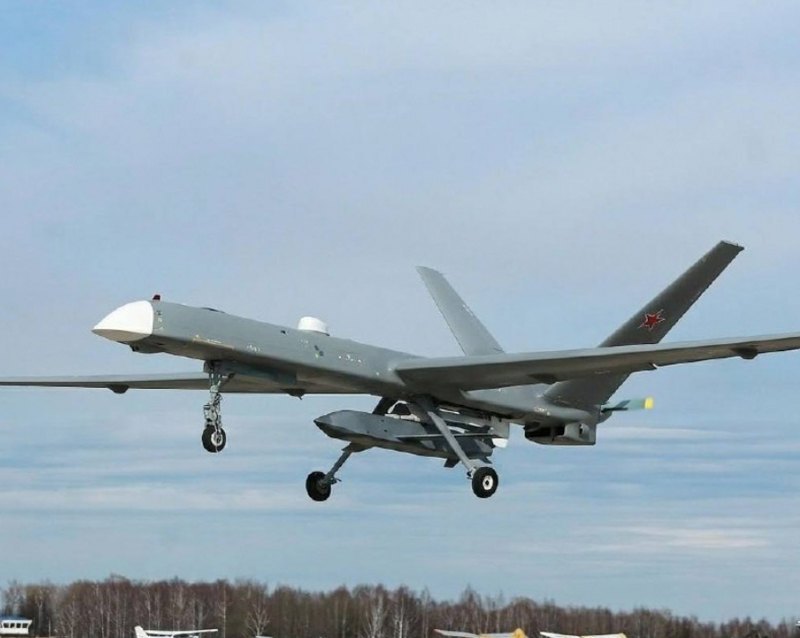
The missile is more manoeuvrable than Russian cruise missiles such as the Kh-101 and Kh-69, while retaining the characteristic flight trajectory of a cruise missile. According to an infographic by Ukrinform, it can make a 90-degree turn at a speed of 250 km/h. The missile’s cruising speed is 520–560 km/h, while its maximum speed is 620–650 km/h.
The Banderol is a hybrid of a kamikaze drone and a missile. It is 5 m long, has a wingspan of 2.2 m and a diameter of 30 cm.
According to Oboronka, the Banderol can travel up to 500 km. It carries a high-explosive fragmentation warhead weighing between 114 and 150 kg, according to various sources.
Like the Kh-101 cruise missile, the Banderol has wings that unfold during flight, while its distinctive shape makes it less visible to radar. However, it is smaller and lacks sophisticated electronics and an optical guidance system.
Components
According to the War&Sanctions portal, the weapon contains a Chinese Swiwin SW800Pro jet engine. It is an engine designed for model aircraft and is even available through online marketplaces.
The missile also contains a jam-resistant Kometa-M8 CRPA antenna manufactured by Russian company VNIIR-Progress, based in Cheboksary. The same type of antenna is used in Geran drones, universal glide and correction modules (UMPK) and unified interservice glide munitions (UMPB).
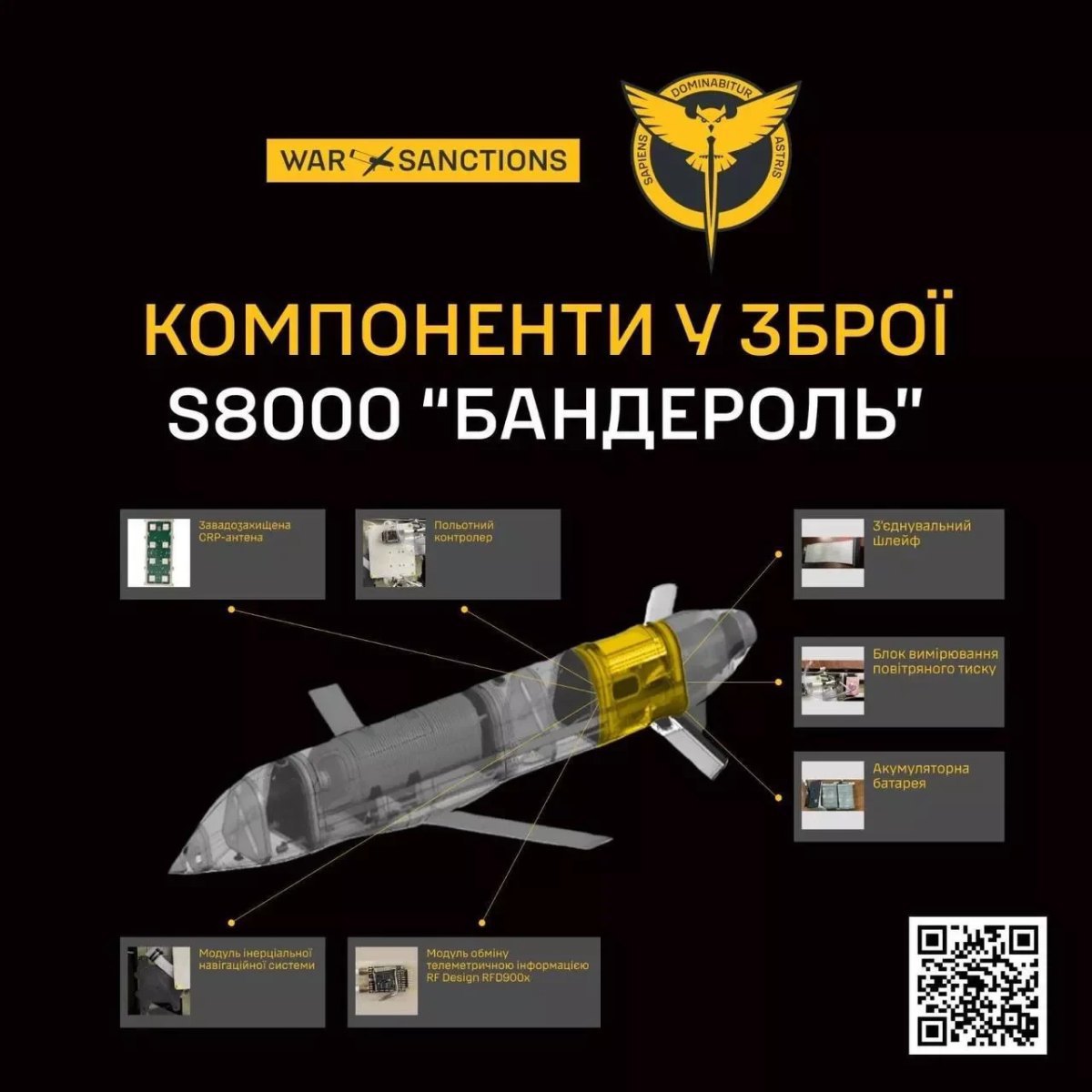
The Banderol contains almost two dozen microchips made by American, Chinese, Swiss, Japanese and South Korean manufacturers. It consists largely of relatively ordinary, commercially available components that any Russian consumer can order through OZON or Wildberries.
According to Militarnyi, Russia can currently produce around 80 such missiles per month. Serhiy “Flash” Beskrestnov, an adviser to the President of Ukraine on the development of defence technology, said that Russia’s production target for Banderol missiles this year is 120 per month.
Banderol strikes
Banderol attacks began as early as March 2025, targeting Odesa Region. In June and July 2026, Kharkiv Region came under the heaviest attacks.
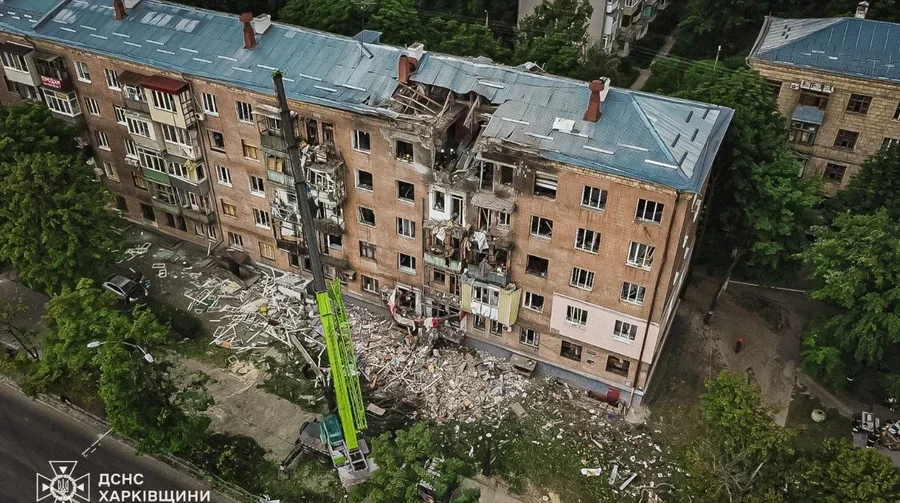
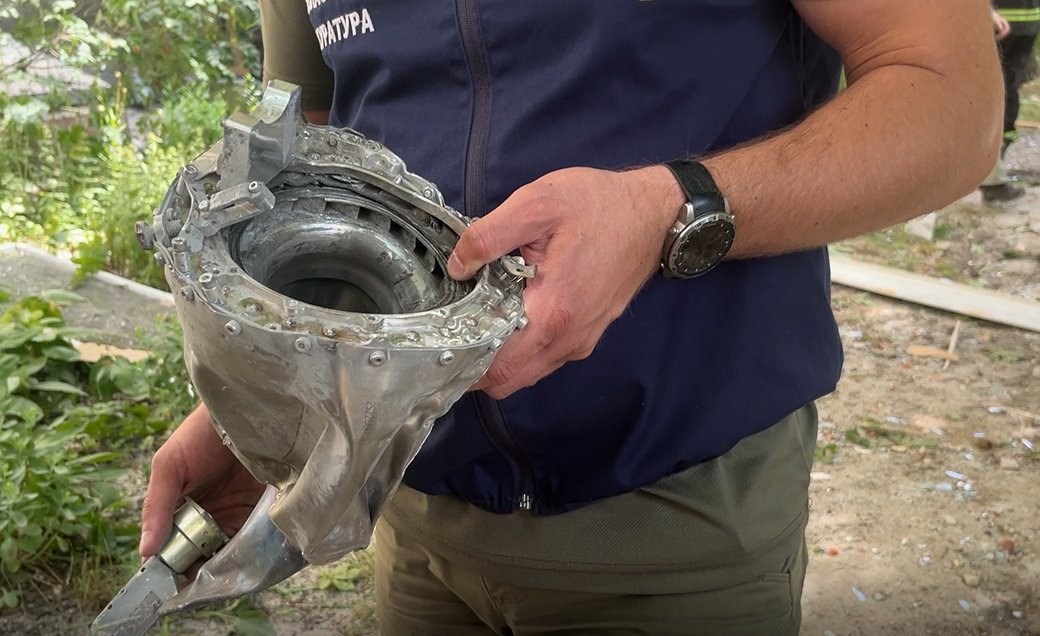
On 8 July 2026, a Banderol struck a five-storey residential building in Kharkiv’s Nemyshlianskyi district. The strike was initially believed to have been carried out using a Tornado-S multiple rocket launcher. However, law enforcement officers later found missile fragments beneath the slabs of a fifth-floor flat.
Thirty-four people sought medical assistance, including children. Two residents were killed. Neighbouring buildings were also damaged.
On 7 August 2026, Odesa was attacked by three Banderol missiles during the day. Ukrainian air defence forces shot down two of them over the sea, while the third struck the roof of the Chornomorets Stadium in the city centre. The roof, stands and glazing of the sports arena were damaged, while windows were blown out at the hotel on the stadium grounds. A fire also broke out after dry grass caught alight. The Chornomorets–Kolos football match was postponed.
Banderol missiles have also begun targeting Kyiv, with the first strike during a combined Russian attack recorded on 15 June this year.
On 25 August, the Ukrainian Air Force warned of Banderol missiles moving towards Kyiv Region. Kyiv Mayor Vitali Klitschko later said falling UAV debris damaged the walls and blew out windows at the level of the 14th floor of a 16-storey residential building.
In Dnipro, a Banderol strike damaged the Karavan shopping centre overnight on 25 August. After two such missiles struck the area, a fire broke out in a nearby car park, with wooden pallets, trucks and passenger cars catching fire.
On 22 August, the Belarusian service of Radio Free Europe/Radio Liberty reported that a Russian Banderol had fallen in Belarus’s Gomel Region. Ukrainian monitoring channels said the weapon had run out of fuel and crashed in a field. Belarusian forces reportedly attempted to shoot down the Banderol, deploying air defence systems and scrambling an Su-30 fighter jet.
Why Russia has started using Banderol missiles
According to aviation expert Anatolii Khrapchynskyi, speaking to LB.ua, Russia sees how Ukraine responds to ballistic attacks amid a shortage of countermeasures and is seeking to exhaust Ukraine’s air defence capabilities.
“We should remember how the first Shaheds emerged – they were also a new threat that we initially lacked a response to. But once mobile fire teams equipped with machine guns were deployed, followed later by interceptor drones, the problem was brought under control.”
During virtually all large-scale Russian attacks, Ukraine intercepts around 96% of aerial attack weapons such as Kh-101 and Kalibr cruise missiles, the expert says. By increasing the number of jet-powered strike weapons, Russia forces Ukrainian forces to deploy aircraft, MANPADS and short-range air defence systems. This creates a need to replenish missiles for these systems, while Ukraine has no domestic production capacity for such missiles.
“Geran-5, Banderol and Kover are appearing. These weapons are much cheaper – the production cost of a Banderol can be as high as $50,000,” Khrapchynskyi says.
To launch a cruise missile, Russia uses strategic aviation – an aircraft resource that cannot be quickly replenished, Khrapchynskyi explains. This also involves the use of expensive cruise missiles.
In the case of cruise missiles, Ukrainian forces can also receive early warning that strategic aircraft have taken off, indicating that a large-scale attack is likely and providing an indication of where it may come from.
With strike UAVs, or so-called drone-missiles, however, Russia diversifies these risks and places additional pressure on Ukrainian air defences by deploying such weapons from different directions.

“Before the emergence of Banderol, Russia did not have cheap jet-powered weapons that could operate, so to speak, from under the wing of tactical aircraft or from a ground platform over a short distance. The Iskander-K is an expensive missile, and they cannot afford to use it that frequently. That is why they are looking for an approach similar to the one we use – cheap strike weapons that significantly affect the ability to defend against such attacks,” the expert says.
Launch methods and main threats
Given the missile’s range, it is possible to determine which regions of Ukraine are at risk, Khrapchynskyi says. Using different launch methods, Russia can deploy Banderol missiles from virtually any point along the border. There have also been confirmed cases of launches from temporarily occupied Crimea.
“There are confirmed cases of these weapons being launched from Orion drones. There have been attempts to integrate them onto helicopters. At the same time, the enemy has released information about ground-based launchers. A ground launch would significantly reduce the range,” the aviation expert says.
The key question is whether radar systems in these areas can detect the target while it is still over Russian territory. This helps provide early warning, allows an aerial target to be tracked and enables it to be handed over between sectors if the threat is not intercepted in one of them.
Banderol missiles launched from ground-based systems have a shorter range, but Russia is still using them, Khrapchynskyi says. This allows them to carry out more launches and to move into a launch area, fire the weapon and withdraw before their location is detected.
Given the warhead’s weight, the weapon’s effective blast radius is around 300 metres.
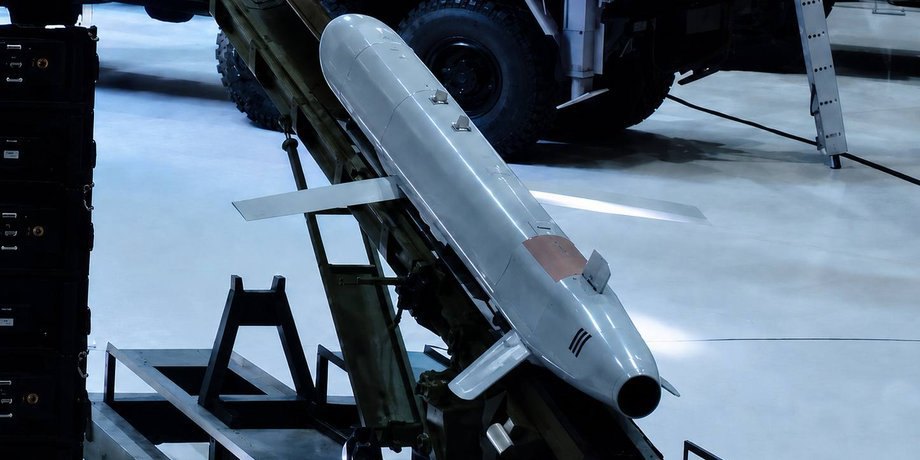
“If there is a threat of these weapons being used, people should stay behind at least two walls,” the expert says.
For now, Banderol operates against stationary targets. To strike moving targets, artificial intelligence systems would need to be deployed to lock onto and track an object based on its visual profile and destroy it.
“In any case, the enemy will experiment with artificial intelligence. They are moving in that direction,” Khrapchynskyi says.
In his view, it cannot be said that Russia will use Banderol specifically against logistics or energy infrastructure – it will target everything in an attempt to exert psychological pressure.
“The tools of influence used by Russia are terrorist in nature. They are trying to strike civilians as much as possible in order to cause humanitarian disasters. There is also psychological pressure on society: the idea that the Defence Forces are unable to protect themselves and cannot shoot down all the missiles. This helps Russian propaganda and bots manipulate public opinion inside Ukraine.”
What can be used to shoot down Banderol
There are currently no cheap interceptors that could be used against Banderol, Khrapchynskyi says. These could be missiles or other systems.
“At one point, we proposed interceptor drones. Now the next step is needed – an interceptor missile costing up to $15,000. Since the interception speeds are significantly higher, this requires fundamentally different guidance systems and a much higher level of automation.”
Detection capabilities also need to be expanded because Russia often uses Banderol at low altitudes. Conventional radar systems designed to scan for larger targets, such as cruise missiles, may fail to detect them.
“A layered system is needed, with a large number of tactical radar systems operating alongside large radars.”
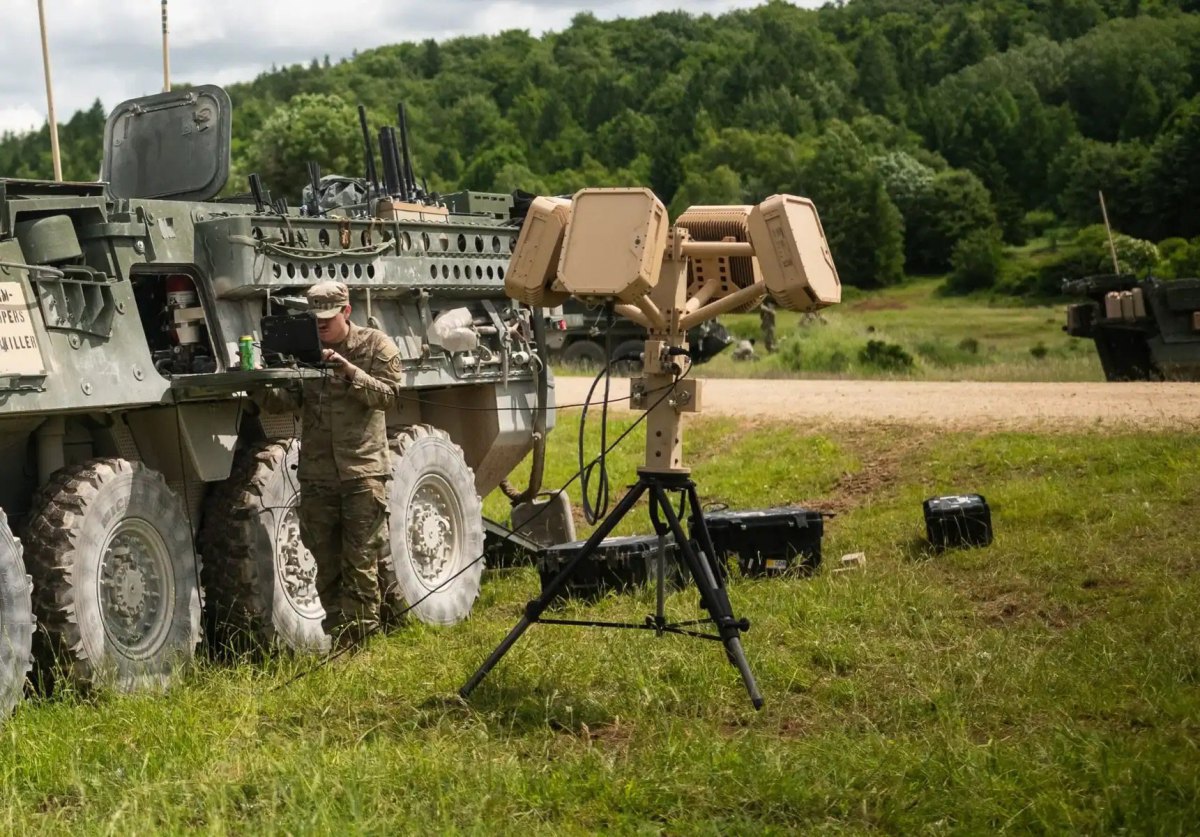
“We are currently building this capability using Western systems such as the American EchoShield — a radar system for countering drones — Israeli RADA radars for missile warning, and Giraffe radars produced by Swedish company Saab. But we need to talk about developing our own capabilities because most of these systems are expensive and we cannot purchase them in large quantities,” the expert says.
When a target is flying at an altitude of 20–50 metres, tactical-level systems can detect it at a distance of up to 15 km. Their numbers therefore need to be increased and deployed along specific directions to cover every metre of Ukrainian territory.
In addition, Banderol can operate at both low and high altitudes, so some radars need to operate in the upper echelon and others in the lower echelon.
“For now, we can use a single radar to cover certain sectors and try to detect targets at both high and low altitudes. Modern warfare requires a large number of sensors capable of detecting targets using different characteristics — acoustic, visual, active and passive radar. All of this should form a single defence system,” Khrapchynskyi says.
Ukraine is developing this capability, but there is currently a severe shortage of radar systems that can not only detect a target but also track it in real time and transmit its coordinates to a weapon system that can automatically intercept a Banderol or Geran-5.
According to the aviation expert, Norwegian NASAMS surface-to-air missile systems and Russian Pantsir systems, for example, use this type of radio-command guidance.