





“The Russian Subtitle Follows the Principle: ‘Forget It. You Just Have to Survive on Your Own’”
My first impression is this: the Russian subtitle is based on the assumption that there is no community you can belong to. You have to survive on your own. Socially, you are as if in open space. There is no sense of belonging.
The correct subtitle assumes there is something you can join. The underlying assumption is that people want to belong to a community. You just have to figure out how to do it.
But the Russian subtitle follows the principle: “Forget it. You just have to survive on your own.” I don’t know—maybe that really is how it is for them.
“If You Think This War Is Immoral, Your Duty Is to Go to Prison in Protest Against It”
You can say that tribes speak one language and share music and culture. In fact, it can be reduced to one very simple thing: understanding that you, like every member of the group, owe your life to that group. And not only your life, but also the identity that allows you to be part of a whole. Without that group, you would not be who you are.
For hundreds of thousands of years, people lived in small groups—around 50 people. That was the typical size of a human community for most of our prehistory. Survival outside the group was unthinkable. There was no idea of, “Oh, I’m independent of everyone”—that’s nonsense.
When I was 18, I had to register for military service in my country. It was called Selective Service (Selective Service. – Ed..). You’re not drafted. But if they need you, they have your address.
I showed the card to my father and said I wasn’t going to sign it. And he replied: “No, you will. If you think this war is immoral, your duty is to go to prison in protest against it. You can’t just be part of this country and give nothing back. You owe it; maybe even your life—you don’t know.”
That was my first experience of what I called “the intoxication of belonging”. Humanity’s oldest drug is belonging to something you’d die for.
“There’s Something Like Intoxication in Fighting Together Against Something”
Some time after the war (the Bosnian War of 1992–1995. – Ed..) I returned to Sarajevo, where a Bosnian journalist interviewed me. We were discussing a book about Americans at war in Afghanistan.
This woman survived the siege of Sarajevo. In the conversation she admitted that during the war she was seriously wounded. A Serbian tank shell hit her parents’ flat. She was 17. Her leg was almost torn off.
Her father carried her through shelling as she bled. Eventually they reached a hospital. They had no medicines. There was no anaesthetic. People held her down while surgeons operated and saved her leg.
She has every right to be against any war. And it was this woman who said to me: “But it’s so strange—we all, in a way, miss that time.”
Later I realised that the soldiers I was with in Afghanistan missed that time too. And then I heard that after the Blitz in London (the bombing of Great Britain by Hitler’s Germany’s air force during the Second World War. – Ed..), in which 30,000 people were killed, people missed that as well.
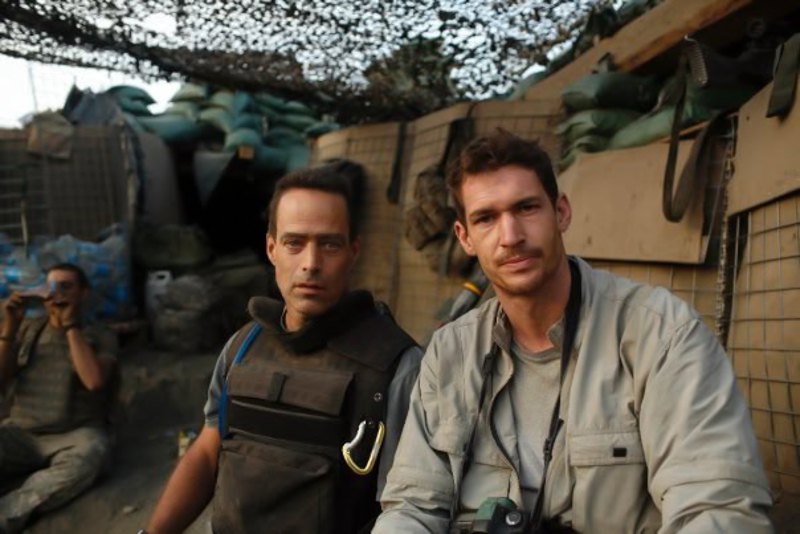
I tried to understand why people can miss something terrible. They lacked a sense of unity. There’s something like intoxication in fighting together against something. And when you’ve lived through that, you miss it afterwards.
Modern society, with its astonishing technology, industry and enormous wealth, forces people to be separated from one another. And all we really want is to be together again.
“You Can’t Put Yourself First and Be a Leader at the Same Time. With Rulers, It’s a Different Story”
The word “leader” (leader. – Ed.) comes from Old English and means “to show the way”. So a leader goes out in front, leading others. If there is danger, he is the first to meet it. Leaders don’t worry about themselves—that’s what makes them leaders. You can’t put yourself first and be a leader at the same time. It’s impossible. They take such positions not because they crave power, but because for leaders it is an honour when others trust them. And they will do everything possible to protect those people.
With rulers, it’s a different story. The English word ruler (“ruler” – Ed.) comes from Latin and means “to straighten”. A “ruler” (ruler. – Ed.) is also a carpenter’s tool used to draw a straight line.
The rules are clear: this is right and this is wrong. Everything is very binary and “black and white”. In this context, rules are often used to protect those in power from consequences, from the need to sacrifice anything, and from losing power.
Leaders say: “We’re taking that hill. Follow me!” Rulers say: “You’re taking that hill. And I’ll watch from here and make sure everything goes well.”
Leaders don’t try to get something for themselves out of a position based on trust. Your country has many leaders who can match the courage of your soldiers and citizens.
“To Move Forward, There Has to Be Understanding and Forgiveness”
Some people are furious with their country because they are being forced to fight. And there are people who, quite understandably, resent the fact that someone enjoys the benefits of the country but sacrifices nothing for it: “Does everything really come for free?”. That’s why anger arises. And it is justified anger. There is no absolute right or wrong here. In both cases, the feelings are entirely understandable.
Soldiers in Vietnam were very angry that they had to fight. They didn’t want the government to put a rifle in their hands, force them to risk their lives and kill people. There are many reasons. Some refuse to fight out of conscience, others out of selfishness.
If, as a society, you are prepared to resolve these conflicts… It’s like in a marriage. There can’t be a marriage where people never argue, where they can’t deal with their partner’s feelings. In a strong marriage they say: “All right, we disagree. Right now we’re really angry with each other, but we’re married. What are we going to do?”.
I don’t really know how to deal with this at the societal level. In the end, to move forward, there has to be understanding and forgiveness.
When people have died or suffered severe injuries, lost children or parents, it is extremely hard to shake the thought that someone else sacrificed nothing. I wish I had a simple answer to that. But I don’t. The most radical thing is that the state can say: “You are no longer a citizen of Ukraine.” I’m not sure that’s a good idea. But I certainly understand the feelings that could lie behind such a decision.
“Human Dignity and Freedom—That’s How I See This Country Now”
You are defending not only Ukraine. You are defending the very idea of human dignity and human freedom—freedom of speech and thought. Anyone, anywhere, who defends these things is defending all humanity.
My country is now at a point where these values are under threat (I realise I’m saying something political now, but forgive me).
Human dignity and human freedom—that’s how I see this country now (Ukraine. – Ed.). Of course there will be problems and disagreements. There will be people you don’t like who don’t do what they should be doing. That doesn’t matter. What matters is what you do.
People keep saying to me: “Thank you for coming to Ukraine.” And I keep thinking: “Thank you for existing at all.” For me, it’s a privilege to be here. I hope I’m worthy of it.