





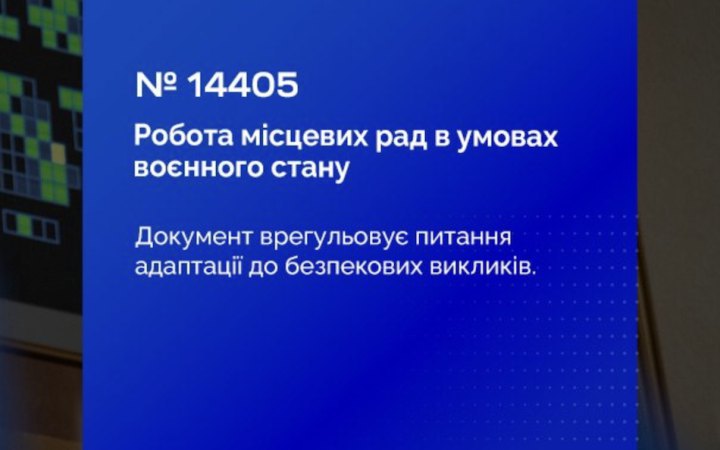
The Verkhovna Rada voted at first reading to approve as a basis a bill to regulate the work of local councils under martial law. A total of 236 MPs voted in favour, the Verkhovna Rada press service reported.
The document provides for the establishment of military administrations in communities if the powers of more than half of local council members are terminated early. It also changes the requirements for their reporting under martial law, on physical safety grounds.
The explanatory note states that as of 23 November 2025, according to the Central Election Commission’s “Local Elections” system, 9,106 local council members had had their powers terminated early or had not taken up their mandates — 21.1% of the total number of seats won in the 2020 elections. The shortfall can be made up only through elections, but elections are prohibited for the duration of martial law. A shortage of councillors threatens a lack of quorum.
The bill proposes establishing that, during martial law and for six months afterwards, special rules will apply to the operation of local councils in territorial communities where the 2020 local elections were held under a majoritarian relative-majority system in multi-member constituencies. The “starting point” for calculations when adopting local council decisions is not the council’s full statutory composition, as under current rules, but the council’s composition (that is, the actual number of councillors elected to the relevant council whose powers have been recognised and have not been terminated in accordance with the procedure established by law).
The document is expected to ensure:
- a reduction in the potential risk of local councils losing their capacity to act;
- for the duration of martial law and for six months after its end/cancellation, the introduction of a new numerical criterion for the capacity of local councils in territorial communities where the 2020 local elections were held under a majoritarian relative-majority system in multi-member constituencies;
- the possibility of stable operation of local councils in the event of the early termination of the powers of individual councillors;
- the adaptation of requirements for local councillors’ reporting under martial law to the need to ensure physical safety;
- legal certainty that, under martial law, military administrations are established, among other cases, when the powers of some councillors are terminated early, resulting in fewer than forty per cent of councillors remaining compared with the council’s full statutory composition, which should ensure the principle of continuity of government;
- the protection of the rights of local councillors in the event of their mobilisation;
- improving the effectiveness of local councillors’ reporting under martial law.