





Russia is increasingly trying to follow a strategy of attrition, but its losses this year exceed recruitment rates, while financial and material costs are rising relentlessly. The Kremlin exaggerates its tactical gains, emphasising the continuity of its advance — meaning the Russian military is systematically misleading the President of the Russian Federation about the real situation on the front line.
The enemy is trying to “creep forward” in Donetsk and Zaporizhzhya Regions, because domestic information consumption in Russia demands at least some kind of “win” — and it is getting ever harder to sell the capture of yet another shed as an outstanding military achievement.
Given this state of affairs, the Russian army has focused on capturing our “belt of fortresses” and is once again trying to improve its positions in the Azov region.
The “belt of fortresses” problem is being tackled by two Russian groupings — South and Centre. Slightly further north, near Lyman, they are supported by the West grouping.
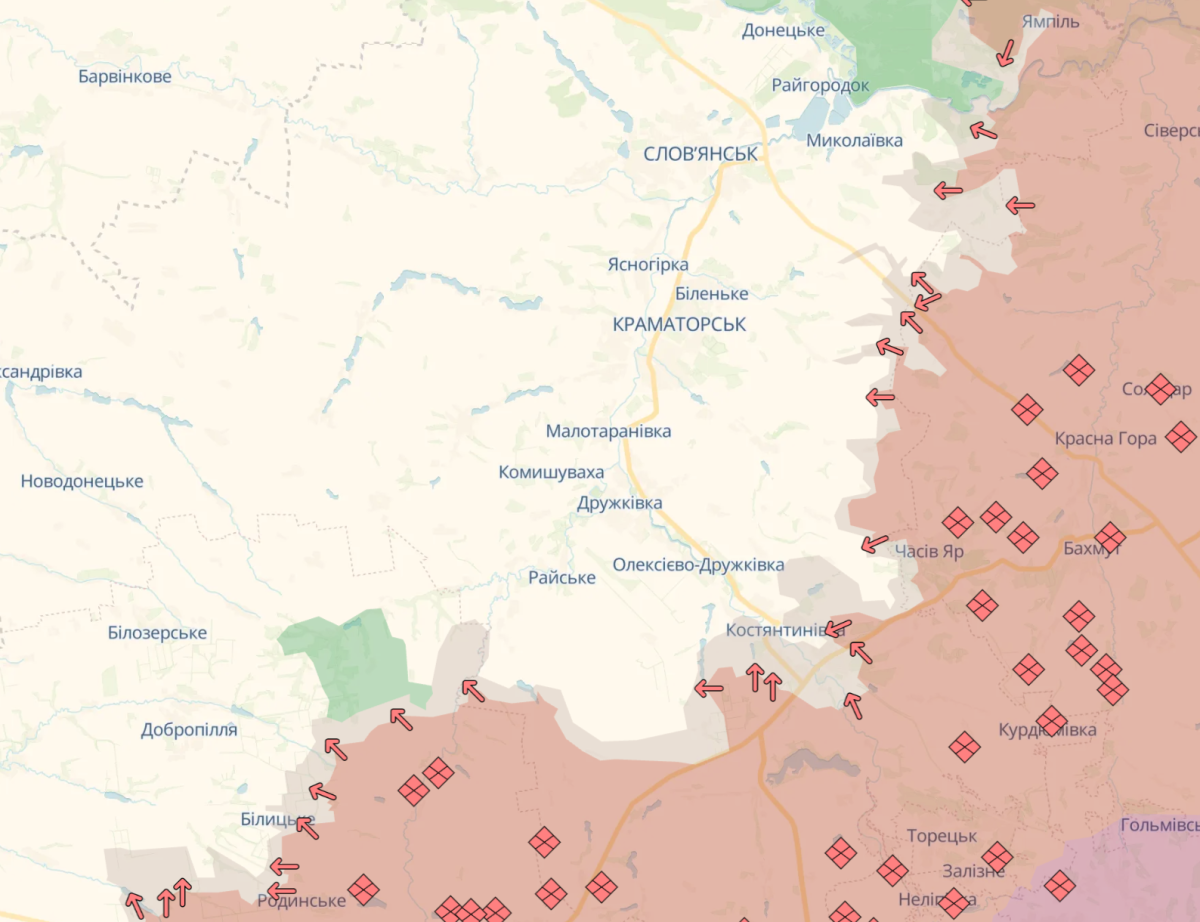
In the north of the “belt of fortresses”, the operational situation should be considered in the interconnection of three operational axes at once — Lyman, Slovyansk, and Kramatorsk. Here, the 3rd Army is advancing with the enemy’s 6th, 85th, 88th, 123rd and 127th brigades from its South grouping. The enemy is delivering two blows in the general directions of Siversk–Slovyansk along the southern bank of the Siverskyi Donets River, and Bakhmut–Slovyansk on both sides of the E40 road, trying to break through with its forward formations from the east and south-east to Slovyansk and from the east to the near approaches to Kramatorsk. The 4th Brigade of the 3rd Army is fighting in the Kostyantynivka area. The so-called “Russian Volunteer Assault Corps” is also advancing here.
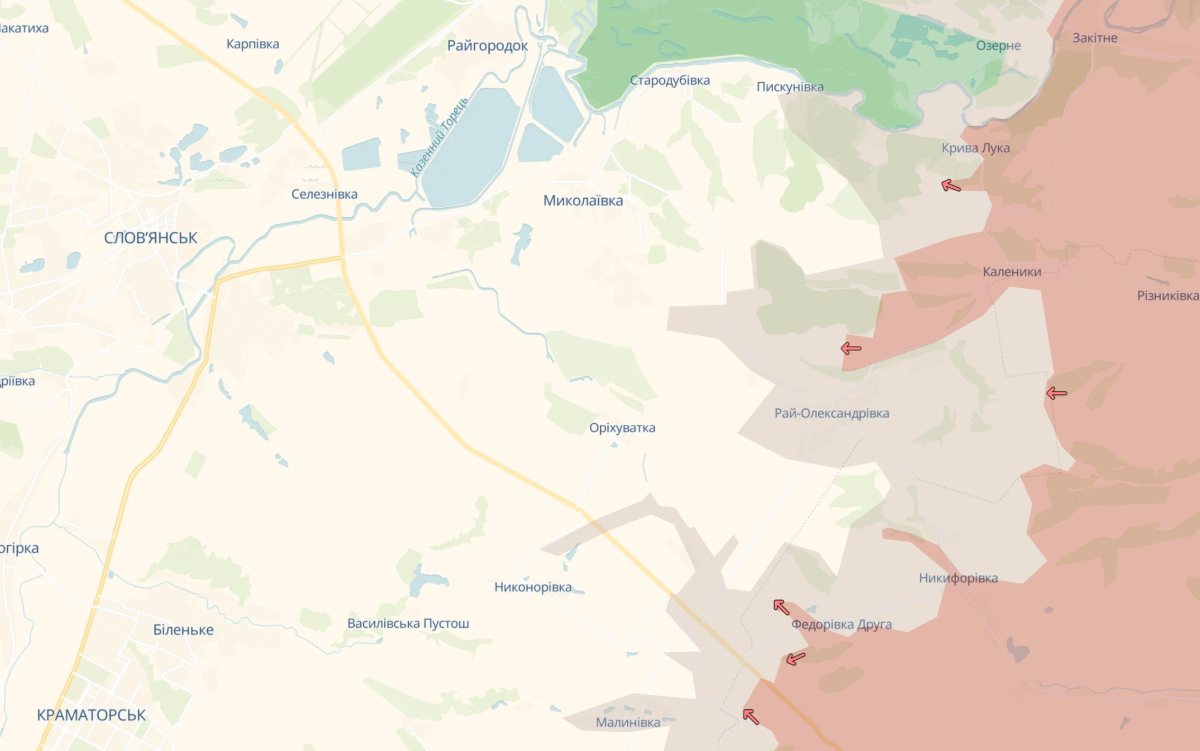
The enemy is fighting on the Yurivka–Ray-Oleksandrivka line, 12 km from Sloviansk, and in the Vasyutynske area, 8 km from Kramatorsk. As the 3rd Army advances towards the Slovyansk–Kramatorsk agglomeration, its axis of advance narrows, increasing troop density — which gives the Russian command the ability not only to conduct assault actions at a fairly high intensity, but to sustain that tempo for quite a long time.
The enemy is trying to reach the lines of Starodubivka–Mykolayivka, Orikhuvatka–Nikanorivka, and Vasylivska Pustosh–Vasyutynske. It is from the last of these lines that one should expect the left-flank formations of the 3rd Army to turn towards Kramatorsk.
On the Zakitne–Kryva Luka sector, the forward elements of the 3rd Army have fully taken control of the southern bank of the Siverskyi Donets River; the enemy’s forward assault groups have already been spotted on the south-eastern outskirts of Piskunivka. Active enemy assault actions continue in the directions of Rai-Oleksandrivka–Mykolaivka and Rai-Oleksandrivka–Orikhuvatka. Separate enemy infantry groups have broken through to the woodland south of Mykolaivka, where they are entrenching roughly 1 km from the village’s southern outskirts. Russian attempts to break through from Ray-Oleksandrivka to Orikhuvatka and to pumping station No. 2 of the Siverskyi Donets–Donbas canal were unsuccessful.
The advance of the 3rd Army’s forward elements on both sides of the Slovyansk–Bakhmut road is developing in the tactical zone; enemy assault groups have moved from Fedorivka Druha along the canal to Yurivka and reached the northern outskirts of Zapovidne.
In effect, with the simultaneous advance along the E40 road and the Siverskyy Donets–Donbas canal to the north-west and north (that is, towards Slovyansk), the 3rd Army command has already begun turning its left-flank troops towards Kramatorsk. Here, enemy assault groups have crossed the canal and are entrenching in Tykhonivka and Malynivka, preparing to continue the advance towards Vasiutynske and Pershomarivka. The enemy is also trying to break through in the direction of Markove–Bilokuzmynivka.
The enemy’s rate of advance remains low — 4–8 km in two months. The combat effectiveness of the aggressor’s forward units has noticeably declined, a consequence of the command style of Lieutenant General Ihor Kuzmenkov, commander of the 3rd Army, which military observer Kostiantyn Mashovets described with the formula: “attack under any conditions — always, immediately, and everywhere”. Above all, the drop in combat effectiveness is evident in the forward units of the 6th and 123rd brigades.
Units of our 11th Corps were unable to stop the enemy’s advance and stabilise the situation, but they continue to hold a number of positions both in the Kryva Luka area and in the Rai-Oleksandrivka area.
Reinforcements should be expected for the 3rd Army. The 3rd Army’s troops will push through to the Mykolaivka–Starodubivka line (the area of the Sloviansk thermal power plant), which, if successful, will worsen the defensive capabilities of the Defence Forces’ Third Corps on the Lyman axis; they will try to seize Orikhuvatka and the area of pumping station No. 2 of the Siverskyi Donets–Donbas canal, which would mean reaching the near approaches to Sloviansk. A breakthrough to the Vasylivska Pustosh–Vasiutynske line would mean reaching Kramatorsk.
Without creating proper operational troop densities and a favourable balance of combat potential, it will not be possible to hold the defence merely by improving command and control. The 3rd Army is the only one of all enemy groupings that has come as close as possible to the Sloviansk–Kramatorsk agglomeration and has a real chance of breaking through to Sloviansk or Kramatorsk “on the move”. The enemy is aware of the low density of the 11th Corps’ battle formations and will continue to use infiltration tactics across the maximum number of sectors. These actions will be accompanied by extensive use of strike UAVs, artillery fire, and air strikes.
The problem of wide gaps between positions and low-density battle formations can be addressed through strict control of areas where there is no Ukrainian infantry — aerial surveillance, sensors and motion detectors, automated reconnaissance-and-alarm fields; in short, everything that makes it possible to detect enemy infantry. The next step is effective counteraction: an enemy soldier who comes into the Defence Forces’ field of view must be guaranteed to lose the ability to appear here a second time. Hence: explosive and non-explosive obstacles at densities above the standard, FPV drones constantly hanging in the air in swarms, multiple-launch rocket systems, on-call artillery with cluster munitions, and ground robotic systems capable of engaging targets.
The new commander of the 11th Corps faces a clearly non-trivial task, which he and his staff will have to solve very creatively.
On the southern flank of the “belt of fortresses”, on the Dobropillia axis, the enemy continues its offensive with the 51st Army (“South” grouping: 1st, 5th, 9th, 110th, 114th and 132nd brigades) and the 2nd Army (“Centre” grouping: 27th Division, 15th and 30th brigades), which are breaking through from the south and south-east to the near approaches to Dobropillia, attacking with their main forces in the general directions of Pokrovsk–Dobropillia and Novotoretske–Novyi Donbas. The 2nd Army’s offensive is supported on its right flank by the 41st Army (“Centre” grouping: 35th, 55th and 74th brigades), which is attacking with part of its forces in the direction of Udachne–Serhiivka.
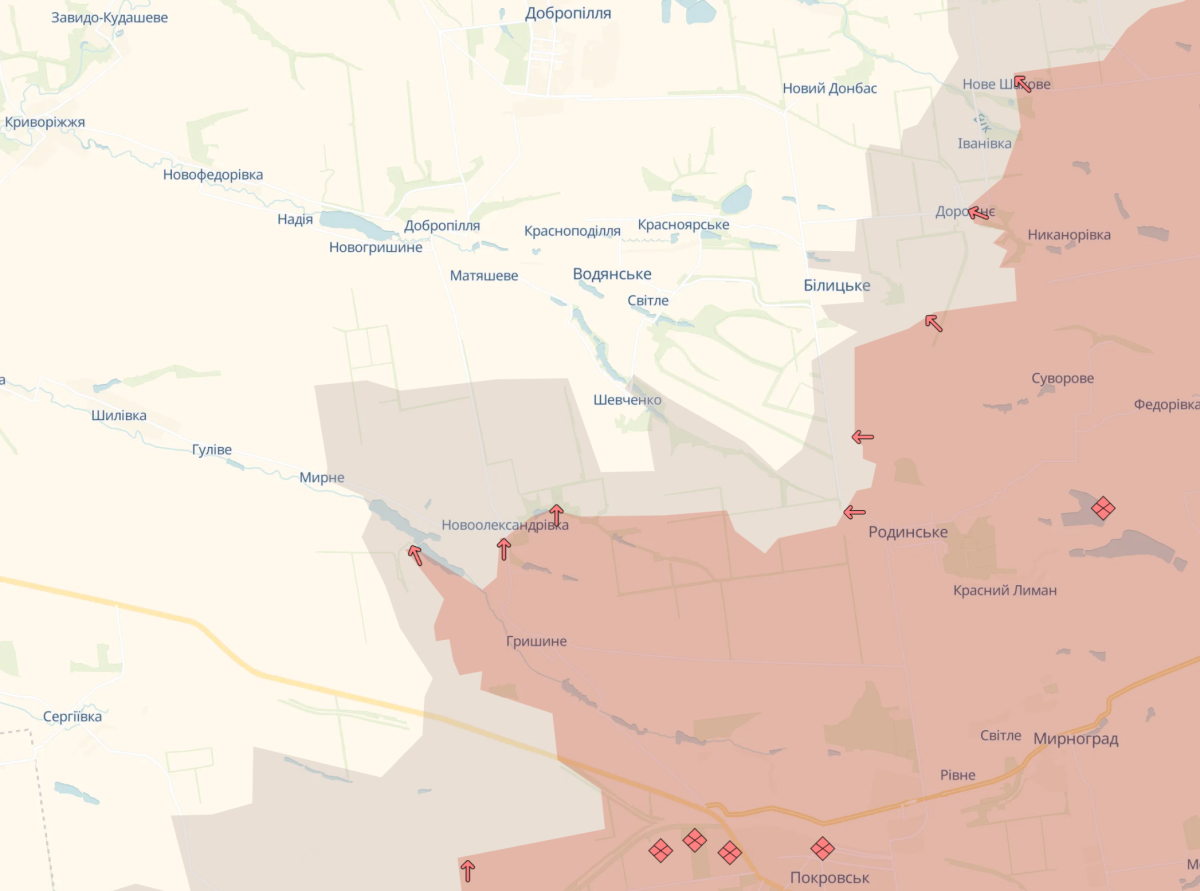
As in the north of the “belt”, the enemy is using the tactic of seeping assault groups through the maximum number of sectors. On the Sofiivka–Novomykolaivka axis, small scattered infantry groups (two or three soldiers) have seeped into the tree lines south of Novomykolaivka and into the village itself. On the Dorozhnie–Novyi Donbas and Nove Shakhove–Vilne axes, similar groups have seeped into the Novyi Donbas and Vilne areas. Those who survived and were not captured are entrenching in Dorozhnie and on the southern outskirts of Vilne. Numerous infiltration attempts are being recorded west of Rodynske, in the direction of Rodynske–Shevchenko, near Vodianske and in the area of the Vodianska mine. The enemy is entrenching on the Shevchenko–Novooleksandrivka line. On the Novooleksandrivka–Matiasheve and Vasylivka–Myrne axes, the enemy attacked energetically but managed to gain a foothold only in Vasylivka.
Overall, the enemy’s rate of advance towards Dobropillia and Druzhkivka has increased in recent weeks. Infiltration groups of the 177th Marine Regiment reached the south-eastern outskirts of Dobropillia; other groups moved from Novyi Donbas to the area north and north-east of Hannivka along the T0514 Dobropillia–Kramatorsk road. Units of the 9th Brigade of the 51st Army and the 61st Marine Brigade are trying to encircle Dobropillia from the east and north-east, relying on the dominant heights south of Step. UAV units are deploying in the area east of Chernihivka; the enemy is concentrating in Bilytske and Matiasheve. The enemy advanced to Kucheriv Yar and Torske after units of the 228th and 239th Motor Rifle Regiments of the 90th Tank Division arrived here.
It is clear that the command of the “Centre” grouping on the Dobropillia axis is actively preparing to sharply increase its efforts here in the near future. This is explained by the need to accelerate the offensive — above all, to create favourable starting conditions for capturing Druzhkivka and, subsequently, Kramatorsk in cooperation with the left-flank troops of the “South” grouping. Another reason is the urgent need to free up the 51st Army for further actions as part of the same “South”.
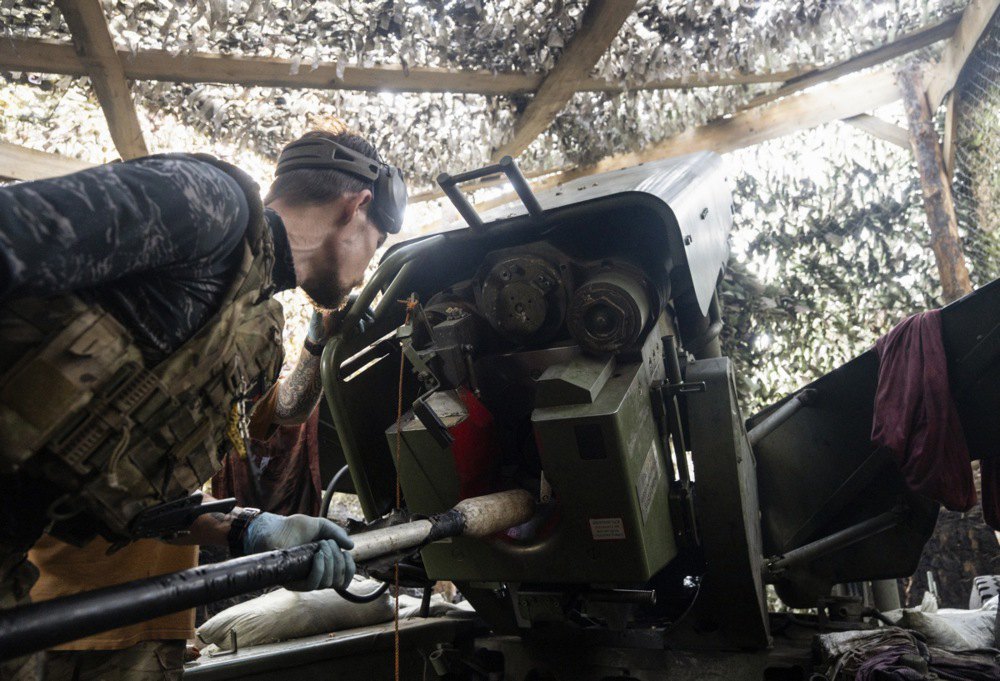
Rapid seizure of Dobropillia significantly improves the enemy’s chances of breaking through to Kramatorsk from the south (this is precisely why the 51st Army is needed). From an operational point of view, success near Dobropillia will provide left-flank cover for the “South” grouping, which has begun the Sloviansk–Kramatorsk offensive operation, against a Defence Forces counterstrike from the southern direction.
We should not lose sight of the fact that the enemy’s 90th Tank Division has already been drawn into exhausting fighting both in its own axis of advance and in the axis of the neighbouring 29th Army of the “East” grouping on the Oleksandrivka axis, where the Defence Forces are persistently counterattacking. Another factor is that the enemy has been unable to take Kostyantynivka under control; its 8th Army and the 3rd Corps of the “South” grouping have fallen behind schedule. This means the enemy’s troops will (eventually) reach the approaches to Kramatorsk in a limited combat-capable state, and on the way they will have to storm Druzhkivka.
The chances that the left flank of the 7th Air Assault Corps and the 1st Corps of the National Guard of Ukraine “Azov” will hold the Dobropillia–Druzhkivka line are fairly high — and in that case, attempts to bypass/encircle the Sloviansk–Kramatorsk agglomeration will be dead in the water, and the enemy offensive will automatically be reformatted into a frontal assault on a well-fortified Defence Forces line — long, bloody, and extremely costly in terms of resources.
Dobropillia is gaining ever greater operational significance by the day. The enemy command understands this and will increase its efforts, including by continually forming more and more assault groups, which are almost its only instrument of advance. If we set aside the hypothetical mobilisation in the Russian Federation, the 51st Army has at its disposal seven mobilisation-reserve regiments (the 86th, 87th, 88th, 91st, 99th, 107th and 111th), while the 2nd and 41st Armies have the 1441st (41st Army) and 1437th Motor Rifle Regiment (27th Division of the 2nd Army) territorial troops regiments. The list of reserve regiments is not exhaustive; there are also, in particular, battalions.
The Orikhiv axis is not related to the “belt of fortresses”, but it is a direction where the enemy is delivering another blow in the context of its strategic offensive operation, and it also demands reserves and resources from the Defence Forces — that is, it supports the actions of the enemy’s main forces on the main axis.
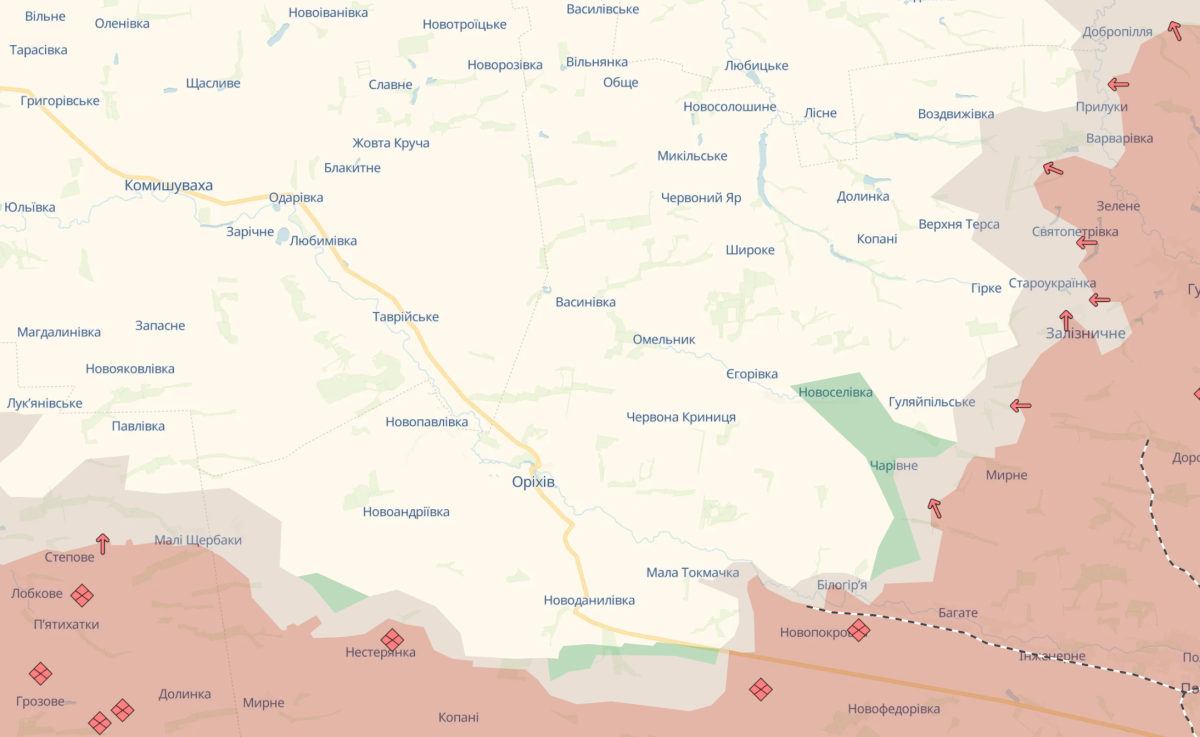
Here, the “Dnipro” grouping is advancing. It includes the 58th Army (19th and 42nd divisions, 136th Brigade, 100th Reconnaissance Brigade, 49th Air Assault Brigade, a composite regiment of the 4th Military Base in South Ossetia), the 47th Division of the 18th Army (manned mainly by Crimeans), the 108th and 247th Air Assault Regiments of the 7th Air Assault Division, a number of units of the 76th Air Assault Division (main forces near Pokrovsk), the 45th Airborne Spetsnaz Brigade, and separate units of the 104th Air Assault Division and the 98th Airborne Division. On its left flank, the 58th Army is conducting active defence, restraining the Defence Forces’ advance along the Dnipro towards Kamianske, to the Yanchekrak River; on its right flank, it is trying to envelop from the west and east the Armed Forces of Ukraine’s Orikhiv defensive area for a subsequent assault.
The Orikhiv defensive area is a powerful splinter in the enemy’s body, so the actions of its “East” grouping’s 5th and 35th Armies on the Huliaipole axis are also subordinated to this aim. This entire group of armies is trying to break through to the Svoboda–Yehorivka–Chervona Krynytsia–Omelnyk area.
The operational situation on this axis is as follows: the advance of the 58th Army’s forward elements has almost completely stopped; the 19th Division has been forced to go over to the defensive on a number of sectors of its axis of advance.
On the Stepnohirsk–Plavni axis, Defence Forces units advanced south in Plavni and reached the railway station, and advanced south along the E105 Stepnohirsk–Kamianske road. In the Stepnohirsk and Prymorske area, the enemy tried to counterattack and unblock the remnants of its assault groups in Stepnohirsk, but was completely pushed out of Prymorske, with some of its infantry groups retreating to the bed of the former Kakhovka Reservoir. The Defence Forces cleared small enemy infantry groups in Stepnohirsk itself and in the area south of Lukianivske and Pavlivka. Our troops are expanding their wedge towards Plavni, which complicates the enemy’s ability to hold its positions on the southern outskirts of Prymorske.
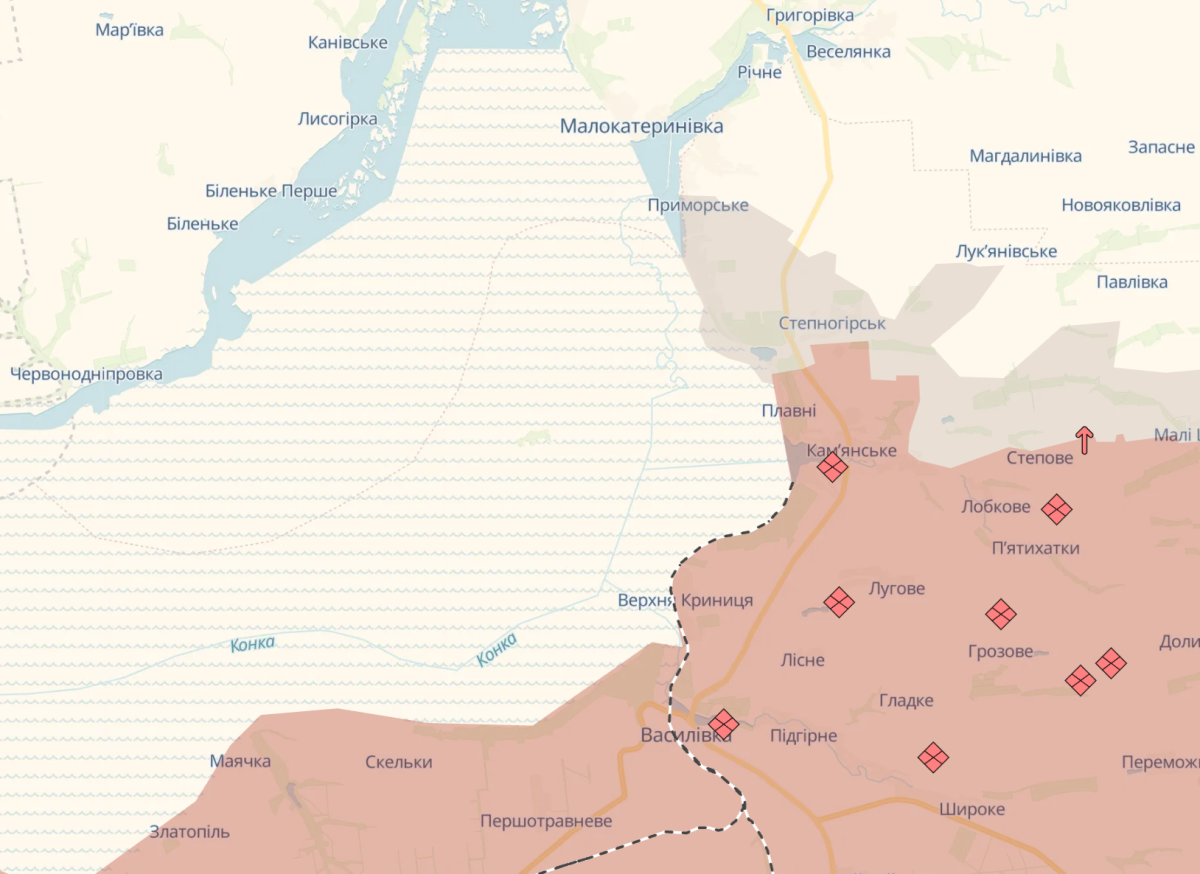
The tactically advantageous positions of Defence Forces units in Kamianske are seriously unnerving the command of the “Dnipro” grouping, especially in connection with the Ukrainians’ advance towards Plavni, so the enemy regularly attacks towards Lobkove from the eastern outskirts of Kamianske. Enemy assault groups regularly attempt to break through towards Pavlivka from the Stepove–Mali Shcherbaky line and from the area north-west of Nesteryanka. It is critically important for the occupiers to reach the heights in the Novoandriivka area and entrench there in order to control the Orikhiv–Komyshuvakha road and the entire area west of Orikhiv. At the same time, this would create a threat to Ukrainian units operating east and south-east of Stepnohirsk.
Mala Tokmachka has been resisting for one and a half thousand days. The aggressor’s units have abandoned the foolish idea of storming this fortress and are trying to bypass it from the north-east, advancing in the direction of Luhivske–Bilohiria. Their assault groups were stopped while moving along the Konka River by the Defence Forces from positions in Bilohiria, which they hold confidently.
The enemy’s 58th Army has found itself in a situation where it cannot advance on Zaporizhzhia and is forced to focus on isolating the Orikhiv defensive area. This operational-tactical dead end will have to be untangled by the enemy command through joint actions of the adjacent flanks of its “Dnipro” and “East” groupings — meaning the context of the 58th Army’s further actions will be determined by the 5th and 35th Armies of the neighbour to the right.
The stakes are the ability to terrorise Zaporizhzhia with all available firepower: the distance from the forward positions on the left flank of the 58th Army to the outskirts of Zaporizhzhia is about 25 km — meaning every kilometre lost in retreat will narrow the arsenal of horrors for Zaporizhzhia, and that does not suit the enemy at all. That is why the army headquarters carried out a series of active actions in the 19th Division’s defensive sector, trying to restore the advance of its forward elements in the general direction of Komyshuvakha and break through to the Malokaterynivka–Komyshuvakha line. Enemy assault groups infiltrated east and north-east of Stepnohirsk, into the Pavlivka area, between Stepnohirsk and Stepove, and into the southern part of Prymorske. Active assault actions resumed in the southern part of Stepnohirsk, between Stepnohirsk and Prymorske. These actions stopped the advance of Ukrainian units and allowed the 58th Army to resume efforts to isolate the Orikhiv defensive area.
The occupiers’ 19th and 47th divisions will push Defence Forces units to the north and north-east of the Stepnohirsk–Mali Shcherbaky line with local counterattacks in the directions of Kamianske–Lukianivske and Stepove–Lukianivske. At the same time, the enemy will hold its positions in the Plavni and Stepnohirsk area. The 42nd Division will try to develop its tactical success in the general directions of Nesteryanka–Novoandriivka and Mali Shcherbaky–Novoandriivka. If the enemy manages to achieve tactical success in areas to the south-west and west of Orikhiv, the tactical situation for the Defence Forces in the Orikhiv defensive area will become significantly more complicated.
The enemy’s “East” grouping’s 5th and 35th Armies will break through in the directions of Huliaipole–Novoselivka and south of Huliaipole. If their main forces reach the Novoselivka–Huliaipilske–Charivne–Chervona area, then the 58th Army will most likely resume attacks from Novopokrovka towards Mala Tokmachka and from Luhivske westwards along the northern bank of the Konka. The aggressor will try to reach the near approaches to Orikhiv from the east and north-east. The 42nd Division will operate to the west and south-west of Orikhiv.
And once again, the main problem for the Defence Forces here is the low manning levels of the brigades and the need to quickly and effectively create a system of control and counteraction against enemy infiltration groups in excessively wide gaps between positions.
On this note, the Defence Forces will enter the autumn-winter fighting season.