





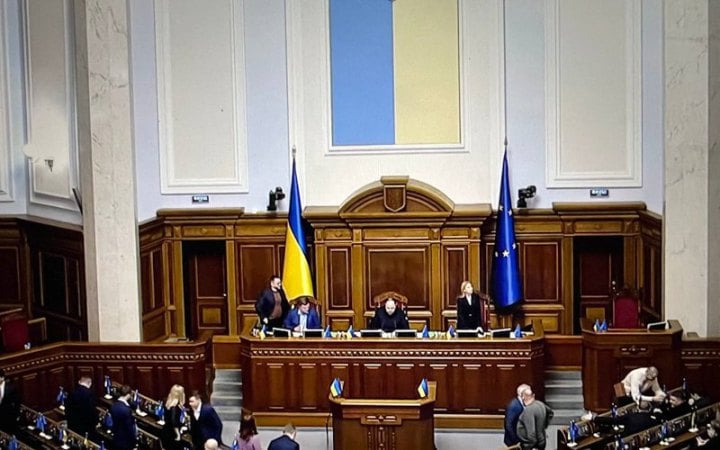
On 15 September, the Verkhovna Rada did not support at first reading draft law No. 15400. It proposed that the money Ukrainian companies pay to obtain permits to export weapons and dual-use goods would be directed to the needs of the armed forces. This was reported by Ekonomichna Pravda.
According to the document, from 1 August 2026 until the end of martial law, the fee for processing and issuing documents in the field of state export control for military goods and dual-use goods would be credited to a special fund of the state budget.
The funds were to be transferred to the Ministry of Defence: 50% for the purchase, modernisation and repair of weapons and military equipment, and a further 50% for the pay of Armed Forces of Ukraine service personnel. Overall, 20% of the value of an export contract is paid for an export permit.
As a reminder, on 1 July the Cabinet of Ministers adopted a resolution intended to introduce an accelerated procedure for exporting weapons. However, as of today, the process has still not been launched. Arms manufacturers are still waiting for the Ministry of Defence to provide a list of critical items that cannot be sold abroad, and producers still do not understand how the Drone Deal procedure—intended to set a framework for which countries weapons can be sold to—will work.
However, the industry says the most critical issue is the rates manufacturers would have to pay. Anastasiia Mishkina, Executive Director of the Technological Forces of Ukraine, an association of private defence technology manufacturers, said in an interview with LB.ua that the rate is too high, noting that its level is excessive.
“In our view, 20–30% of the value of an export contract is too much and economically unjustified. The Technological Forces of Ukraine overwhelmingly stated that the rate should be zero. The so-called fast-track decision was meant to make exports administratively easier, but these rates make them economically unviable. That is because the price on the global market is set not by the manufacturer but by the market and competition. This additional fee eats up all the earnings, and the contract is highly likely to go to another manufacturer. In other words, with our own regulations we are giving a price advantage to competitors abroad,” she said.
According to her, this could be felt most acutely when it comes to components.
“Right now, a 30% rate is proposed for such deals. Manufacturers gave us an example: a Chinese sensor costs $150, while the production cost of a Ukrainian equivalent is $120. A 30% rate completely removes the advantage of Ukrainian localisation. And this is at a time when there is public talk of the need to localise critical components, because our co-operation with the European Union and the United States depends on it. But with the percentage proposed in the resolution, we are undermining the rationale for this localisation,” Mishkina explained.
She added that the association proposes setting a zero rate at the outset, and before introducing any other rate, first calculating possible scenarios.