





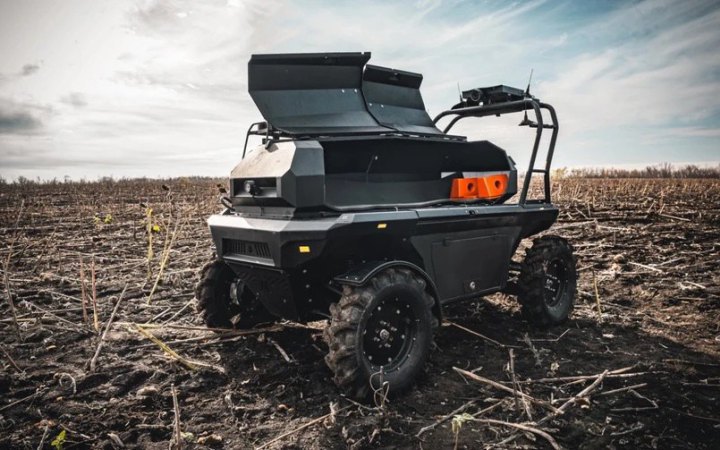
More than half of missions—51.9%—by the “Maul” ground robotic system to evacuate wounded personnel ended with the casualties being handed over for further stages of medical care. The First Separate Medical Battalion published these figures.
“Maul” was developed after the Medical Service of the 1st International Legion began looking for an alternative to traditional evacuation methods in late 2023. The battalion tested the ground robotic systems available at the time in combat conditions, but, according to the military’s assessment, they lacked sufficient speed and cross-country capability, had limited range, and did not provide adequate protection.
Their own system was built on the basis of a quad bike. “Maul” was fitted with an internal combustion engine, suspension, an armoured capsule for transporting a casualty, and electronic warfare equipment. This made it possible to increase the system’s speed, mobility, operating range and protection.
In January 2025, “Maul” was first used in combat conditions to carry out logistics tasks. It carried out its first successful evacuation of a wounded person in October of the same year.
According to the First Separate Medical Battalion, as of August 2026 the system’s maximum speed during a combat mission was 82 km/h without a casualty and 64 km/h with a casualty on board. Average speed during evacuations is 30–40 km/h. The maximum distance “Maul” covered during one of the missions was 110 km. Its range, the battalion notes, is in practice limited by the fuel tank’s capacity.
“We cannot provide absolute figures for the evacuations we have carried out using ground robotic systems. By the time this publication was released, the Unmanned Systems Company of the First Separate Medical Battalion had conducted hundreds of missions using ‘Maul’. By a mission we mean a ‘Maul’ sortie in response to a request from a neighbouring unit within our area of responsibility. We consider missions successful when the casualty evacuated by ‘Maul’ was handed over for further stages of care,” the publication says.
Read alsoEvacuating a wounded person from the kill zone: how units cope, what options exist, and what the military and political leadership thinks
At the same time, an unsuccessful mission does not always mean a person’s death: in half of such cases the system returned without a casualty, and in the rest it was lost before the patient was loaded. In 4.6% of all missions, “Maul” was destroyed when the casualty was already on board.
“On average, one ‘Maul’ evacuates 1.92 wounded people over its service life. However, practice shows that ‘Maul’ can survive for as little as 20 minutes or for as long as 12 successful missions. Factors affecting mission outcomes include preparation time, situational awareness, coordination with neighbouring units, weather conditions, and enemy activity in the sector. In the vast majority of missions, time of day was not a decisive factor,” the unit said.
Overall, according to the DELTA combat system, from the start of 2026 to early September, around 112,000 logistics and evacuation missions by ground robotic systems were recorded.