





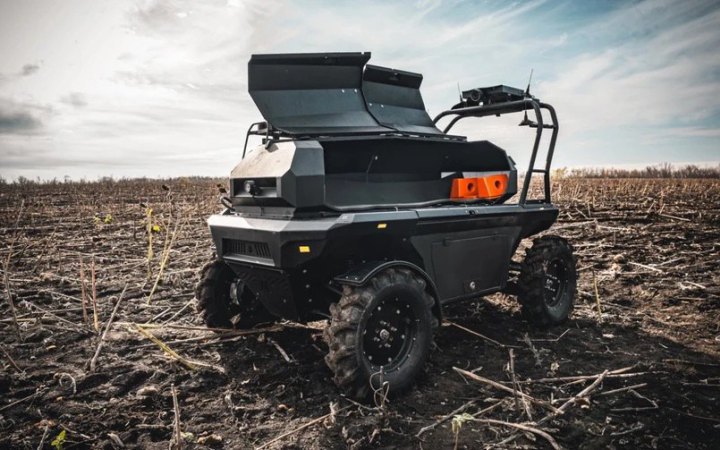
The Come Back Alive Foundation has launched the RoboBro project, aimed at developing the capabilities of military units to carry out evacuation and logistics missions using unmanned ground vehicles (UGVs). This is stated in the foundation’s press release.
Come Back Alive explains that evacuating a wounded serviceman from the line of contact currently poses a risk not only to the serviceman himself, but also to the crew of the evacuation vehicle or fellow soldiers who go to rescue him. The kill zone, stretching 20 kilometres or more, is under round-the-clock aerial surveillance by Russian forces. Using UGVs is virtually the only way to evacuate wounded personnel from the most dangerous areas.
“We have moved people’s role to the second stage of the evacuation. The first is the UGV: it goes to the line of contact and extracts the wounded serviceman. The second is handing the casualty over to the medical evacuation crew. This reduces the risk to the driver, medic and medical orderly. It also saves the life of the wounded serviceman, who under other circumstances would have to be carried out by people,” explains the operator of the Maul UGV from the First Separate Medical Battalion, call sign “Miller”.
Come Back Alive began providing discreet support for UGV-based evacuation operations in January 2026. According to the foundation, the equipment supplied has already helped save 42 lives.
Seven units will join the project initially: the First Separate Medical Battalion, the 92nd Separate Assault Brigade, the 93rd Mechanised Brigade, the 95th Separate Air Assault Brigade, the 110th Mechanised Brigade, the Active Operations Department of the Defence Intelligence of Ukraine, and the 125th Separate Heavy Mechanised Brigade. The foundation plans to expand the list over time.
For the project, Come Back Alive will purchase Ukrainian-made UGVs, including the Maul, Tarhan 200, Volia-E and Simba. The cost of one ranges from UAH 400,000 to more than UAH 1 million.
The foundation notes that for UGVs to carry out missions on the frontline, an entire ecosystem is needed: the robotic systems themselves and spare parts, command-post equipment, communications systems such as Starlink, electronic warfare equipment, control systems, transport and more. As part of the RoboBro project, Come Back Alive is therefore developing the capabilities of the units and providing them with all the infrastructure needed for evacuation and logistics missions using UGVs.
UGVs are also used to deliver equipment, ammunition, food or weapons to frontline positions, as well as materials for constructing shelters, and to evacuate wounded personnel. Robotic systems can also be used for mine-laying and demining and for combat missions. The platform’s design and configuration depend on its intended purpose. Units may have teams of engineers who modify the systems, adding capabilities not included in the standard configuration, such as more powerful batteries, communications equipment and more.
At the same time, the foundation says, robotisation using UGVs does not mean that the process is fully autonomous or can be carried out without human involvement. A typical evacuation mission involves at least seven servicemen: a UGV operator and assistant, a duty officer; a specialist monitoring the aerial situation; a medic remotely accompanying the casualty; an intelligence specialist; a communications specialist and others. A separate workshop team services the UGVs and prepares them for their next mission. Depending on the distance and the situation along the route, one evacuation mission can take more than 10 hours.
Recently, as part of its Dronopad project, the Come Back Alive Foundation specifically raised more than UAH 180 million to protect critical infrastructure in southern Ukraine. This includes ports and maritime routes.