





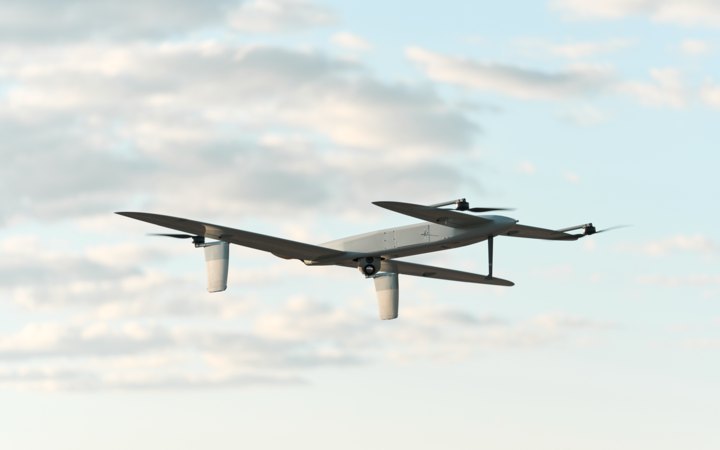
Ukrainian company ANT has presented an updated version of the MERCURY unmanned aerial system. The main changes concern the drone’s endurance and range, operating altitude and speed. The company reported this on Instagram.
MERCURY is a Ukrainian-made reconnaissance drone designed for aerial reconnaissance, target detection, fire adjustment, area monitoring and real-time surveillance of enemy assets by day and night.
The updated system has received a number of engineering changes aimed at expanding reconnaissance capabilities. In particular, time aloft, flight range and altitude, as well as speed, have been increased. According to the manufacturer, this makes it possible to carry out complex tasks without forced landings to replace batteries, operate deeper behind enemy positions, gain a better view of the terrain and respond more quickly to changing conditions.
MERCURY is a V-TOL type system, meaning it can take off and land vertically. For launch and recovery, it only needs a площадка measuring five by five metres. The stated maximum flight endurance is up to five hours, and the flight range with a video link is up to 70 km. In the case of flying without a link while recording data onboard, the stated range is up to 150 km, while the maximum distance reaches 300 km, the developers note.
According to the manufacturer, the drone’s operating altitude is up to 4,000 metres. The stated maximum speed is up to 126 km/h, and cruising speed is 90 km/h. MERCURY has a four-metre wingspan and a take-off weight of 19 kg. The drone is also capable of withstanding winds of up to 15 m/s, the developers say.
The system is equipped with a daylight camera and a thermal imager. The thermal imager’s resolution is 1280 × 1024 pixels, its magnification is 4×, and the daylight camera’s zoom reaches 210×. The video system makes it possible to use the daylight camera and thermal imager within a single system. To protect against icing, PTT heating is used.
The system uses two independent communications channels. If one channel is jammed by electronic warfare (EW) equipment or its performance deteriorates due to interference, the drone will switch to a backup channel at 433 MHz.
According to the company, the system supports manual control, flight using GPS and GLONASS satellite navigation, automatic flight along a set route, and automatic return to the launch point. The manufacturer also claims the ability to continue the mission in adverse weather conditions, in radio-silence mode, and in areas where EW systems are being actively employed.
ANT also reports testing the system’s resilience to EW воздействия, in particular with regard to control signals, video transmission and GNSS satellite navigation.
The unmanned aerial system includes two MERCURY aircraft, one base station and two transport cases. The base station includes a laptop, monitor, joystick, control panel, antennas, tripod and chargers.