





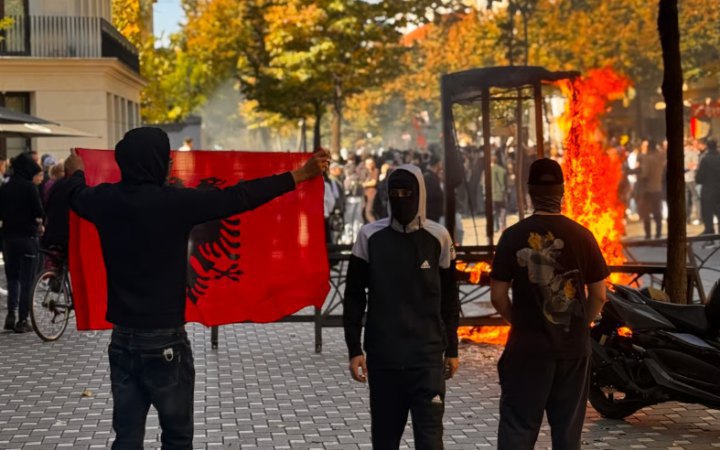
Two mass protests took place in Albania’s capital, Tirana: for the 19th consecutive day, students and lecturers held a rally outside the Ministry of Education, while nearby the opposition Democratic Party staged its own demonstration.
Tensions in the city escalated after students refused to merge their protest with the political party, Radio Televizioni Shqiptar reports.
The mass rallies quickly turned into violent clashes with law enforcement. Groups of masked protesters began throwing Molotov cocktails, pyrotechnics and stones at police and government buildings, and even used slingshots. Protesters also set fire to rubbish bins and tried to break through police cordons.
To disperse the crowd near the Ministry of Education and the government building, police used water cannon and tear gas. As a result, special forces gradually pushed protesters off the central boulevard.
Opposition MPs say they support the students’ demands and stress the need for the government to resign, while law enforcement officers continue to patrol the streets of Tirana and urge citizens to refrain from violence.
- Protests have been continuing in Albania’s capital for about two weeks. They grew out of a months-long protest movement against the construction of a luxury resort on the country’s coastline. On 24 October, the protest became even larger as university lecturers, teachers, opposition politicians and civic activists joined the students.
- The main confrontations unfolded in Tirana’s central square, where demonstrators tore up paving stones from the pavements and threw them at law enforcement officers, and also set fire to rubbish bins. As a result of the unrest, hundreds of people were injured, and government buildings and businesses were damaged. According to tax authorities, losses at 127 businesses have already reached €2.15 million.
- Meanwhile, the head of the Albanian government Edi Rama announced that a draft law would be submitted to parliament that would allow the authorities to tackle violence more effectively during acts of civil disobedience.