







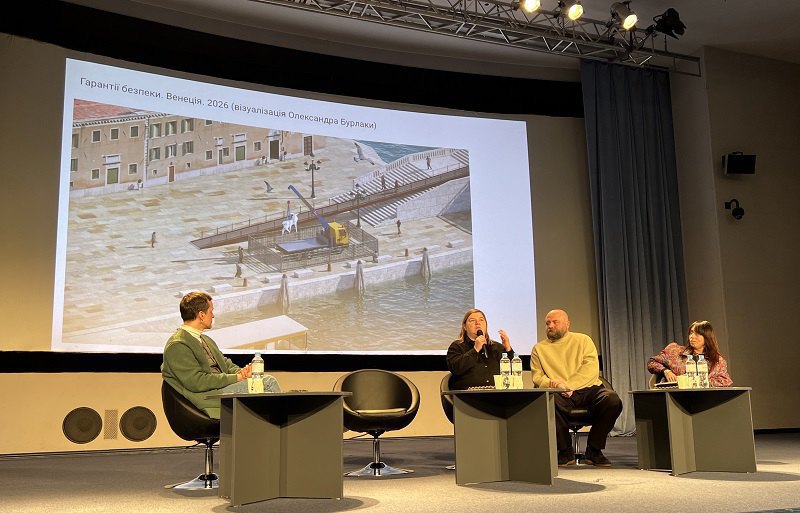
The Security Guarantees project consists of a concrete sculpture called Deer, evacuated from Pokrovsk, and documentation that will tell the story of its journey. The author of the sculpture, Zhanna Kadyrova, is already well known in the world (including in Venice) for her objects made of utilitarian materials such as stone, concrete, and tiles. For example, in 2019, her performance project Market (concrete and tile sausages, bananas, watermelons, which the artist sold by weight) and Second Hand ("clothes" made of concrete and tiles from the Darnytskyy Silk Factory) in the main curatorial programme of the 58th Biennale. During the 59th Biennale, Kadyrova, together with the Continua gallery, presented Palyanytsya, created from river stone, in Venice. Since then, the artist has shown Palyanytsya at nearly a hundred exhibitions in different countries around the world (it can now be seen in Kyiv at the exhibition Different Places at the National Art Museum of Ukraine) and has sold objects from this series for about 500,000 euros, which she donated to the army.
Kadyrova created the Deer in 2019 in collaboration with artist Denys Ruban, commissioned by the city of Pokrovsk for a park undergoing renovation. At that time, the front line was 40 km from the city; now, fighting continues daily in the city itself.
The 2.5-metre-tall Deer, made in the origami aesthetic, was cast in concrete on a pedestal from a Soviet jet aircraft that was removed from the park in the 1990s. Thus, a peaceful deer — a typical park sculpture — replaced a military object, a marker of the Soviet empire. This meaning of the sculpture was not intended from the outset; it developed over time, and the curators incorporated it into the concept of the biennial project. "The main theme we are exploring is a return to the history of the Budapest Memorandum, one of the security guarantees," explains curator Leonid Marushchak. "The deer appeared in place of the Soviet aircraft, which was the first carrier of nuclear weapons, which we got rid of after signing the memorandum." "The security guarantees of the Budapest Memorandum are just paper," adds Zhanna Kadyrova. "And this origami-style sculpture also looks like it's made of paper. It wasn't planned, but that's how it turned out."
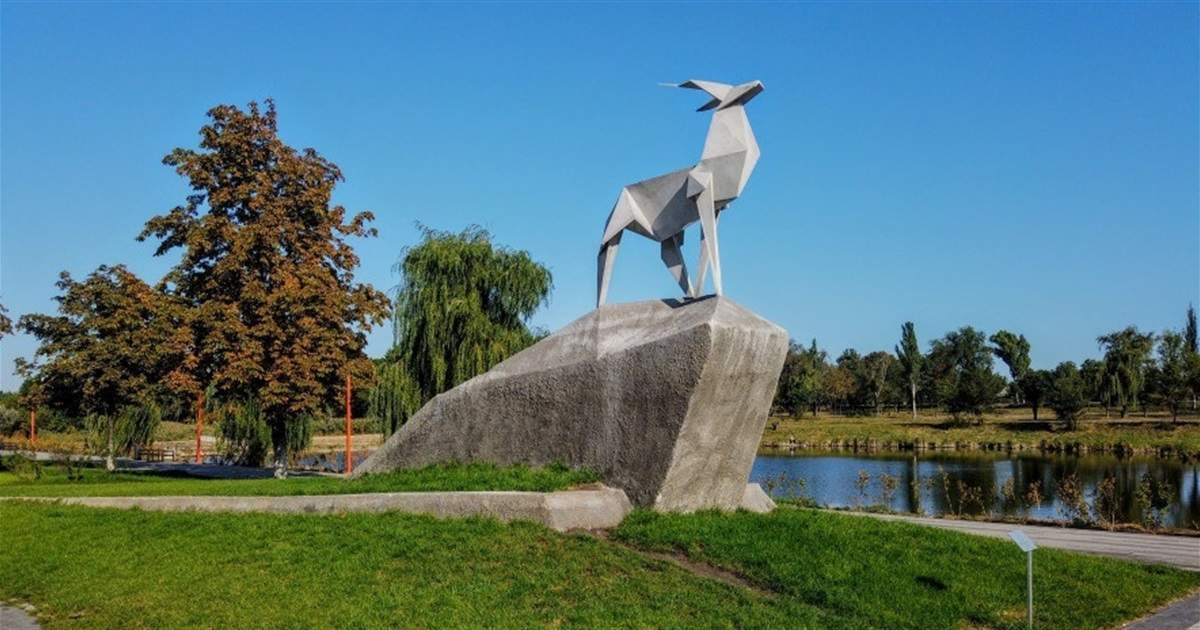
In order to install the Deer in Pokrovsk, sculptors had to "lift" a pedestal from an aeroplane for aesthetic and anti-vandalism reasons. This influenced the decision on how to present the sculpture in Venice: throughout the Biennale, which will last until November, the Deer will be suspended from a truck with a crane, which will stand on the embankment near the Giardini. During the dismantling of the sculpture, it had to be cut off along with part of the pedestal, so the fragile Deer cannot stand on its own legs. "We want to display it in a public space in a suspended state," says Kadyrova, "which will symbolise its displaced fate, that it has left its pedestal and is wandering the world, that Venice is just another stop."
The sculpture was taken out of Pokrovsk on 30 August 2024. It was evacuated by the NGO Museum Open for Renovation, headed by Leonid Marushchak. Since the start of the full-scale invasion, the NGO has, according to its own estimates, removed about 2 million artefacts from threatened areas. "When we were evacuating, we completely forgot about this Deer at first, but then we remembered it by accident," says Marushchak. "We offered to evacuate it to the Pokrovsk Museum, because it was clear that the museum itself would not do so. They supported the proposal. Then we went to the city council. It was a difficult process because there is still no procedure for how to do everything. We had to be as persistent as possible, to show that we weren't going anywhere and would get what we wanted. As paradoxical as it may sound, the Deer was saved by Leontovych (composer Mykola Leontovych, author of Shchedryk — Ed.). During the reconstruction, a bronze sculpture of Leontovych was placed at the entrance to the park, as he had lived and worked in Pokrovsk for several years. [He was allowed to be evacuated, and with him, Deer] — and this, of course, raises questions about the [administration's] understanding of what is valuable and what is not.
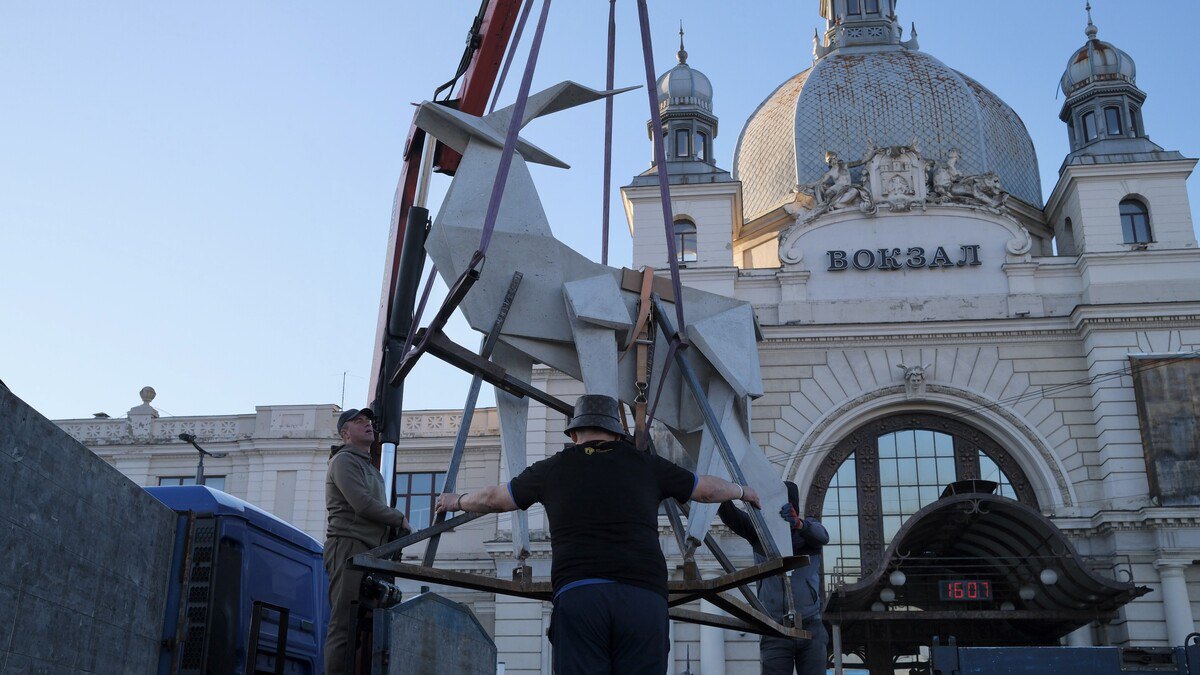
The Deer was brought from Pokrovsk to Vinnytsya (the city signed an agreement with Pokrovsk and officially accepted the sculpture), where it was kept until the start of the biennial journey. "At first, Zhanna [Kadyrova] and I wanted to show it at EXPO 2025 in Japan," recalls Marushchak. "That didn't work out, so we started thinking about where else it could be presented. We remembered Venice and decided to consult with Ksenia Malykh, who has extensive experience with Venetian projects (Malykh curated a number of PinchukArtCentre projects and was the manager of the Ukrainian National Pavilion in 2019, when the Open Group presented the project The Falling Shadow of 'Dreams' on the Gardens of Giardini. — Ed.), and that's how the whole story came to an end."
In the autumn of 2025, the Deer began its journey to Venice. It was shown in a number of Ukrainian cities: Kyiv, Lviv, Ivano-Frankivsk, and Yasinya. "At every stop on our journey," Kadyrova recalls, "we met people from Pokrovsk or families of people who were fighting or had died near Pokrovsk. In Lviv, refugees approached me and showed me photos with tears in their eyes, where they were in a park in Pokrovsk with this Deer in the background. It is very important to them that this sculpture continues to live, that it was not destroyed like their city was. I don't know how our journey will continue, or if anyone in Europe has heard of Pokrovsk. We'll see. My dream is for the deer to return to its original pedestal, if that is possible. But for now, let it travel and tell its story.
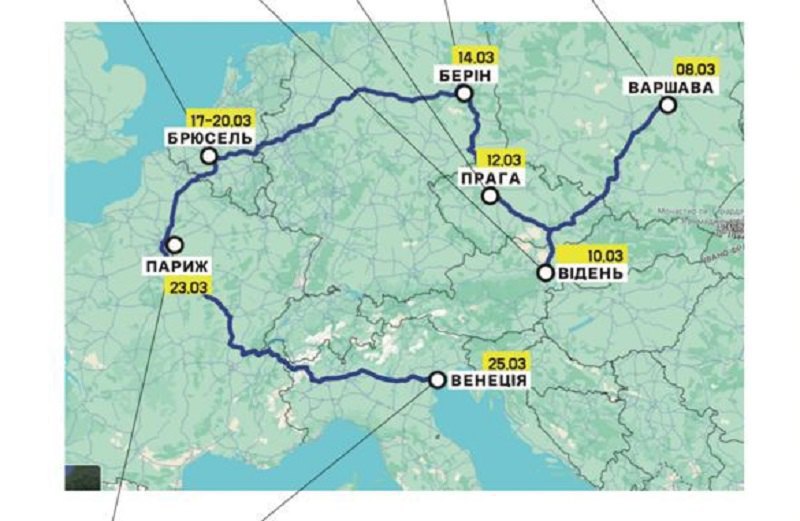
The Deer has already crossed the Ukrainian border: it was left for the winter in Białystok, Poland, at the Arsenal Gallery, at Kadyrova's solo exhibition. In March, it will embark on a European tour: the next stops are planned in Warsaw, Vienna, Prague, Berlin, Brussels, and Paris. It is due to arrive in Venice at the end of March, when the team will begin preparing it for display at the Biennale. "We are documenting every step of this journey," says Kadyrova. "We will make a video collage and show different days simultaneously on several monitors: the reality of our cities and how a homeless deer travels through Europe." The team will present the documentation in a room in the Arsenale, which in previous years was the main location of the Ukrainian pavilion.
Read alsoZhanna Kadyrova: “Why is our Biennale pavilion so small and inconvenient if it’s meant to draw attention to the war?”
The Deer itself, suspended on a truck, will be placed in the city. "The idea here is that everyone will ask questions: what is happening, is it still being installed, why isn't it in the pavilion," explains Marushchak. "This is important because we ourselves do not understand what the future of the sculpture will be. And we also don't yet understand what to do with the empty pedestals that remain in Ukraine, who will fill them and when. All of this comes together in one big metaphor." "From the beginning, we tried to get the best place for our sculpture," adds Malykh. "We don't have clear confirmation yet, it's a complicated bureaucratic process, but there is every reason to believe that we will succeed. It is very important that we have the active support of the Ministry of Culture, without which we would not have been able to do this. The Biennale is a private institution, and it can only be influenced through diplomatic skill."
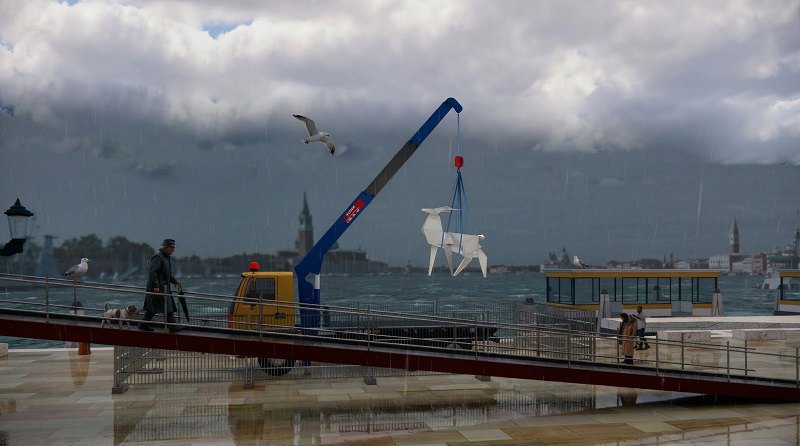
In recent years, the Ministry of Culture has been the commissioner of the Ukrainian pavilion at the Biennale (previously, this role was performed by the PinchukArtCentre for a long period). But while the role of commissioner was previously assigned to deputy ministers, this year it is being performed by Minister Tetyana Berezhna herself. "One of my tasks as commissioner was to build understanding between us and the organisational team from Venice," says Berezhna. "We showed a visualisation of the place where we want to see our deer and resolved this issue to everyone's benefit. It is very important that this year at the Biennale we will raise the issue of security guarantees. This topic comes up in absolutely all negotiations, and we are grateful to the team for being able to convey it so subtly. Established ideas about the world order need to be rethought, and Ukraine is pointing this out: security guarantees do not work, we no longer live in the reality we used to live in. It is very important that the Ukrainian pavilion speaks this language."
"It is difficult to find a language that will make us heard abroad," Malykh continues. "You cannot speak too emotionally, you cannot illustrate your words too graphically, because you will be considered unprofessional, undiplomatic, unreasonable. I think this project has brought everything together. It is the ideal context for this statement. The Venice Biennale is an event that brings together those who are considered opinion leaders. It is our tool of influence. Artistic expression has several layers, and we understand how it will work. First, there will be: oh, a truck! In Venice, a truck is more surprising than a sculpture. There are no cars here, not even bicycles. The city strictly controls all visual communication, right down to supermarket signs. This is what makes it a place where artistic expression lives, like in a museum, where nothing distracts you from looking at art.
As commissioner, the Ministry of Culture has to pay for Ukraine's participation in the biennale. This year, as last time, the budget for this is 5 million hryvnya. This is not enough, so the pavilion team continues to search for partners and sponsors. However, while in previous years the ministry's cooperation with the team was rather nominal (in 2024, the curators even doubted whether they would be able to implement the project due to the passive position of the Ministry of Culture), now the curators speak of comprehensive support from the ministry.
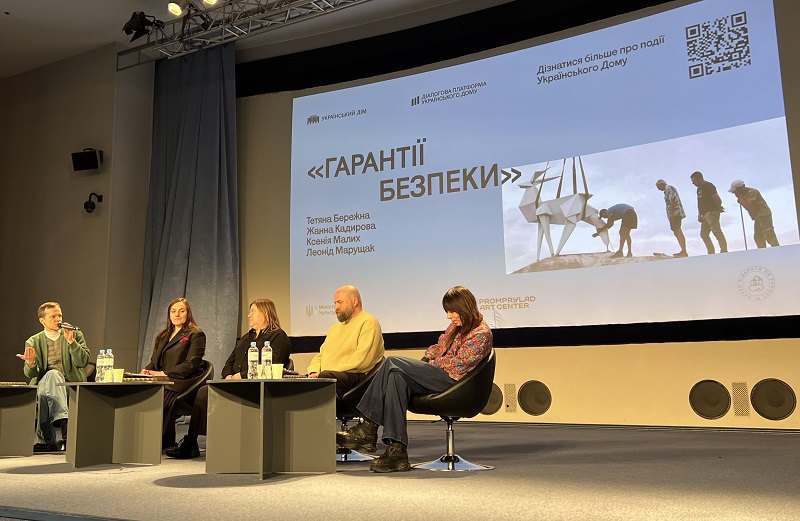
They also note that state participation in the biennale has finally gained institutional continuity and legitimacy, and that the pavilion teams from different years do not compete for symbolic supremacy — they support each other. “In 2018, we had to defend the selection procedure for the biennale project,” recalls Malykh. “At that time, there were attempts to use telephone law, to put pressure on the ministry through the prosecutor’s office. The ministry stood its ground, and since then we have had no problems with the selection process. This is an important achievement for us: we have a democratic procedure that works. And it's great that we have continuity in the work of the national pavilions: no curator has ever done this twice in a row. Why do you think that is (laughs)? There is already a tradition of passing on experience; the curators of the previous pavilion gave us a whole set of instructions with advice: how to do it, who to work with, contractors' contacts, budgets. And we will pass everything on to the next team in the same way. This is our strength — that we support each other, so we become stronger and more experienced.
***
The Ukrainian national pavilion project will be presented by the Promprylad Art Centre (Ivano-Frankivsk) in partnership with the NGO Museum Open for Renovation. Curators: Kseniya Malykh, Leonid Marushchak. Artist: Zhanna Kadyrova. The authors of the video documentation are Natalka Dyachenko, Pavel Sterets, and Maks Maslo.
The 61st Venice Biennale will run from 9 May to 22 November 2026. The Ukrainian pavilion project will be open throughout this period.