






The plot of the book, like that of the film, is a biography of a real Transcarpathian molfar healer, Andriy Voron. He lived to the age of 104, and his life reads as a compendium of the turbulent and tragic events of the twentieth century. Voron fought for Carpathian Ukraine in 1939, lived for periods in countries neighbouring Transcarpathia, spent many years in the Gulag, and eventually returned home, where he became a respected elder and a renowned practitioner of folk medicine.
The screenplay was written by Ivan Nikolaychuk himself, in collaboration with screenwriters Anatoliy Krym and Carlos de los Ríos. According to the director, this was the most challenging stage of the film’s production. In fact, filming began while the script was still unfinished. This was the first—but not the only—major problem. The Eternity Man relies heavily on voiceover narration, functioning as a kind of semantic crutch for the film, dispensing banal aphorisms in the vein of “life wisdom”, explicitly steering the plot and accompanying it from the opening shot to the final frame. At the same time, it fails to compensate for the near absence of narrative momentum in a film that runs for more than two hours.
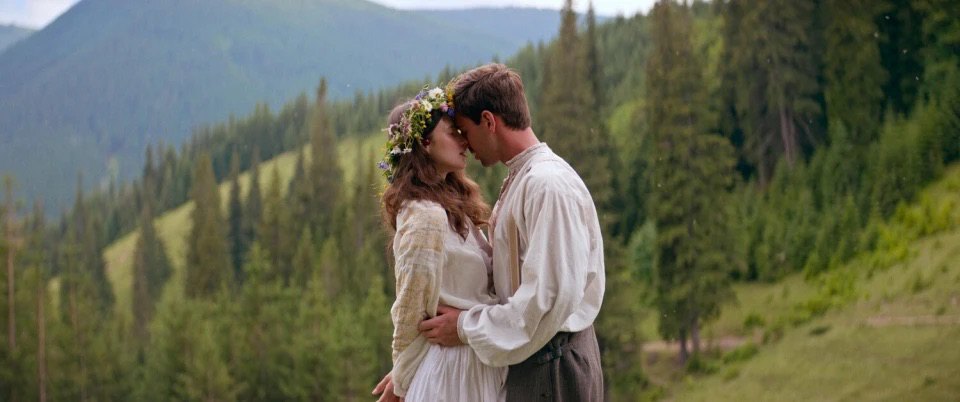
Nikolaychuk attempts to fuse a whole range of genres: melodrama, historical film, a Robinsonade, and prison drama—all of it wrapped in what is meant to be a philosophical parable with overt references to the films of Terrence Malick. Both conceptually and visually,The Eternity Man resembles Malick’s The Tree of Life. But there is a catch: before making extended cinematic parables, Malick earned a degree in philosophy and studied under Martin Heidegger, one of the most influential philosophers of the twentieth century. For some reason, Ivan Nikolaychuk decided he could create something comparably complex and conceptually dense without that kind of background.
The Eternity Man is also, to a large extent, a kindred spirit to A Whole Life (2023) by Austrian director Hans Steinbichler. That film was shown in Ukraine only in limited release, so it never reached a wide audience. In it, Steinbichler spends more than two hours telling a rather dull story of the life and love of a simple Austrian man from the Alps, while simultaneously trying to convey the grandeur of mountain landscapes and a philosophically banal meditation on the meaning of life. The Eternity Man, at least, contains some degree of narrative tension: the character of the tyrannical Czech gendarme Růžička, sex scenes, the Gulag arc, and the episode of taming a wolf. If the protagonist of A Whole Life is a lumberjack, Nikolaychuk’s hero is a true molfar—one who, through the power of faith, melts the ice of Kolyma and is capable of curing all illnesses with herbs.
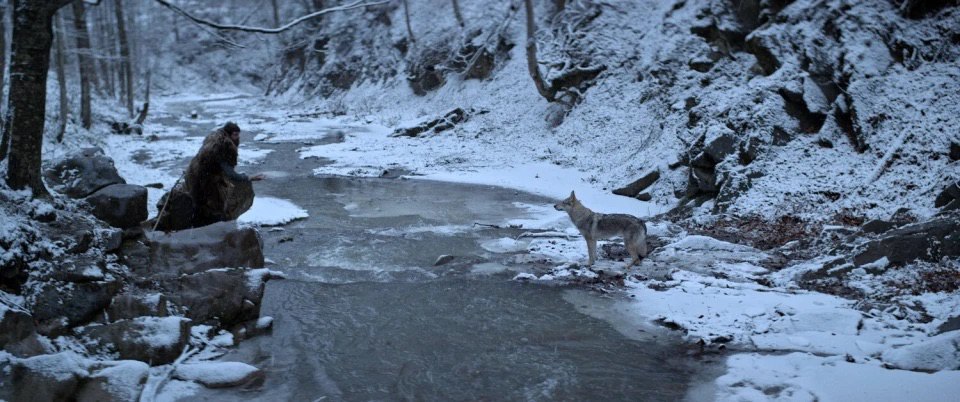
Ukrainian historical cinema has its own Scylla and Charybdis, between which it is almost impossible to pass. The first is an almost museum-like visual aesthetic (one might recall recent films ranging from Kruty 1918 to Another Franko). The Eternity Man suffers from this flaw as well, where museum gloss and poster-like imagery replace an authentic reconstruction of historical reality. The second is patriotic pathos combined with excessive sentimentality (a quality for which the founding figure of the genre, Oles Yanchuk, was already criticised back in the 1990s). In The Eternity Man, overwrought emotions, pompous dialogue, poor CGI and the intrusive repetition of Myroslav Skoryk’s Melody turn the film into a very long and very dull sentimental melodrama, with cinematography that resembles an advertisement for mineral water or beer infused with Carpathian flavour.
The Eternity Man is an example of how the adaptation of an interesting book — one based on a gripping non-fiction story — becomes a clumsy melodramatic narrative driven by off-screen banalities presented as life philosophy. Had Nikolaychuk used all the footage he shot and divided it into several hour-long episodes, there might have been a chance to produce a middling television historical melodrama, akin to Jacob’s Life based on Volodymyr Lys’s novel or And There Will Be People based on Anatoliy Dimarov’s work. In feature-length form, however, the attempt to combine the stylistics of Terrence Malick and Oles Yanchuk merely creates a sense of boredom and wasted time.