







Feminist upbringing and the English language
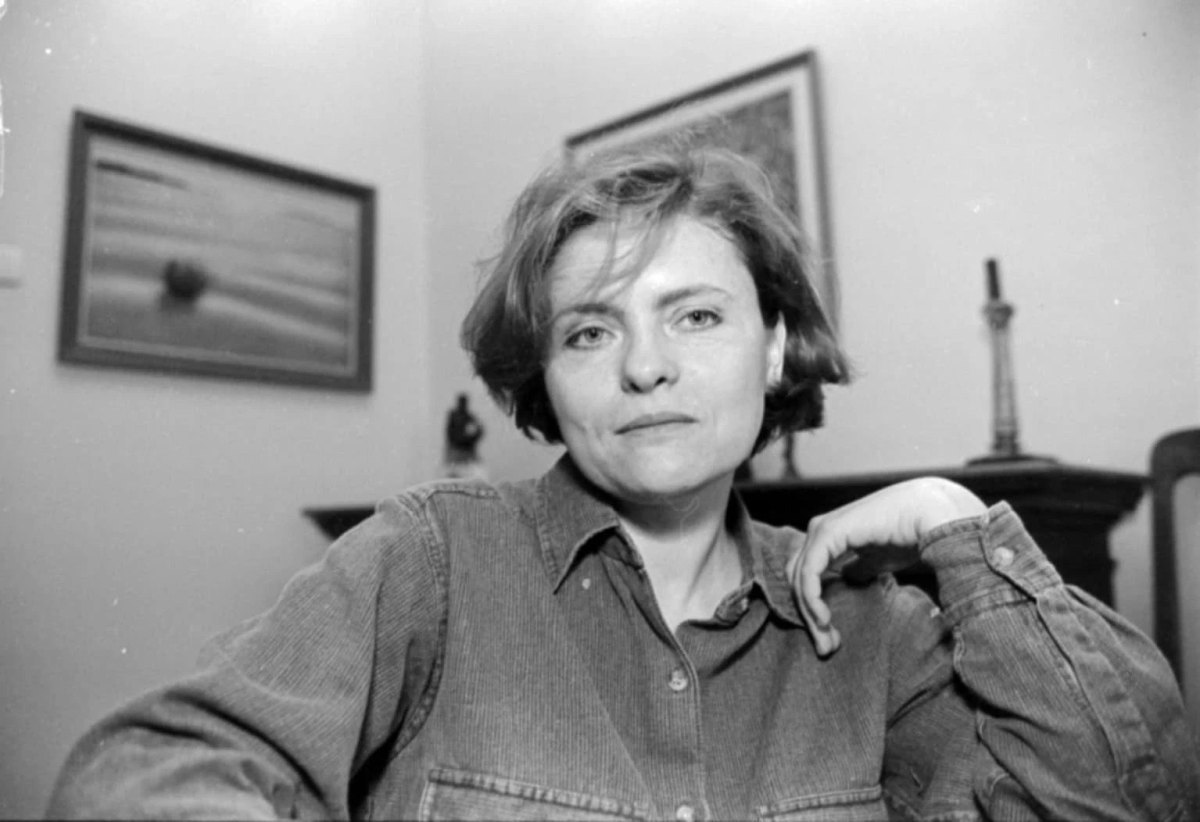
Solomiya Pavlychko was born in 1958 in Lviv, into the family of the renowned poet Dmytro Pavlychko and Bohdana Pavlychko. She later recalled that her father was строгий and demanding, raising his daughters as intellectuals. She also described her upbringing as feminist, as she was taught to rely solely on herself — without any expectation of a fortunate marriage.
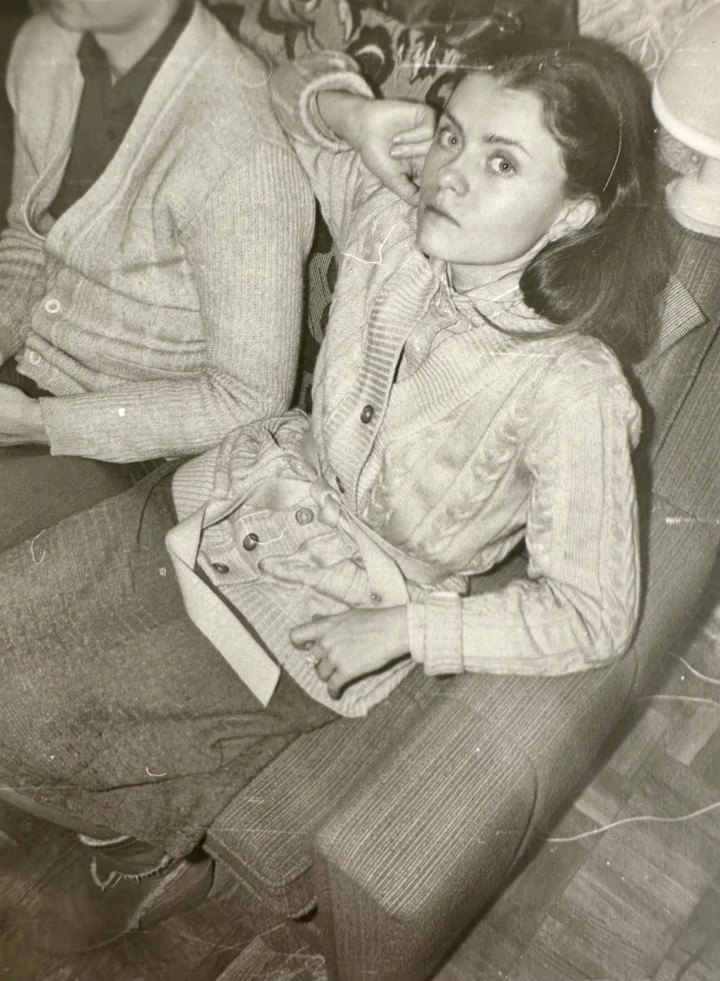
From childhood, Solomiya dreamed of studying Oriental studies, but she learned English and, after finishing school, followed her father’s advice by enrolling in the Department of Romance and Germanic Languages at Taras Shevchenko University of Kyiv.
“Dmytro Vasylovych used to say that his daughter was more talented than he was,” the writer Oleksandr Ratner recalled in 2008. “Once he showed me Solomiya’s article on mid-nineteenth-century American poetry. It mentioned nearly 115 poets, of whom I had heard of only two or three. Dmytro Vasylovych admitted he knew no more than twenty. Vitaliy Korotych, who had a complicated relationship with Dmytro Pavlychko, once met his wife, Bohdana Pavlivna, and said: ‘I read your Solomiya’s article on American poetry in a journal. I’m impressed! Whom does she take after to be so clever?’”
Even from this quote, it is clear how deeply Soviet Ukrainian society was steeped in patriarchal attitudes. Strong and intelligent women were feared and often suppressed, prompting remarks such as, “Whom does she take after to be so clever?”
In the 1980s, her field of interest was Anglophone literature: Byron, Mark Twain, Hemingway. She translated Lady Chatterley’s Lover by D. H. Lawrence. In the Soviet tradition, the novel had been shrouded in a kind of artificial prudery. Solomiya Pavlychko changed this, lifting taboos around language and demonstrating that the Soviet ban on eroticism and sexuality in literature was misplaced.
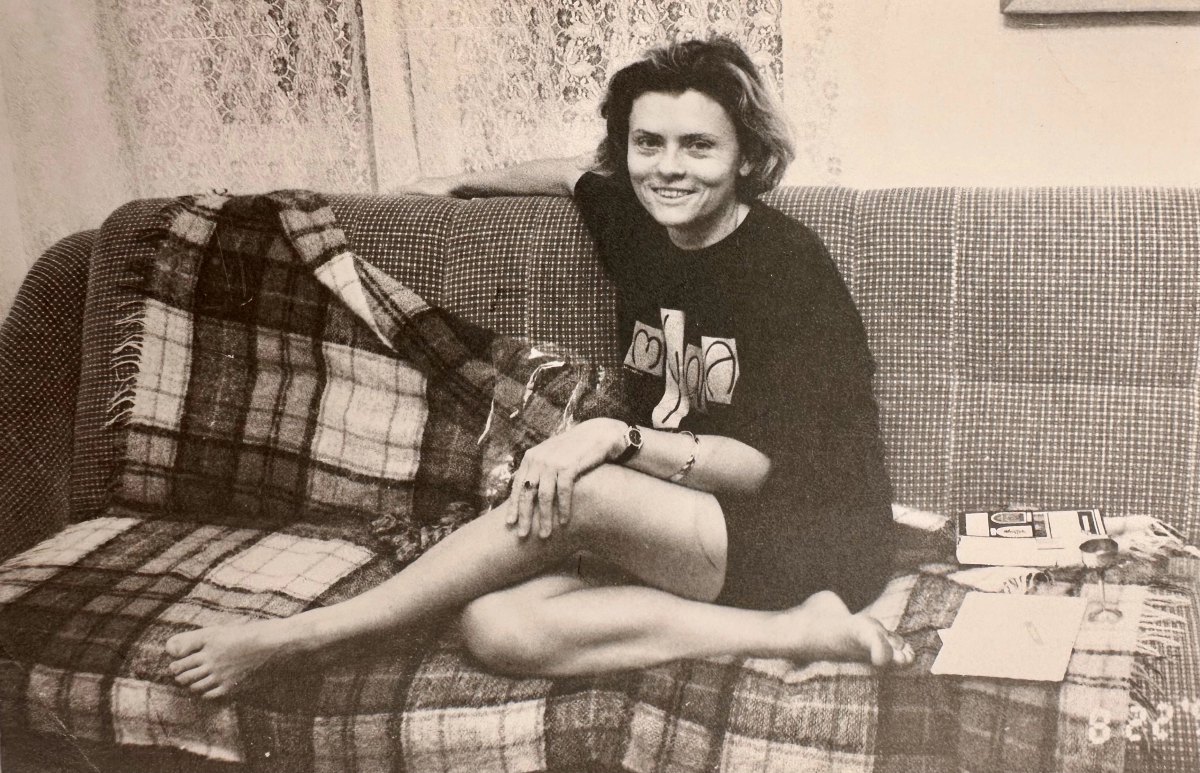
She also immersed herself in the work of the American poet Emily Dickinson, about whom few people in Ukraine at the time had even heard. Working with Dickinson’s texts became a turning point for Solomiya Pavlychko.
Osnovy Publishing
In 1987, Pavlychko completed her PhD dissertation, Philosophical Poetry of American Romanticism. By then, she was already teaching at Taras Shevchenko University.
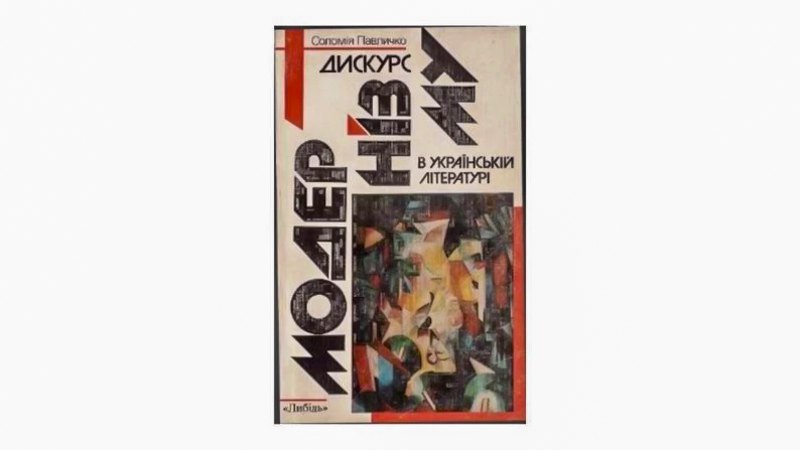
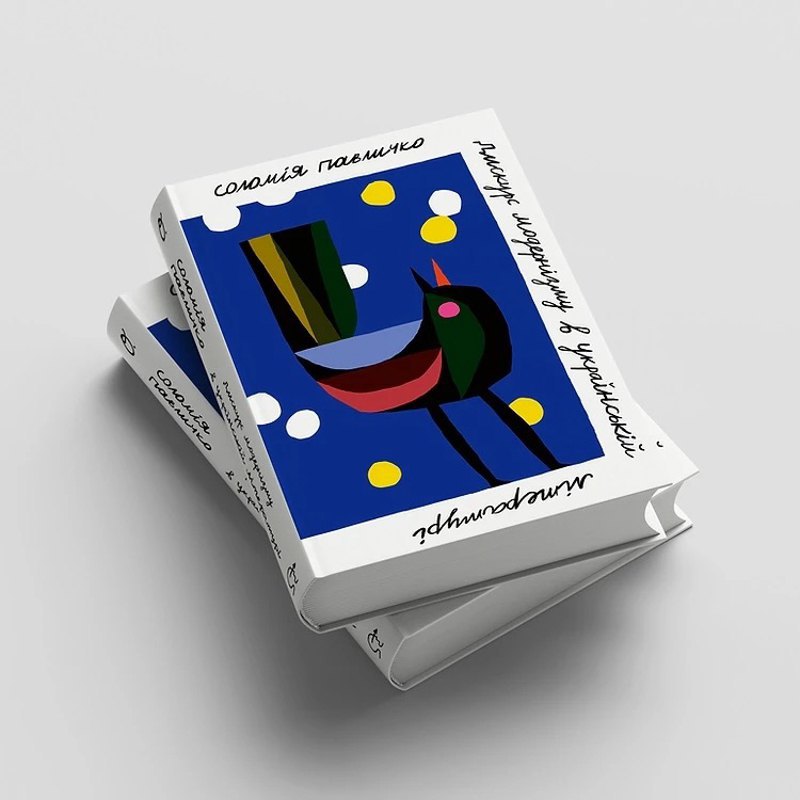
As Doctor of Philology Tamara Hundorova recalls, in 1990 the first feminist circle of literary critics emerged at the Institute of Literature. This intellectual environment later influenced Pavlychko’s most well-known scholarly work, The Discourse of Modernism in Ukrainian Literature.
In 1991, just as Ukraine was gaining independence, Emily Dickinson’s Poetry was published in Ukrainian translation by Solomiya Pavlychko at Dnipro Publishing House. At the same time, she was already planning to establish her own publishing house.
In 1992, together with her then-husband Bohdan Kravchenko, she co-founded Osnovy Publishing. The launch was supported in part by funding from the International Renaissance Foundation. The publishing house set out to publish books that were not only unavailable in Ukraine at the time, but often entirely unknown — both the works and their authors. Osnovy released Ukrainian translations of works by Simone de Beauvoir, Plato, Guy de Maupassant, Augustine of Hippo, and others.
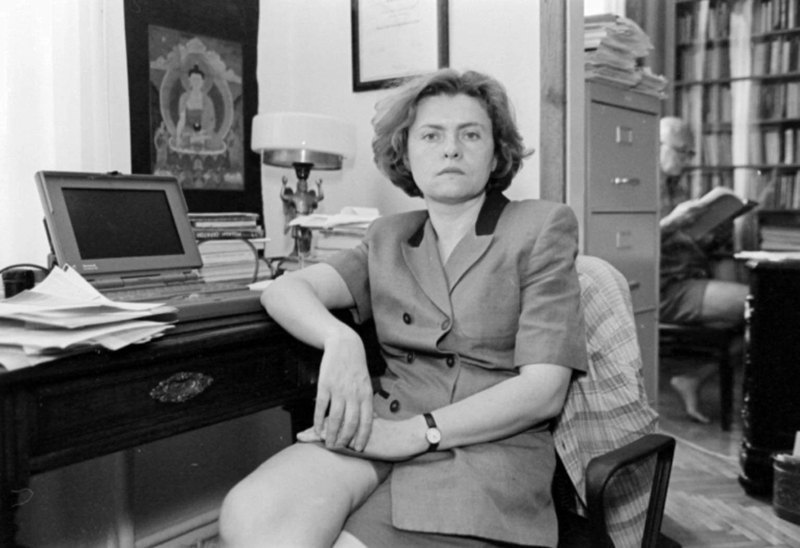
In the early 1990s, Solomiya Pavlychko went on a research fellowship to Canada. From there she brought back suitcases full of books, including works on feminism. As Professor Vira Aheyeva recalls, she and other women in their intellectual circle learned about the development of feminist discourse in the West from these books and conversations — as nothing of the sort had yet been written or discussed in Ukraine.
Later, Solomiya Pavlychko became one of the first invited visiting lecturers at the Harvard Summer School of Ukrainian Studies and at the University of Alberta. Her international experience proved critically important: she saw what contemporary humanities scholarship looked like and how far Ukrainian academia lagged behind it. From that point on, she focused on narrowing this gap.
“Explosive” doctoral dissertation
In December 1995, Solomiya Pavlychko defended her doctoral dissertation, The Discourse of Modernism in Ukrainian Literature. In this work, she carefully analysed examples of Ukrainian modernism — from the writings of Lesya Ukrainka, Olha Kobylianska, Hnat Khotkevych, and Mykhailo Yatskiv, to representatives of the Young Muse and Ukrainian House movements, as well as 1920s writers, prominent figures of 1940s émigré literature, and the New York Group of the 1960s and 1970s.
At the time, the procedure for defending a dissertation was still entirely Soviet in style: strictly scripted, with no room for independent thinking. Vira Aheyeva recalls how, after Solomiya’s presentation, a young man stepped up to the podium — someone unknown in literary studies circles. It turned out he was... a chemist. And he proceeded to “tear apart” Pavlychko’s defence, humiliating and condemning virtually every thesis she put forward. He was particularly outraged by the phrase “lesbian fantasies,” which the scholar had used in her analysis of the correspondence between Lesya Ukrainka and Olha Kobylianska. According to Aheyeva, his indignation appeared genuine.
Today, the quotations from the writers’ letters cited by Pavlychko would hardly shock anyone, but in the 1990s her interpretation was a bold provocation that was widely discussed in academic circles and the press. “The letters embodied a dream of love that was never fully realised in their lives. A lesbian fantasy, for which there are also grounds in Kobylianska’s diaries and earlier works,” the scholar wrote.
At first, Solomiya was intimidated by the aggressive speech of the stranger, but as his intervention dragged on, she regained her composure. She returned to the podium and responded: “I believe that everything we discuss in private should also be discussable in public.”
The defence was unanimously approved, and the monograph moved beyond the academic sphere, becoming one of the first truly popular contemporary works of Ukrainian literary scholarship.
A new scholarly perspective
The controversy surrounding Solomiya Pavlychko’s work did not subside for a long time. A significant part of the post-Soviet literary and academic establishment was not ready to take Ukrainian classics down from their pedestals or to examine their legacy through a modern critical lens. Pavlychko did not merely lift taboos around certain aspects of canonical writers’ lives and works — she introduced a new methodological approach to literary studies in Ukraine.
In a letter to her colleague, literary scholar and critic Yuriy Lutskyy, based in Toronto, Pavlychko wrote that calls for her “removal” were even made from the parliamentary tribune by the poet and communist MP Borys Oliynyk. “The Rukh newspaper wrote that I should see a doctor,” she noted in the letter. “Sil’ski visti publishes outraged letters from villagers in every issue. Of course, no one has read the book, and no one feels the need to read it.”
Among the topics she explored was the Ukrainian literary canon: whether it exists, and who shaped it and when. In The Discourse, she wrote: “A canon is not a collection of the best texts, but the result of cultural power.” Ideological influence played a decisive role in shaping what was considered the Ukrainian canon, and Ukrainian modernism was simply not allowed to develop organically.
Pavlychko was also the first in Ukrainian literary scholarship to introduce a feminist perspective: she demonstrated how women’s voices were either ignored or reduced to symbolic roles. She spoke about the need to rethink the entire body of texts and insisted that a text does not have a single “correct” meaning, and that criticism is always interpretation shaped by the reader’s position. Her ideas remain relevant today.
Continuation of life
On the last day of 1999, Solomiya Pavlychko died from carbon monoxide poisoning in her apartment.
The news was devastating for everyone who knew and loved her. Writer Oksana Zabuzhko, who was a close friend of Pavlychko and saw her as an older sister, has said more than once that this loss was the hardest for her after the death of her own father.
After the founder’s death, Osnovy Publishing was headed by Valentyna Kyrylova. Over the following decade, the publishing house focused on issuing translated textbooks across various disciplines.
In 2010, Osnovy was taken over by Solomiya Pavlychko’s daughter, Dana Pavlychko. She renewed the publishing house, shifting its focus toward non-fiction, the humanities, and translated literature that had previously been largely inaccessible to Ukrainian readers. In this sense, Osnovy continued and developed Solomiya Pavlychko’s intellectual legacy: openness to Western theory, critical thinking, and the re-examination of the canon.
In 2024, Dana Pavlychko sold the publishing house to the Ukrainian School of Political Studies. Co-owners included the Agency for Legislative Initiatives, USPS alumni Andriy Vyshnevskyy and Anastasiya Borodina, and the head of the Agency, Svitlana Matviyenko. Osnovy entered “a new stage of development with new owners.” The new team announced plans to establish a Solomiya Pavlychko Research Centre and to publish a complete edition of her works. This has not yet happened.