





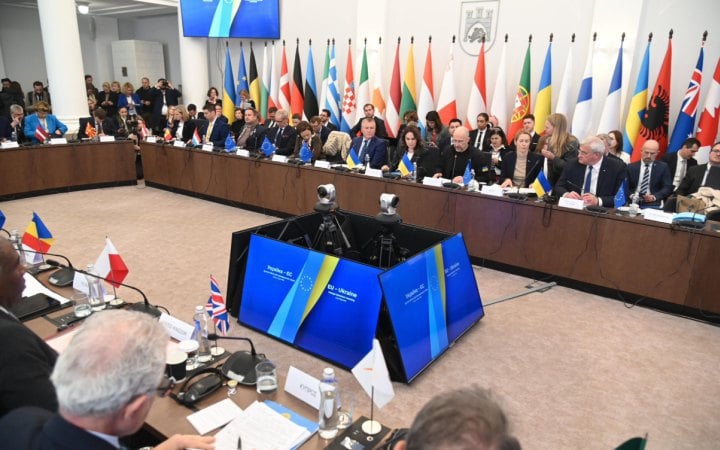
Today, 36 countries and the European Union officially declared their intention to join the Expanded Partial Agreement on establishing the Special Tribunal for the crime of aggression against Ukraine, bringing its creation closer.
The relevant statements were made during the annual meeting of the Council of Europe’s foreign ministers in Chisinau, Ukraine’s Prosecutor General Ruslan Kravchenko reported.
“This is evidence that Russia’s international crimes against Ukraine, which have specific names and dates, will also result in verdicts at the level of the aggressor state’s highest military and political leadership,” Kravchenko said.
Practical work began back in 2023, when the International Centre for the Prosecution of the Crime of Aggression against Ukraine (ICPA) started operating at Eurojust in The Hague. This was the first real step toward establishing the Tribunal. Evidence is already being assembled there, coordination among prosecutors is under way, and materials are being prepared for the Tribunal’s future Office of the Prosecutor.
The next step is legal formalisation. On 25 June 2025, the President of Ukraine and the Secretary General of the Council of Europe signed the Agreement establishing the Tribunal. On 15 July 2025, the Verkhovna Rada ratified it.
Countries that have declared their intention to join must now complete their national ratification procedures. After that, the Tribunal will gain a fully empowered international foundation. The Netherlands will host the initial stage of its work—in The Hague, the world capital of international justice.
What Comes Next
Next steps include forming a steering committee, the work of a preparatory team, selecting premises, appointing judges, prosecutors and staff, approving procedures, and securing funding.
“The Tribunal is moving from the realm of a political decision to the realm of an actual launch. It will investigate and try those who bore personal responsibility for the decision to wage aggression against Ukraine. Positions, immunities, borders—none of these are an obstacle,” Kravchenko said.
Cases may be heard in absentia.
The Office of the Prosecutor General, together with law enforcement agencies, is documenting and investigating all international crimes committed by Russia against Ukraine. As of today, there are more than 256,000 of them. That is more than 44 terabytes of digital evidence and already more than 1,100 suspects.
Some of these materials, including evidence related to the planning, preparation and waging of an aggressive war against Ukraine, will form the basis of the Special Tribunal’s work on the crime of aggression.
“Every missile that struck Ukraine’s cities. Every civilian life taken. Every child taken out of Ukraine. All of this is material for the Tribunal,” the Prosecutor General added.
- Deputy Head of the Office of the President Iryna Mudra said that the statute of the Special Tribunal provides for the possibility of holding sessions not only in The Hague, but also outside the body’s permanent location.
- It is known that the body’s judges will be elected by the Tribunal’s Steering Committee. The statute provides for a register of 15 judges. In particular, five judges will serve on the Appeals Chamber. It also предусматривает one judge for the Pre-Trial Chamber and three judges for the Trial Chamber.
- According to Mudra, it remains to formally adopt and bring into force the Expanded Partial Agreement, complete the formation of the financial base, sign a full agreement with the Netherlands on hosting the Special Tribunal, form a roster of judges, elect a prosecutor, adopt procedural rules, and roll out the full judicial structure.