





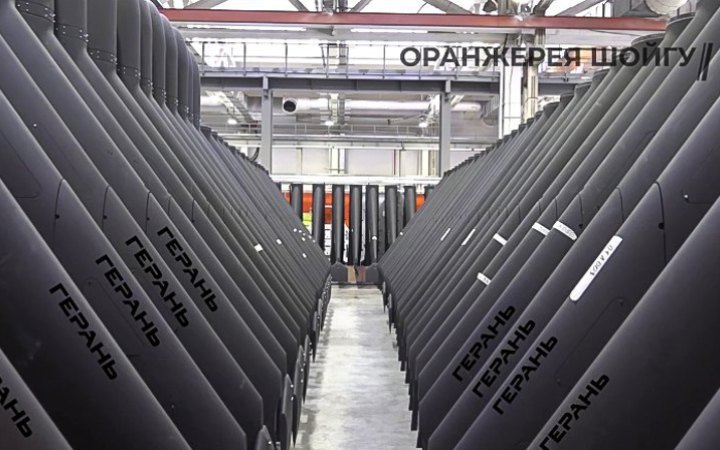
Russia is taking steps to ramp up capacity to produce tens of thousands of attack drones, which it uses to strike Ukrainian cities.
Politico reports, citing plans from a Russian state-owned company that have come into the outlet’s possession.
The expansion of the Alabuga-Volokno plant (part of the state corporation Rosatom) in Tatarstan will allow Moscow, by 2029, to produce an additional 500 tonnes a year of aerospace-grade carbon fibre for military needs.
This strong and lightweight material is a key component in manufacturing a drone’s airframe.
Experts estimate that such an increase in output would mean an additional 28,000 combat drones produced each year — a 78% rise in weapons production. “…similar to the one that hit a passenger train near the Polish border this month, as well as the aircraft that have killed many Ukrainian civilians,” Politico notes.
According to Ukraine’s estimates, Russia is currently capable of producing more than 36,000 Geran kamikaze drones a year.
These plans underscore Russia’s bet on combat drone technology to sustain its war machine, which it is increasingly directing against the rest of Europe.
The Alabuga-Volokno Plant Is Under Western Sanctions
The United Kingdom, the United States and a number of other Western countries have imposed sanctions on the Alabuga-Volokno plant and its parent company — UMATEX, Rosatom’s advanced materials manufacturing division.
The plant is a key link in Moscow’s military-industrial supply chain. Earlier this year, it received a disguised shipment of chemicals for carbon-fibre production weighing 46 tonnes from a Chinese state corporation. This is evidenced by Rosatom’s internal transport and customs documents published by the outlet in early September.
Previously, Rosatom said that the company and its subsidiaries “act in full compliance” with current legislation and regulatory requirements.
China’s embassy in Washington said it was unaware of any plans to expand Russian drone production and that it “strictly controls the export of dual-use goods in accordance with the law”.
“Business plans, design projects and engineering documentation obtained from Russian sources by the Ukrainian Centre for Security and Cooperation — a Kyiv-based analytical centre close to the Ukrainian government — contain detailed information about the plant’s expansion, as well as layouts of its equipment and construction,” Politico adds.
A special committee of the US House of Representatives on China reviewed the documents and found them to be genuine, a US government representative familiar with their contents said. Ukrainian authorities also reviewed the documents and confirmed their authenticity, a Ukrainian official noted.
Alabuga–Volokno Is Already Expanding, Foundations for a New Plant Being Prepared
According to official documents, in May the Russian government approved Rosatom’s plans to create a new line at the Alabuga–Volokno plant — a facility intended for the “production of chemical fibres and threads” — with a capacity of up to 500 tonnes of carbon fibre a year.
According to a Ukrainian official, satellite images taken between May and July show preparatory work on the site allocated for the expansion project, adjacent to the existing Alabuga–Volokno plant in Tatarstan. The images, provided by the USCC, contain “evidence that the facility is already growing”, the official said.
At present, the “foundations are being prepared” for the new plant, said weapons expert David Albright — founder and president of the Washington-based think tank the Institute for Science and International Security — who independently obtained satellite images of the site dated August.
He said the planned completion of the plant in 2027 “requires a rapid pace of work”.
- Rosatom’s plans to expand capacity to meet Russia’s need to increase the production of combat drones are causing concern not only in Ukraine. As Serhii Kuzan, head of the Ukrainian Centre for Security and Cooperation, said, the expansion of Alabuga and its associated enterprises should be seen not merely as a problem for the Ukrainian front, but as a long-term security challenge for all of Europe.