





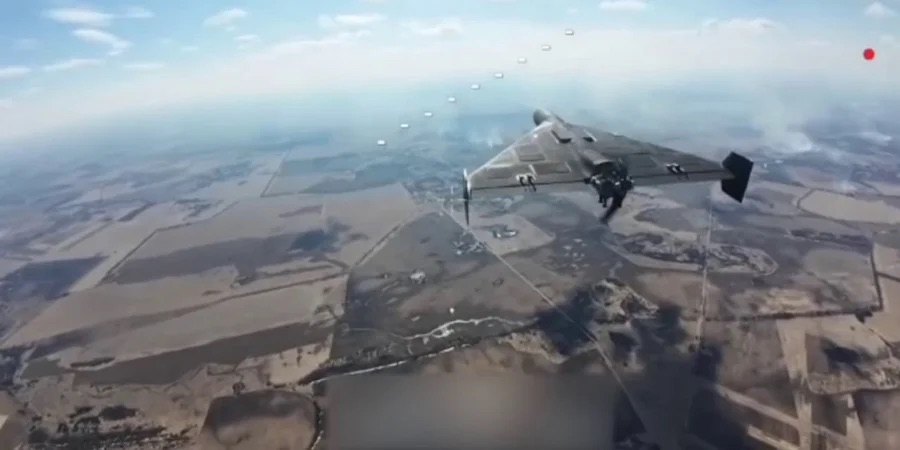
All this airborne rubbish reaches us from relatively stable directions — Oryol (the most popular), Kursk, the Millerovo airfield (Rostov Region), the Primorsko-Akhtarsk airfield (Krasnodar Krai), Donetsk airport, the Hvardiiske airfield and Cape Chauda (the Autonomous Republic of Crimea).
The main way most of these drones are launched is from the ground, using rail or catapult launchers. Often these launchers are mobile, mounted on lorries or pick-ups. This makes it possible to operate from unplanned and unprepared areas, quickly concentrate for a launch and disperse afterwards. But if the launch is of the first type, there is a need for ground infrastructure — so-called “drone ports”.
The enemy launches the Shahed-136 and “Geran-2” from a ground-based rail launcher. Typically, up to five UAVs are placed on one launcher. Launch is carried out using a solid-fuel rocket-assisted take-off booster (RATO). The booster accelerates the drone to a speed sufficient for flight, after which it is jettisoned and a piston engine with a pusher propeller starts up.
“Geran-3” (production has been halted; the enemy is firing off the remaining stock) and “Geran-4” (jet-powered) are also launched from rail launchers. Jet UAVs require longer rails (for example, the drone port near Tsymbulovo in Russia’s Oryol Region has rails of about 80 metres). Initial acceleration uses the same RATO or an equivalent, then the turbojet engine starts and the booster is jettisoned. Launchers for jet models are usually separate from piston ones and are more substantial.
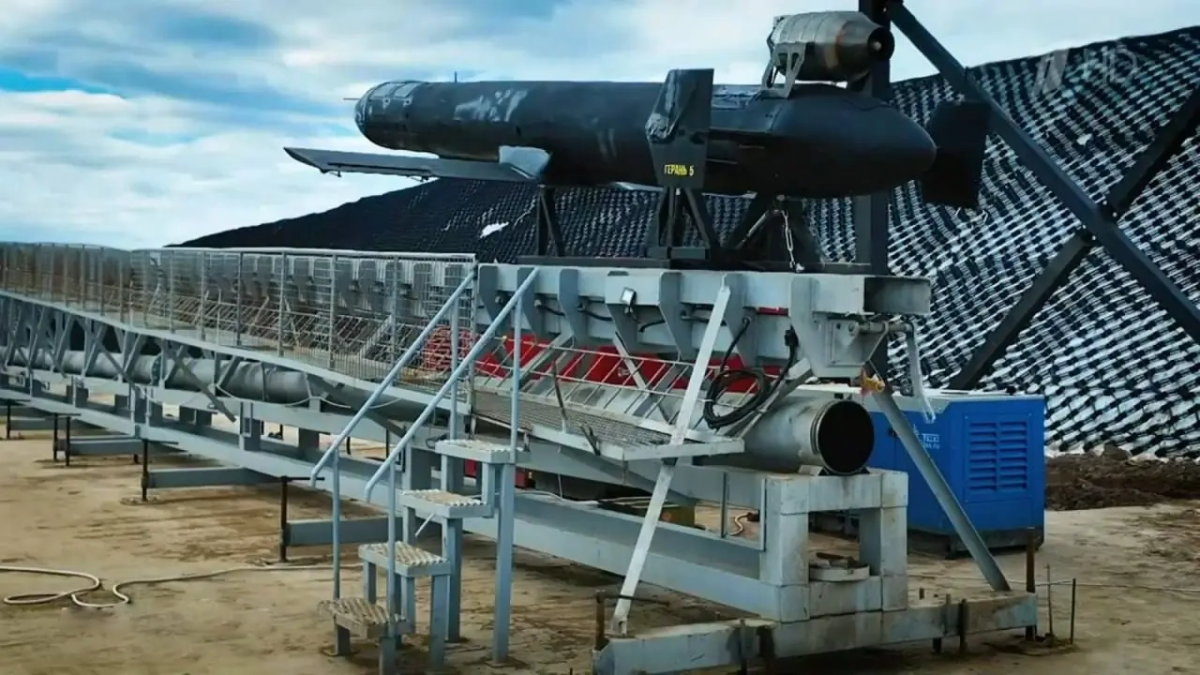
“Geran-5” takes off like the “Geran-4”, from long rails.
The Russians are working on the option of air launch — from Su-25 ground-attack aircraft and Mi-28N attack helicopters (a squadron of the enemy’s 39th Helicopter Regiment from the Dzhankoi airfield is doing exactly this, launching “Banderol” and the new “Dan-T” cruise missile from the airspace over the Sea of Azov). Air launch increases range and makes it harder to identify the launch site.
The decoy drones and reconnaissance drones that we set aside at the start of the text also take off from drone ports and move as part of strike groups in a single wave. That means the ground infrastructure has to be designed to launch them as well.
What does a typical drone port look like?
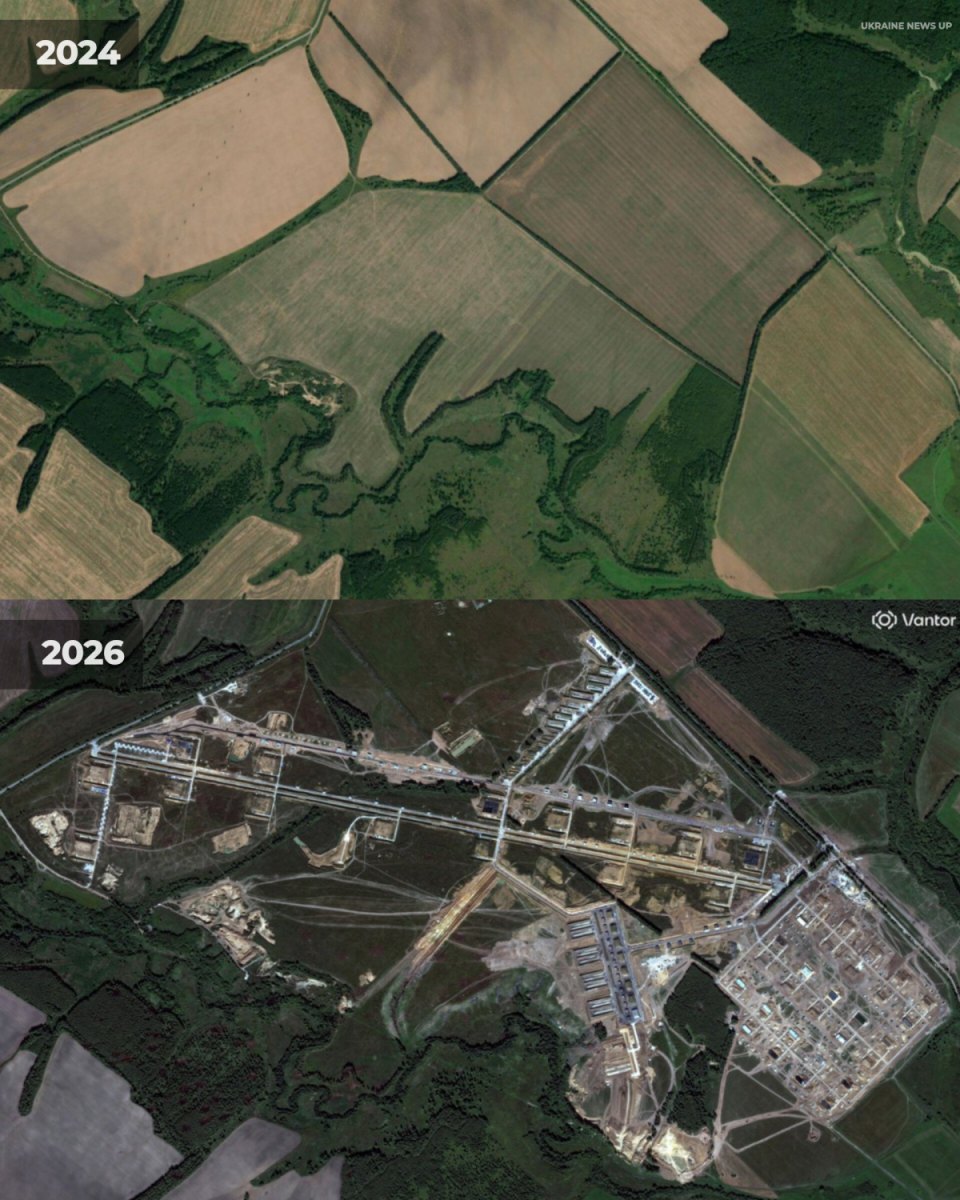
The largest today is the drone port in the village of Tsymbulovo in Russia’s Oryol Region. Until recently, it did not exist at all — there was a bare field where the base now stands.
The typical infrastructure of a Russian drone port consists of several main elements: launch positions (the most important component), which include stationary rail launchers (catapults). There may be anywhere from a few to 16 or more. Another element is long runways or roads for launching from mobile launchers mounted on lorries.
The Russians equip garages and hangars to store UAVs and rocket boosters. They can be small, for one or two drones; medium (for five or more); and large hangars or warehouses. Increasingly, storage sites are being set up in underground concrete structures. Open parking areas are needed, where UAVs are rolled out before launch. A preparation and servicing area is required — technical pads or hangars for pre-flight preparation, places to fit warheads, check electronics, refuel, and repair areas (hangars or shelters).
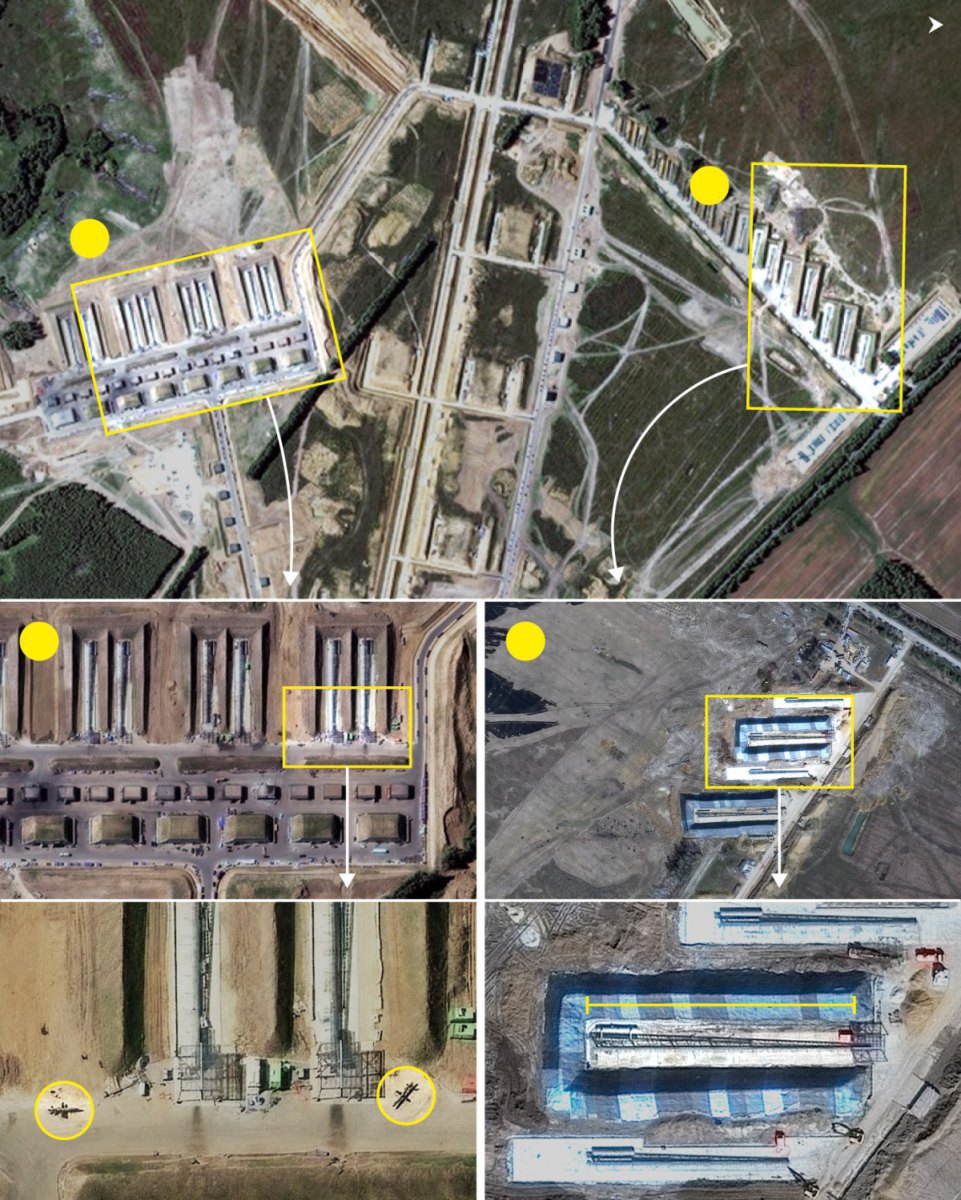
Drone-port operations are supported by auxiliary infrastructure — fuel depots, warhead storage, spare parts, power-supply facilities (diesel generators, transformers; in Tsymbulovo, solar panels for autonomy). All of this is connected by internal roads and access routes. As at any decent airfield (it may be unmanned, but it is still aviation), there should be a weather station, a communications hub, a position for radio-technical and navigation support units, an air-traffic control tower, and parking for vehicles (including mobile launchers). War also implies deploying air-defence positions, security, observation posts, and shelters for personnel around the drone port.
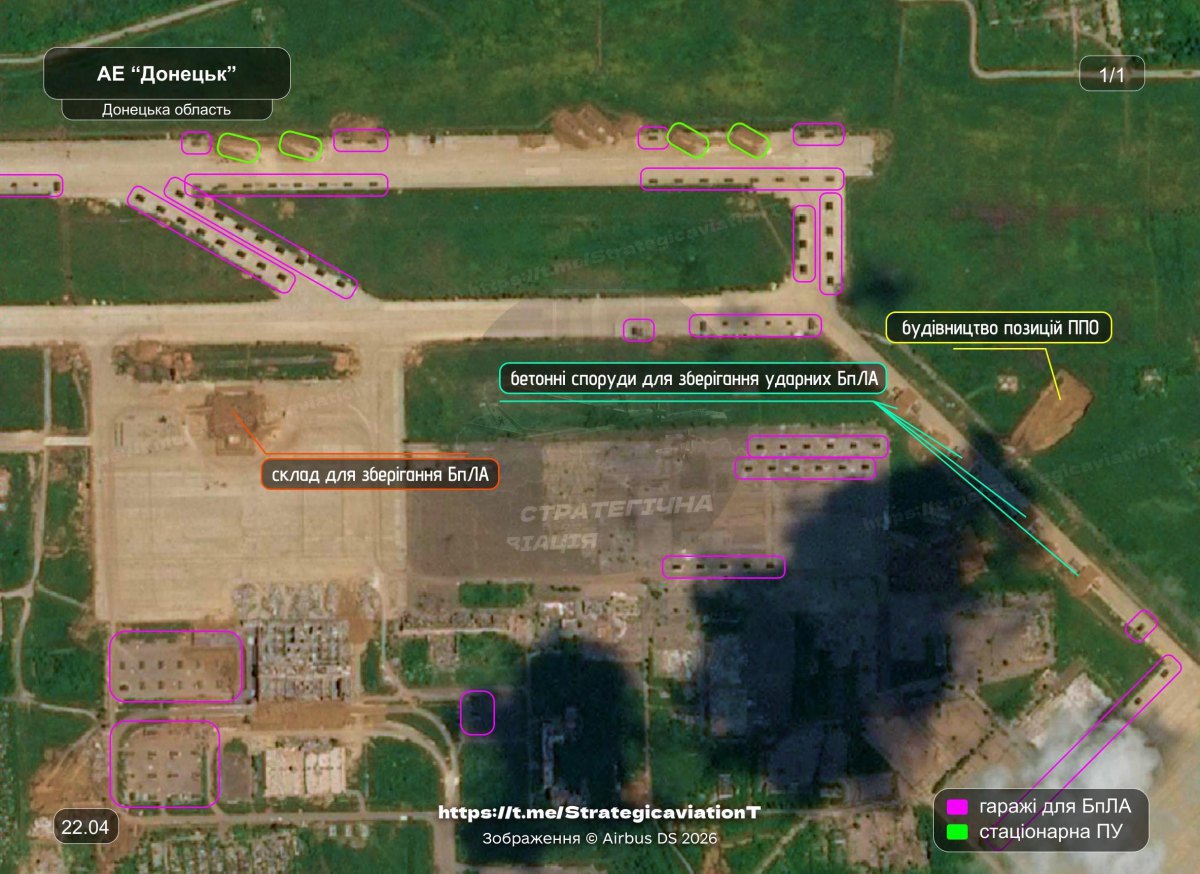
At large sites such as Tsymbulovo or Donetsk Airport, dozens and even hundreds of drones can be stored at the same time.
Drone ports or UAV launch sites have been identified at the Shatalovo air base in Smolensk Region, at the airfield in Yeysk in Krasnodar Krai, and elsewhere.
Once we understand how preparations for the use of strike UAVs are carried out, we can see that it is possible not only to intercept drones in the air over Ukrainian territory or destroy manufacturing plants, but also to actively target the places where they are stored, prepared and launched. Yes, this is a difficult task: destroying an underground concrete shelter is hard and costly (each individual storage site would need to be hit by a ballistic or cruise missile — preferably several), and stocks are dispersed over large areas, including beyond the drone ports themselves.
The most vulnerable targets appear to be stationary launchers and runways/roads. But this is not a panacea: they are restored fairly quickly, although time would be gained for our air defences and for the emergency and rescue teams restoring Ukraine’s critical infrastructure. With that in mind, such strikes are justified.
Air-defence engagements in southern Ukraine show that enemy drones are actively using a communications technology known as mesh. Mesh in Russian UAVs (“Geran”/Shahed, “Herbera” and others) is a decentralised radio network that allows drones to communicate with one another and with an operator in real time. Each drone is equipped with a mesh modem (mostly Chinese-made, for example the XK-F358 from Xingkai or equivalents). The modems create a dynamic network in which each drone acts not only as a receiver but also as a signal repeater for others. In other words, there is no single “main” node: each drone relays for every other. If one drone is shot down or its signal is jammed, data is automatically rerouted through other nodes in the network (a self-healing property). This makes it possible to significantly increase the range at which drones can be controlled (to 150–175 km or more from a ground station), receive video in real time, change route and target during flight (including guiding onto moving objects — trains, vehicles, and so on), and continue the mission even when a significant share of drones has been destroyed.
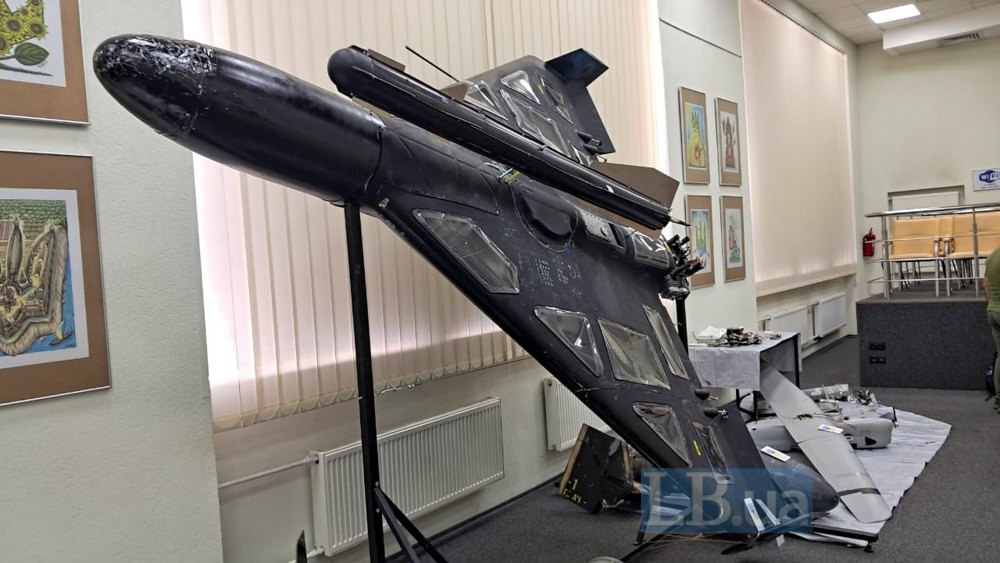
If previously most Shaheds flew to pre-programmed coordinates, with mesh they have become controllable almost like FPV drones, but at long range. That is why during strikes, for example on Odesa, information systems displaying the air situation very often show a single drone over the sea, which continues to act as the mesh network’s relay node until the very end. This is how the relay network for control signals and telemetry is built between the enemy’s UAV command post somewhere in Crimea and strike groups over the Ukrainian coastline.
Belarus and its game of switching mobile communications towers on and off cannot be ignored. Ground repeaters (radio towers and mobile communications antennas) on the territory of this would-be empire’s branch have played — and continue to play — the role of ground nodes in the mesh network. They receive a signal from UAV operators or from drones closer to the border, amplify it and pass it further into Ukraine. This gives the enemy the ability to control drones over Kyiv and across northern and western Ukraine, where direct radio communication from Russian territory does not reach. An additional bonus is a high-quality channel for video and route correction.
Border Guard Service intelligence and some other informed sources have recorded several such points (including in Homiel Region, near the border). They operate on TV towers or similar tall structures. In February and June 2026, their operation was temporarily halted (including after Zelenskyy’s ultimatum to Lukashenko). Periodically, the repeaters are reactivated.
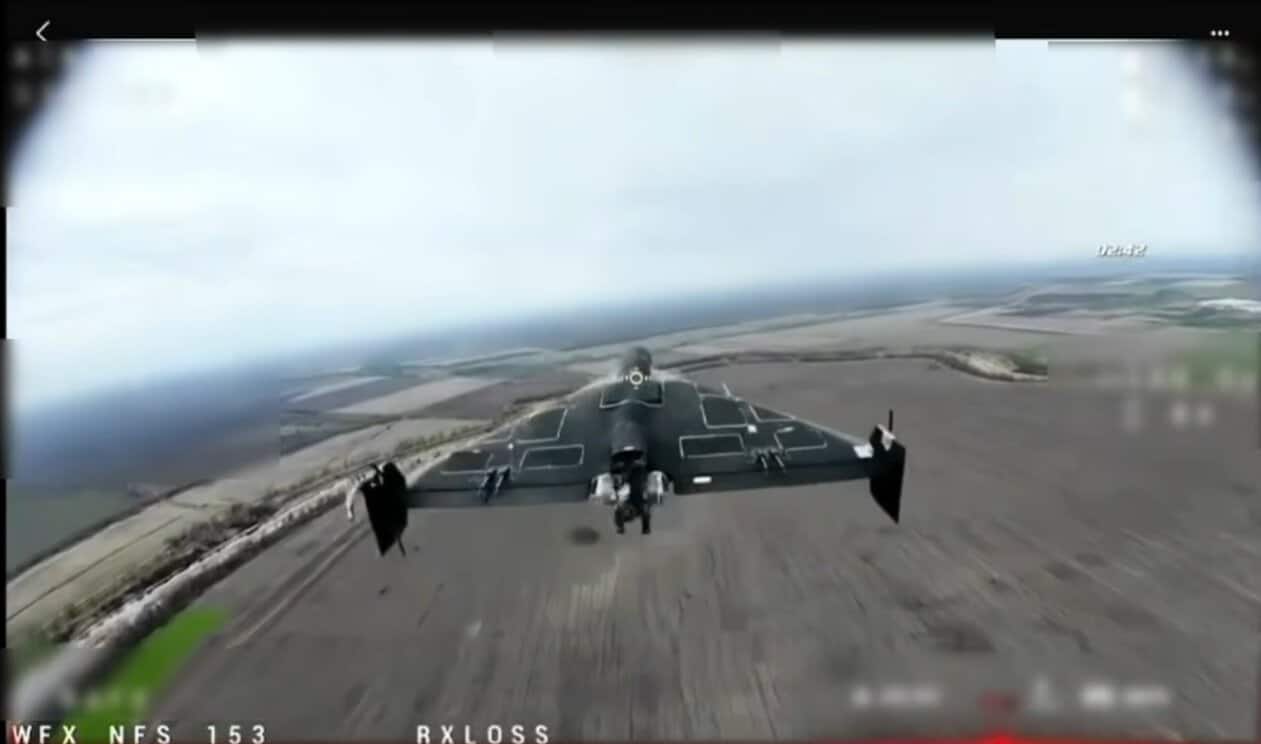
According to Serhii Beskrestnov, for roughly a year the Defence Forces have done almost no systematic work specifically to counter mesh technologies. And in general, the problem of repeaters on Belarusian territory cannot be solved by electronic warfare alone. The issue can be resolved, as they say in NATO, by “special or kinetic actions”. But today the political risks of such actions outweigh the potential gains.
Read also“We still don’t have a solution that will outjump the ‘Shahed’.” A conversation with the director of the Prytula Foundation about the search for means against jet-powered drones
Therefore, the Defence Forces have developed and continue to develop electronic-warfare capabilities able to suppress mesh communications. Specialised systems are already in operation (for example, “Shatro Anti-Mesh” from Unwave and other developments) that can suppress channels between mesh modems at ranges from several hundred metres to several kilometres. Some developments are tailored specifically against the mesh networks of jet-powered “Shaheds”. A suppressed modem deprives the drone of online control; the UAV switches to autonomous mode (flight by coordinates) or begins performing standard manoeuvres (a circle, a figure eight — whatever the autopilot is programmed to do when control is lost).
We can see that this scourge is not insurmountable, but countering it is a complex, multi-layered task — not only technical, but also tactical.