





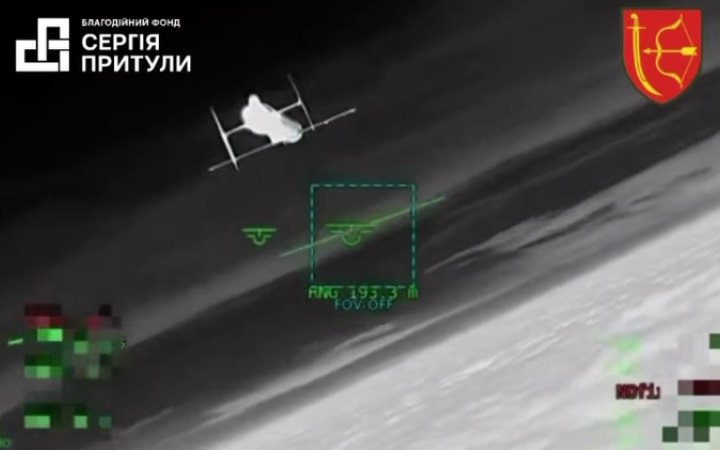
The “Hawk” crew of the 1020th Anti-Aircraft Missile and Artillery Regiment in the Chernihiv region destroyed a Russian Geran-5 drone missile using a jet interceptor. The Serhii Prytula Foundation published footage of the interception.
“For the crew, this was the first combat use of such a system, and for the Foundation it was the first time a high-speed target has been shot down by the latest interceptor less than a week after the purchase of such systems was announced,” the organisation said.
The Geran-5 is a Russian jet-powered strike UAV whose characteristics are close to those of missiles. Its range is up to 1,000 km. Russia began using it against Ukraine in early 2026.
As a reminder, the Serhii Prytula Foundation contracted interceptor drones of various types to counter jet-powered aerial targets in response to the changing nature of Russian air attacks. The Foundation explains that the need for a new generation of interceptors is growing because Russia is using jet-powered UAVs and drone missiles, which fly faster and significantly reduce the time available for response and interception.
Read also“We still don’t have a solution that will outmatch the Shahed.” A conversation with the director of the Prytula Foundation about the search for means to counter jet-powered drones
As Kyrylo Liukov, head of the unmanned systems department at the Serhii Prytula Foundation, notes, several manufacturers have already successfully completed range trials and confirmed the main tactical and technical characteristics of their developments. At present, certain solutions are being prepared for combat use by specialised units of Ukraine’s Defence Forces. The tests also showed that some interceptors are already capable of pursuing jet-powered UAVs and striking targets with a turbojet engine.
Ukraine is currently seeking ways to counter jet-powered drones at various levels. At the end of August, Defence Minister Yevhenii Khmara said that there are already four potential interceptors that can shoot down Russian jet-powered “Shaheds”.
In turn, Brave1 CEO Andrii Hrytseniuk said that to counter Russian jet-powered UAVs, the cluster is working in four areas:
-
turbojet interceptors with an engine like that of a cruise missile;
-
impeller-driven interceptors with electric propulsion — about eight times cheaper (the engine costs $500–1,000 versus $5,000–8,000 for a turbojet);
-
ultra-fast electric racing quadcopters capable of accelerating to more than 450 km/h;
-
means of shooting down “Shaheds” on head-on courses, which six companies are working on.