





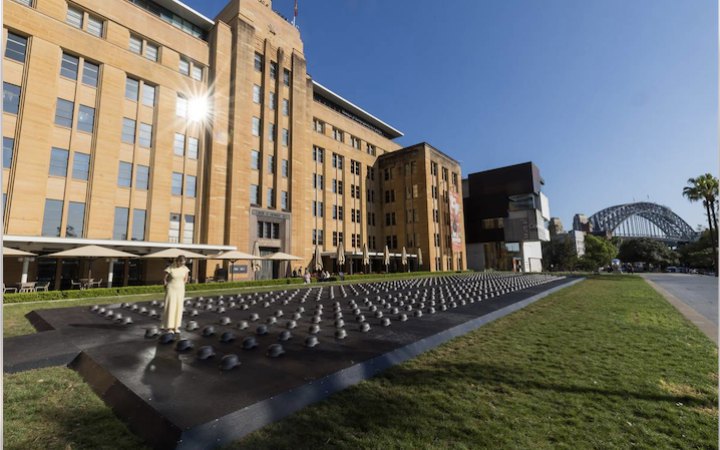
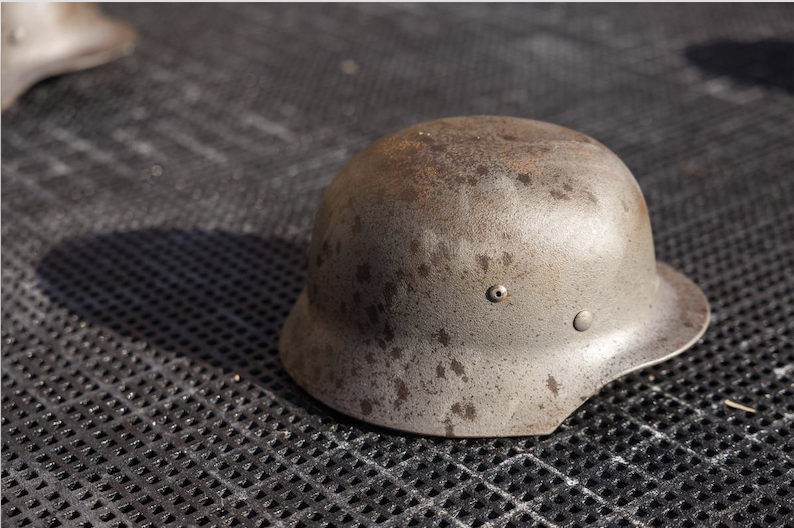
On 25 September, an installation titled Mushrooms by Chinese artist Ai Weiwei was unveiled outside the Museum of Contemporary Art Australia in Sydney, featuring 500 cast-iron combat helmets arranged in ten rows, The Art Newspaper reports.
According to the artist, the idea arose when Germany offered Ukraine 5,000 helmets for its military shortly before Russia’s full-scale invasion of Ukraine in February 2022. At the time, Germany’s response to an impending humanitarian catastrophe was condemned worldwide for being paltry.
As Ai notes, the work is a “metaphor and a warning” about how quickly humanity can slide into an age of darkness. Its title symbolises “growth in the dark” and “nuclear mushroom clouds”, and in Chinese the term also alludes to endless delays.
Ai stresses that it is not a “political joke”, but rather a demonstration of how superficial current national leadership’s understanding of human nature and possible future events can be.
“The history of civilisation spans only a few millennia, and in that time humanity has still not developed a clear understanding of the value of the individual, nor established sufficient constraints on the political actions of states, regimes, or interest groups,” Ai explains.
He adds that humanity remains in a state of uncertainty, in which the very foundations of human life are increasingly vulnerable to being destroyed. And what today is called civilisation, or the familiar sense of security, can disappear in a very short space of time.
Ai shares that although the modern era seems full of possibilities, he has never before felt humanity facing such a profound sense of uncertainty about the future as it is now.
“This uncertainty arises not only from the rapid development of society, technology and productive capacity,” Ai explains. “It is also driven by humanity’s deep immersion in the simple pursuit of material gratification and the gradual loss of the ability to reflect on the value of life itself.”
In his view, it is not only wars but also the rapid development of artificial intelligence that challenges many of humanity’s existing value systems, encompassing questions of trust and faith, as well as the increasingly distant and hostile relationship between individuals and society.
Ai added that the ability to speak openly about human rights and freedom of expression is “the last form of resistance available to humanity”. This idea formed the basis of the project.
The Mushrooms installation will be exhibited for seven months. It was presented as part of the Neil Balnaves Tallawoladah Lawn Commission programme, named after Australian philanthropist and businessman Neil Balnaves, who died aged 77 in a boating accident near Tahiti in 2022.
About Ai Weiwei:
- a contemporary Chinese artist and civic activist;
- has faced persecution for openly criticising the Chinese government over human rights;
- lived in the United States from 1981, and returned to Beijing in 1993 due to his father’s illness — the Chinese poet Ai Qing;
- since 2011, an honorary member of the Royal Academy of Arts, as well as a recipient of a number of honours, including the Václav Havel Prize for Creative Dissent and Amnesty International’s human rights award “Ambassador of Conscience”;
- in 2021, Ai Weiwei’s book 1000 Years of Joys and Sorrows: A Memoir was published;
- in 2025, at the Culture Pavilion at VDNH, Ai presented a sculpture titled Three Perfectly Proportioned Spheres and a Camouflage Uniform Painted White — in September 2026, the artist reported that the warehouse where the work was stored had been hit in a Russian attack by two ballistic missiles on 19 July 2026.