





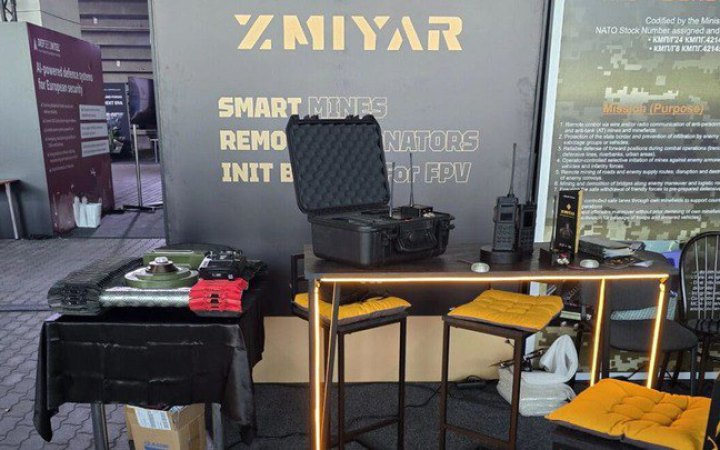
Ukrainian defence startup Zmiyar took second place at the IT Arena Startup Competition 2026 and received a cash prize of $20,000. This was reported on the Lviv IT Cluster Facebook page.
The company is developing a networked minefield management system that makes conventional mines “smart”: an operator can remotely activate or deactivate charges, monitor their status in real time, and see the mines’ locations on a digital map.
First place in the competition and the largest prize — $30,000 — went to energy startup Sirocco Energy. Third place and $10,000 went to Versi Bionics, a developer of bionic prosthetics.
Zmiyar is a Ukrainian defence-tech company from Kyiv, founded in 2023. The company manufactures military equipment for the Defence Forces. Its developments include electronic initiation systems for drone warheads and remote-control systems for minefields.
Lviv IT Cluster is a Ukrainian technology business association that brings together more than 300 companies and startups, as well as a community of over 100,000 specialists. Lviv IT Cluster is also the organiser of IT Arena, one of Ukraine’s largest technology conferences. The IT Arena Startup Competition is also held as part of the event. In 2026, 40 semi-finalists were selected to take part.
A separate defence tech category at IT Arena was launched in 2023 together with Brave1. However, this year there was no separate defence category: defence startups competed in the main Startup Competition alongside projects from other technology sectors. The total prize fund was $65,000.
This is what the list of winners in the separate category looked like in previous years:
In 2023 first place went to Himera with tactical radios (Software-Defined Radio). Second place was taken by Zvook, which develops microphones and audio technologies. Third place went to the Falcons team with a direction-finding system for radios, electronic warfare equipment and UAVs.
In 2024 the winner was Oko Camera — a Ukrainian developer of thermal imaging modules for UAVs. Second place went to Vidar Systems, which works in the field of acoustic technologies. Third place went to Norda Dynamics — a company that develops software for defence tech.
In 2025 first place was taken by Dwarf Engineering — a platform for B2B integrations between drone autonomy developers and manufacturing plants, which also creates its own Narsil autonomy module. Second place went to BabAI with its AI system for protection against enemy FPV drones. Third place went to Bravo Dynamics with a mesh communications system for Phantom 3.0 ground robotic complexes.