





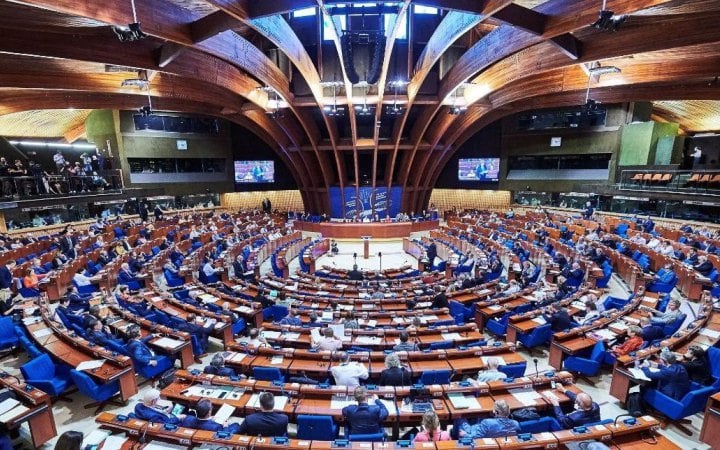
The Parliamentary Assembly of the Council of Europe proposes channelling frozen Russian state assets towards compensation for Ukraine and Ukrainian victims after the ECHR delivers judgments in inter-state cases.
This is stated in the text of the resolution approved by PACE.
The Assembly stressed that Russia owes more than €3.3bn in unpaid compensation under rulings of the European Court of Human Rights. The Russian Federation continues to ignore its legal obligations, refusing to comply with the Court’s judgments and to cooperate with the Council of Europe’s supervisory mechanisms.
In its resolution, PACE urged member states and observers to take concrete steps to address the situation. The Assembly also calls for countries’ national laws to be adapted so that the Court’s judgments can be enforced at domestic level.
In addition, PACE appealed to its members, as well as the EU, with a proposal to impose personal sanctions on those responsible for serious human rights violations recorded by the ECHR, including violations of the right to life, torture and slavery, and to apply universal jurisdiction.
Among the resolution’s other demands are to preserve all case materials in proceedings against Russia, protect the personal data of unlawfully deported Ukrainian children, and provide full information about them through a special international mechanism.
- The European Commission does not currently consider finding new ways to use frozen Russian assets for Ukraine’s benefit to be a top priority. In Brussels, they are first trying to determine Ukraine’s actual financial needs.
- According to the Financial Times, the European Commission is looking for a mechanism that would be more acceptable, in particular, to Belgium. In that country, the Euroclear depository holds most of the Russian central bank assets frozen in Europe.