





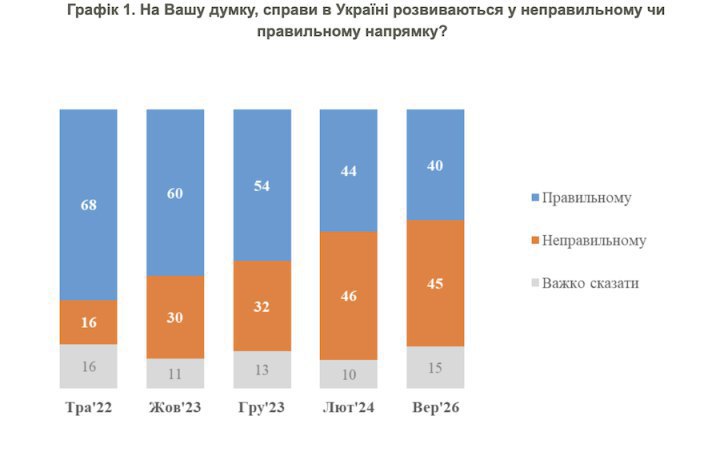
45% of surveyed Ukrainians believe that, overall, things in Ukraine are moving in the wrong direction. Another 40% are convinced the direction is right, while the rest were unable to decide, according to the results of a survey by the Kyiv International Institute of Sociology (KIIS).
The last time such a survey was conducted was in February 2024. The figures from that survey and the new one are almost identical: there are slightly fewer people saying the direction is right (down from 44% in February 2024 to 40% now), but there is no statistically significant change in the share saying the direction is wrong (46% then and 45% now).
“Instead, there are slightly more people with undecided views (10% then and 15% now),” the results say.
Among those who fully trust the President, 39% believe the direction of affairs is wrong or were unable to decide on an answer. 61% consider it right. Among those who rather trust him, the share who consider the direction of affairs right falls to 54%.
Among those who do not trust the President, the majority believe the direction of affairs is wrong.
Sociologists also examined the emotions Ukrainians feel towards the authorities. Survey participants were read a list of 12 feelings or emotions, from which respondents were asked to choose up to three answers.
“Most respondents spoke of disappointment (44% of all respondents, up from 36% in December 2025) and shame (33%, up from 20%). Next come answers such as hope (23%, the same as before), anger (20%, up from 14%), compassion (16%, unchanged), hatred (14%, up from 11%), and indifference (12%, up from 7%). Relatively few respondents spoke of sympathy (4%, unchanged), laughter (4%, unchanged), or pride (7%, unchanged),” the survey says.
From 12 to 21 September 2026, the Kyiv International Institute of Sociology (KIIS) conducted its own nationwide public opinion survey, “Omnibus”, to which, at the request of the NGO “Forum”, questions were added about the direction of affairs in the country, what Ukrainians feel towards the current authorities, and some other questions. A total of 1,002 respondents were surveyed using the CATI method, based on a random sample of mobile phone numbers across all free territory of Ukraine. Formally, under normal circumstances, the statistical margin of error for such a sample (with a probability of 0.95 and taking into account a design effect of 1.3) did not exceed 4.1% for indicators close to 50%, 3.5% for indicators close to 25%, 2.5% for indicators close to 10%, and 1.8% for indicators close to 5%. Under wartime conditions, in addition to the stated formal error, a certain systematic deviation is added.