





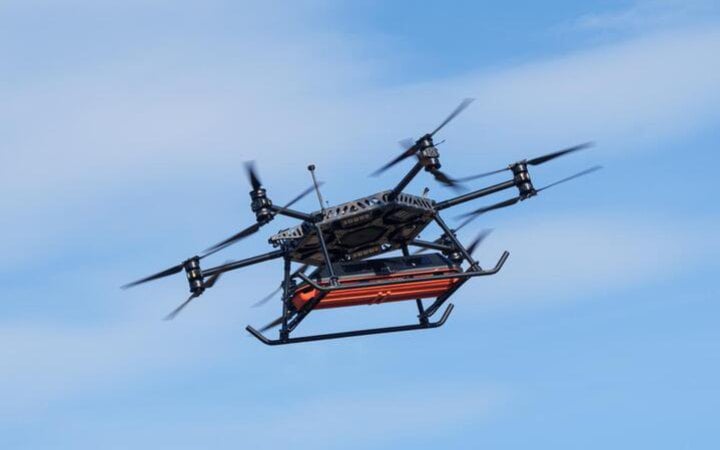
Ukrainian defence technology company SkyFall has unveiled the StarGate unmanned aircraft for airborne medical evacuation of the wounded. Associated Press reports this, after its journalists attended a field demonstration of the drone.
According to a company representative, the idea to develop such a drone emerged in response to a request from the military. Last year, the commander of the 475th Separate Assault Regiment, known as Code 9.2 and using the call sign “Flint”, approached SkyFall’s founder with a request to develop a safer way to evacuate wounded soldiers from hard-to-reach positions.
Associated Press notes that Code 9.2 fighters have to move on foot to a front-line position to retrieve the wounded, because vehicles there are vulnerable to drone attacks. The unit also uses unmanned ground systems to evacuate casualties and deliver supplies, but they typically need two to three hours to reach the position. The time depends on the distance, road conditions and the threat from the air, the commander of Code 9.2 said.
“Covering 10 kilometres in a matter of minutes would be a game-changer on the front line,” he said.
Read alsoEvacuating a wounded person from the kill zone: how units cope, what options exist, and what the military and political leadership thinks
According to the manufacturer, StarGate’s one-way range is 15 kilometres, potentially allowing it to reach severely wounded soldiers who have been trapped deep inside the strike zone.
Developers say StarGate can carry a payload of up to 150 kilograms. That is enough to transport a wounded soldier wearing body armour and carrying combat gear, the company said. The drone’s medical compartment is built around a stretcher.
The drone’s stated cruising speed is 65 km/h, with a maximum of up to 105 km/h. SkyFall says preparing the aircraft for flight takes about 10 minutes.
StarGate’s design has been modified several times. Improvements include brackets for easier transport, medical stretchers, and upgraded software and protection.
StarGate uses two communications channels — Starlink and the company’s own L-Link system — as well as an artificial intelligence-based system that helps maintain control when satellite navigation is unavailable.
According to a company representative, the drone is flown manually, but it has several AI functions that allow it to operate without GPS, as well as in situations where signals are spoofed or operating frequencies are jammed by electronic warfare systems.
If communications are lost entirely, developers claim StarGate can independently plot a route to a safe area. The drone is designed to operate in rain and snow, and for night missions it is equipped with thermal imaging cameras.
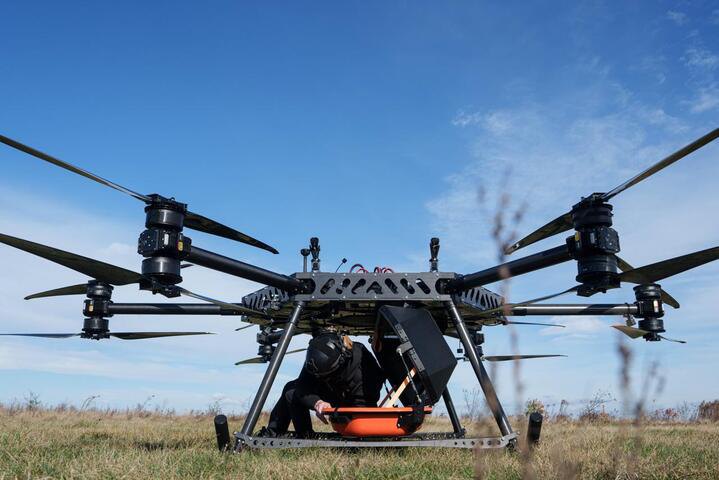
Developers also say the drone has demonstrated the ability to continue flying after losing one of its engine-mounted brackets. During tests, the unmanned aircraft also demonstrated a defence system against attacking FPV drones using a net launcher.
This week, the military began testing the drone on the front line. However, according to the commander of Code 9.2, it is still too early to draw conclusions. The unit needs at least a month of working with the drone before it can provide substantiated statistics on its effectiveness.
“This is an entirely new way of evacuation. At the moment it’s difficult to speak in detail about the advantages and disadvantages. We need to work with it more,” he said.
SkyFall estimates the cost of one system at at least $50,000, depending on the configuration. By the end of 2026, the manufacturer plans to produce up to 1,000 units a month.
SkyFall emerged after the start of the full-scale invasion in 2022 and manufactures drones. Its heavy Vampire drone, known to the Russian military as “Baba Yaga”, is used by Ukrainian forces for combat missions. The company produces the heavy Vampire UAV, the Shrike FPV, and P1-SUN interceptor drones.