





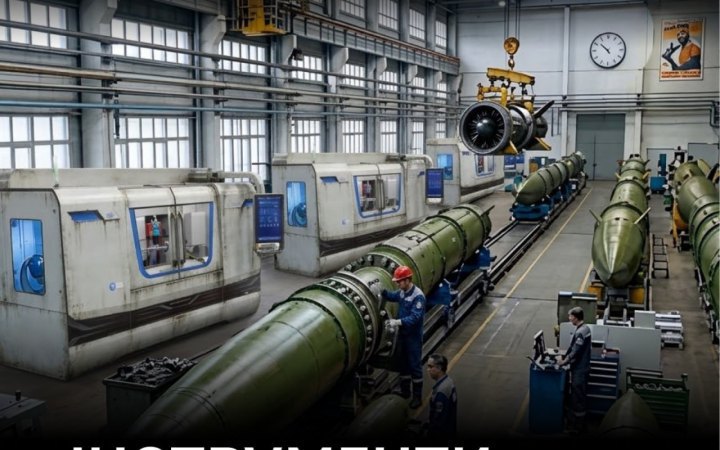
Ukraine’s Defence Intelligence (HUR) on the War&Sanctions portal published data on 30 items of foreign-made technological equipment used by enterprises involved in Russia’s ballistic weapons production chain.
According to the intelligence report, Russia’s defence industry is heavily dependent on foreign technologies. In particular, despite all efforts, the Russian Federation is still unable to replace industrial equipment from global manufacturers with localised equivalents.
The intelligence service released details of technological equipment made in China, Germany, Taiwan, the United States, Turkey, Switzerland and Italy that is used by Russian plants manufacturing ballistic missiles and their components: altimeters, aerodynamic control fins, gyroscopes and more. A notable trend is the growing number of Chinese machine tools and machining centres, including five-axis models. Chinese machines use European, Japanese and Taiwanese components: CNC systems, servo drives, high-precision spindles and bearings, measuring and rotary systems, linear guides, thermal stabilisation tools and machining process monitoring, among others.
On HUR’s list:
- a five-axis universal machining centre GX-650 made by Hyper Machine Tool (PRC), used by the Votkinsk Plant, which produces 9M723 Iskander-M ballistic missiles and the missile section of the Kh-47M2 Kinzhal aeroballistic missile;
- Shtral turning and milling machining centres (PRC) involved in the production processes at JSC “PEMZ Molot”, which manufactures electronic equipment units for Iskander-M missiles;
- measuring equipment from German manufacturer Rohde & Schwarz installed at UPKB “Detal”, which produces altimeters for Zircon missiles.
The intelligence service noted that, to deprive the aggressor of the ability to continue the war, it is necessary, among other things, to:
- tighten end-user controls and verification of the actual place of use of products, including introducing on-site inspections by authorised representatives at the declared equipment installation address;
- extend enhanced control procedures to spare parts, components, technical fluids, consumables, software, updates and servicing required to operate the equipment;
- conduct regular audits of distributors, dealers and other intermediaries, especially those supplying higher-risk jurisdictions, and identify signs of re-export or a change of end user;
- investigate cases where a manufacturer’s products are found in Russia’s military-industrial complex, establish supply chains and take steps to stop further deliveries via the relevant intermediaries;
- restrict supplies of CNC systems, tooling and other components to Chinese manufacturers that supply their equipment to enterprises in Russia’s defence industry.