





For a long time, Ukraine has built its partnership with the United States along the following tracks: military assistance, sanctions pressure on Russia, and political support in international forums. This partnership will be tested by Trump and will remain one of the most important for the Ukrainian state, despite all the ups and downs both countries have faced since the blue-and-yellow flag of independence first flew over Kyiv.
The History of the Relationship
The United States recognised Ukraine as an independent state on 25 December 1991 by a decision of President George H. W. Bush — the very day Gorbachev resigned. Official diplomatic relations between Kyiv and Washington were established on 3 January 1992, just nine days later. According to US State Department data, total American support for Ukraine from 1991 to 2014 amounted to around $5bn across all areas combined: dealing with the aftermath of Chornobyl, social exchanges, economic assistance, support for democratic elections, anti-corruption programmes, and energy.

Ultimately, we have come a long way — from roughly $5bn in humanitarian and democracy support over the first 23 years of independence to roughly $120–125bn in military and financial support since 2022: the scale of co-operation increased by orders of magnitude after Russia’s full-scale invasion.
At the same time, the experience of recent years shows that the scale and dynamics of this relationship warrant a separate, specially designed approach in the form of a formalised concept/strategy — just as euro-atlantic integration or the country’s recovery and reconstruction have (or will later have).
Today, Ukraine has a number of regional foreign-policy or communications strategies, is working on updating the Foreign Policy Strategy of Ukraine, and has security memoranda with dozens of countries. The logical next step would be to complement this architecture with a separate, clearly articulated approach to relations with the United States.
The Case for It
The practice of adopting dedicated foreign-policy strategies towards specific countries is widespread among democracies. In July 2023, Germany adopted its first-ever China Strategy. It was developed by the Foreign Ministry, and agreement within the coalition gave the government a broad political mandate to implement it. Norway has separate co-operation strategies with India (2018) and Brazil (2011, updated in 2025). In 2018, Australia approved a detailed Economic Strategy for India through to 2035, with defined priority sectors and even a focus on specific regions within the country. Sweden and the Netherlands adopted their own strategic documents on China in 2019.
The closest example to Ukraine’s realities is Lithuania: on 15 May 2024, its government approved Strategic Guidelines for relations with the United States, and the Foreign Ministry later adopted an action plan for 2025–2027. The document aims to maintain Washington’s political attention and the US military presence in the Baltic states, strengthen contacts with the administration and Congress, and ensure regular high-level bilateral dialogue.

It is also telling that the United States itself has an Integrated Country Strategy (ICS) for every country, including Ukraine, while Ukraine has no comparable document for its key partner.
The current 2021 Foreign Policy Strategy lists the United States among Ukraine’s priority partners. It was adopted before the full-scale invasion and the subsequent change of US administration, and it defines five different types of strategic relationships with 13 states. Given Ukraine’s critical dependence on the United States in the areas of security, intelligence, financing post-war reconstruction and recovery, as well as sanctions pressure on Russia, a dedicated US strategy modelled on Lithuania’s approach (guidelines plus a multi-year action plan) would be a logical and well-grounded step for Kyiv.
The United States’ permanent seat on the UN Security Council, the already-mentioned substantial volumes of military and financial assistance (despite difficulties felt since January 2025), and its influence on global security processes — all of this shapes a relationship that differs from co-operation with other partners in both character and mechanisms of engagement.
A separate strategy is also advisable because the American political system works differently from the European one. In Europe, support for Ukraine is largely institutionalised: EU decisions have longer inertia and depend less on a change of a single leader, although they can be blocked by certain mechanisms when consensus is required.
In the United States, by contrast, support is more personalised and cyclical, as it is reviewed with each election, each change in the composition of Congress, and the agenda of a new administration. A dedicated strategic document (or integrating a distinct strand into an updated Foreign Policy Strategy) would make it possible to track these cycles systematically and adapt communications and priorities in advance, rather than building a new approach from scratch each time.
There is a third argument too: a potential that should be unlocked more fully. This is about the diaspora, veterans’ and religious communities, university networks, and state and local levels of government in the United States, which often hold more stable attitudes towards Ukraine. A separate strategy would make it possible to turn work with these communities from ad hoc campaigns into a consistent long-term policy of building bottom-up support in American society.
The scale of this potential is clear from the statistics. According to the Migration Policy Institute (MPI), based on the 2024 American Community Survey, the Ukrainian diaspora in the United States numbers around 1.4 million people who were born in Ukraine or have Ukrainian heritage. After 2022, the Ukrainian community grew noticeably: the number of people from Ukraine exceeded 510,000, 28% more than in 2021.
Even more importantly, support for Ukraine in American society has long since extended beyond the diaspora itself. In the first year of the full-scale war alone, US citizens submitted more than 216,000 applications to personally sponsor Ukrainians. These applications came from 9,766 postcodes across all 50 states, with the largest numbers from New York, Illinois, California, Washington, Florida, Pennsylvania, New Jersey, and Ohio.
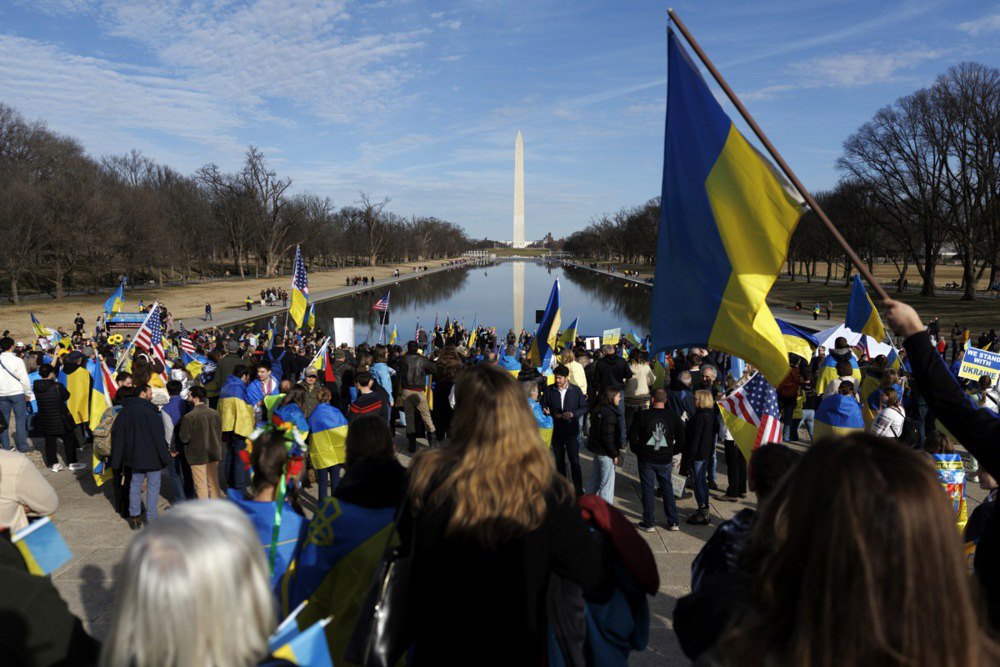
So, there is a broad geographic network in the United States of families, communities, and churches with a personal connection to Ukraine, spanning both “blue” and “red” states. A dedicated strategy could systematically engage precisely this kind of network to build stable support for Ukraine that is independent of the political cycle.
Finally, a separate strategy provides agency. With a clear document setting out priorities and a horizon for the relationship, Ukraine comes to Washington with its own agenda, rather than merely responding to what the other side proposes. This is not only about framework agreements, but about the ability to formulate and defend Ukraine’s interests consistently.
Key Elements of a US-Focused Foreign Policy Strategy
If we talk not only about the need for such a document but also about its content, several cross-cutting strands stand out.
First — the security and defence-industrial track that goes beyond the “donor–recipient” logic: joint weapons production, localisation of American technologies in Ukraine, participation by Ukrainian manufacturers in NATO or US defence-industry supply chains, and producing US missiles for Patriot PAC-2 GEM-T and PAC-3 in Ukraine.

Second — systematic work with Congress and both parties: engagement with relevant committees, pro-Ukraine caucuses, the staff of members of Congress who shape the agenda regardless of who is in the White House, think tanks, non-profits, and lobbying organisations.
Third — subnational diplomacy: governors, state legislatures, sister cities, and chambers of commerce often take a more stable and pragmatic approach to relations with Ukraine and can help balance frequent swings in national politics.
Fourth — the economic and investment track: attracting American private capital for reconstruction, working with the DFC, and developing agreements such as the resources deal that go beyond purely military assistance.
Fifth — the diaspora and public diplomacy as one of the foundational tools of such a strategy: systematic work with the Ukrainian community, veterans’ organisations, and church and university networks as a political resource that influences members of Congress locally.
Each of these strands exists today separately and on an ad hoc basis, in the form of specific projects or initiatives. A strategy is, above all, a way to bring them into a single logic, with clear goals, responsible institutions, and performance indicators.
This raises the question of format. It could be a standalone strategic document, by analogy with regional strategies. Or it could be a dedicated, fully fledged section within a new Foreign Policy Strategy of Ukraine. Both options make sense, and the choice between them is a matter of legal and bureaucratic expediency.
But whatever the format, the main thing is that relations with the United States receive their own logic of presentation, their own goals and indicators in the final document, and do not dissolve into general wording. Such a document would add predictability to bilateral relations.