





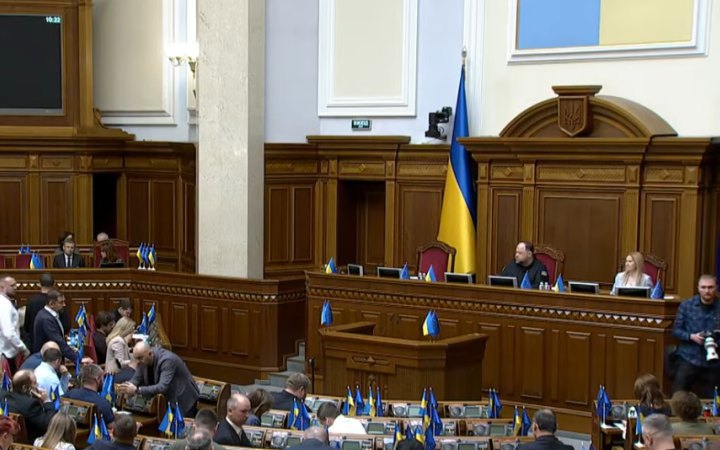
Today, 29 October, MPs adopted an appeal calling on the international community not to recognise the results of the elections to the 9th convocation of Russia’s State Duma.
As became known from the Verkhovna Rada broadcast, this concerns Resolution No. 16091.
A total of 250 MPs voted in favour.
The Verkhovna Rada appealed to the UN, the European Parliament, parliamentary assemblies and governments around the world, urging them not to recognise the legitimacy of the elections to Russia’s State Duma or their results.
As stated in the explanatory note to the document, the aggressor state’s holding of elections in the temporarily occupied territories of Ukraine is an encroachment on the sovereignty and territorial integrity of our state and an attempt to impose the political and state institutions of the occupying power on the occupied population.
“No voting under conditions of occupation, military presence, coercion, persecution and imposed citizenship can produce a legitimate expression of will or create for the Russian Federation any rights whatsoever with regard to the territories of Ukraine,” it says.
The authors of the document add that, in the international legal order, democratic elections are one of the fundamental mechanisms for the legitimate formation of state power, and that adherence to generally recognised democratic principles and electoral standards is a necessary condition for international trust and the legitimacy of representative bodies.
States that recognise and share these principles should proceed from the fact that elections cannot be used as a formal procedure to legitimise authoritarian rule, aggression, occupation or the illegal annexation of another state’s territories.
Recognising such “elections” sets a precedent for undermining the shared rules of international coexistence and, in effect, encourages states to use “electoral procedures” as a tool to cover up unlawful actions. Therefore, non-recognition of such “elections” is necessary to preserve the international democratic order.
- The Parliamentary Assembly of the Council of Europe recognised the elections to Russia’s State Duma held on 18–20 September as fictitious and illegitimate in view of the suppression of the political opposition, the barring of anti-war candidates, the mass imprisonment of dissenters and the absence of independent international observers.
- And the European Union is preparing sanctions against individuals who organised the Russian “elections” or stood as candidates in the temporarily occupied territories of Ukraine.
Today, 29 October, MPs adopted an appeal calling on the international community not to recognise the results of the elections to the 9th convocation of Russia’s State Duma.
As became known from the Verkhovna Rada broadcast, this concerns Resolution No. 16091.
A total of 250 MPs voted in favour.
The Verkhovna Rada appealed to the UN, the European Parliament, parliamentary assemblies and governments around the world, urging them not to recognise the legitimacy of the elections to Russia’s State Duma or their results.
As stated in the explanatory note to the document, the aggressor state’s holding of elections in the temporarily occupied territories of Ukraine is an encroachment on the sovereignty and territorial integrity of our state and an attempt to impose the political and state institutions of the occupying power on the occupied population.
“No voting under conditions of occupation, military presence, coercion, persecution and imposed citizenship can produce a legitimate expression of will or create for the Russian Federation any rights whatsoever with regard to the territories of Ukraine,” it says.
The authors of the document add that, in the international legal order, democratic elections are one of the fundamental mechanisms for the legitimate formation of state power, and that adherence to generally recognised democratic principles and electoral standards is a necessary condition for international trust and the legitimacy of representative bodies.
States that recognise and share these principles should proceed from the fact that elections cannot be used as a formal procedure to legitimise authoritarian rule, aggression, occupation or the illegal annexation of another state’s territories.
Recognising such “elections” sets a precedent for undermining the shared rules of international coexistence and, in effect, encourages states to use “electoral procedures” as a tool to cover up unlawful actions. Therefore, non-recognition of such “elections” is necessary to preserve the international democratic order.
The Parliamentary Assembly of the Council of Europe recognised the elections to Russia’s State Duma held on 18–20 September as fictitious and illegitimate in view of the suppression of the political opposition, the barring of anti-war candidates, the mass imprisonment of dissenters and the absence of independent international observers.