





Canada will join the EU’s supercomputer network, Politico reports.
On Thursday, European Commission President Ursula von der Leyen said that Canada “will now become part of this network”.
According to von der Leyen, Canada’s accession “will give Canadian industry, start-ups and researchers access to European supercomputing resources”.
“Combined with Canada’s advanced artificial intelligence industry, this will allow us to develop highly competitive, innovative and secure artificial intelligence systems,” she noted.
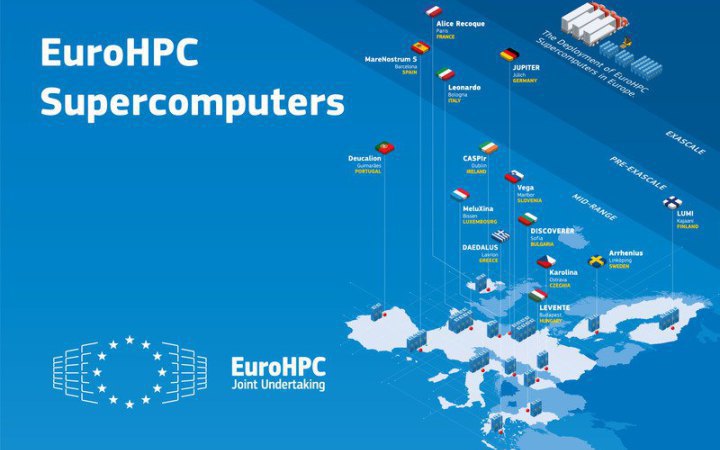
The EU’s supercomputer network is run by the EuroHPC Joint Undertaking – an EU public-private partnership structure with a budget of €8.2 billion. The network includes 14 supercomputers (some of which rank in the global top 10), 19 specialised facilities for developing artificial intelligence (so-called “AI factories”), and 10 quantum computers.
This structure will also oversee seven large-scale data centres for artificial intelligence needs – so-called “AI gigafactories”, construction of which is planned for next year, with total investment amounting to €30 billion.
Experts welcomed the potential cooperation between the EU and Canada in computing capacity, but noted that this is only the beginning.
“Cooperation on computing capacity is one of the most obvious short-term options for cooperation between mid-sized players in the AI field,” said Anton Laicht, a fellow in the Technology and International Affairs programme at the Carnegie Endowment for International Peace.
At the same time, he added that for now such cooperation “does not reduce the actual dependence on the United States”.
- Canada’s participation in the EU supercomputer network is a continuation of its previous partial involvement in the EU’s flagship research and innovation programme, Horizon Europe.
- Horizon Europe partially funds EuroHPC.
- To date, 38 countries have joined the EU supercomputer network: the EU’s 27 member states, as well as a number of non-bloc countries, including Norway, Switzerland, the United Kingdom, Israel and Turkey.