





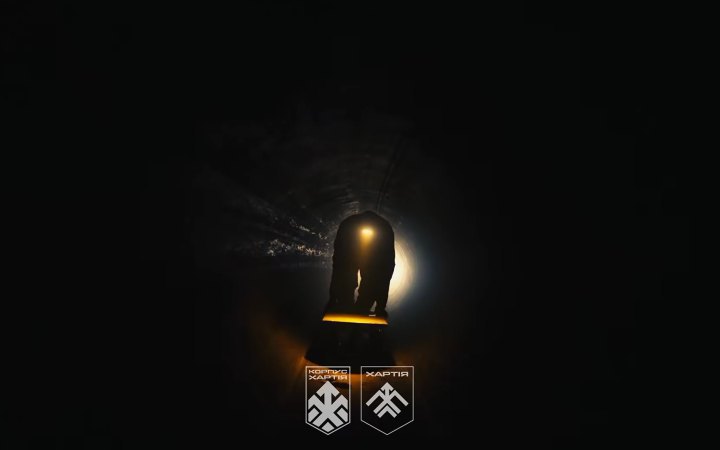
As part of Operation Veles, servicemen of the 2nd Corps of the National Guard of Ukraine’s Khartiia unit set up a transport network inside the pipes of an abandoned gas pipeline on the Kupiansk axis. In particular, they developed homemade scooters for moving personnel. Khartiia engineers with the call signs “Leshy” and “Sam” spoke about building the underground system in a video.
On the Kupiansk axis, the Russians used the gas pipeline pipes to infiltrate the city unnoticed. With the sky swarming with enemy drones and movement on the ground difficult, Khartiia fighters decided to deliver an asymmetric blow to the occupiers — to use the underground pipeline and turn their own tactics against them.
Adapting the pipe for combat tasks, the servicemen say, was difficult because of residual petrol there and the associated risks. They took oxygen cylinders with them and moved by crawling in short stretches.
“Every 100–200 metres we carried out reconnaissance, with the risk of not getting out of the pipe alive, because gas remained there. From the first hole in the pipe, gas pressure came out and the petrol ignited. We couldn’t put the fire out for a week. We called it ‘dragon fire’. Fortunately, no one was killed or injured,” says “Sam”.
Eventually, to make moving through the pipes easier, the servicemen began using trolleys. Later they came up with special “scooters”. The first “scooter” prototype was made in a day. The platform can carry more than a tonne of cargo. It is used to deliver ammunition, equipment and troops to positions, as well as to evacuate the wounded.
Over the past six months, the design has received several modifications. The first version could move only in one direction. To turn it around, fighters had to widen certain sections of the pipe and use winches.
Later, the servicemen developed a two-way model they called “Cat-Dog”. It can move forwards and backwards without turning around — on the principle of the underground, where the driver moves to the other controls. The unit is not disclosing other modifications at this time.
“Moving on all fours is difficult — after all, we’re intelligent people. So we came up with equipment: electric-powered ‘scooters’. We call them ‘cat-dog’. It’s the simple underground principle — there’s one handlebar on one side and another on the other. The driver switches to the other handlebar and goes the other way. Maintaining the ‘scooters’ isn’t very difficult; they’re as simple as possible and easy to repair,” explains “Leshy”.
The unit is currently working on simplifying the design so that servicemen can repair it themselves without specialised technical skills. The kit includes spare parts and tools for maintenance.
“This is the delivery of combat kits, food and supplies for the troops, and the evacuation of the wounded and the dead. Right now, there is no safer and faster route for evacuating the ‘three-hundred’,” explains “Sam”.
As a reminder, the underground counter-offensive Operation Veles on the Kupiansk axis became known in late October. The grouping under the command of the 2nd Corps of the National Guard of Ukraine’s Khartiia unit combined the underground offensive with actions on the surface and drone strikes. As a result, the occupiers were denied the ability to get into Kupiansk’s rear, and Ukrainian troops advanced more than 15 kilometres through underground communications.