





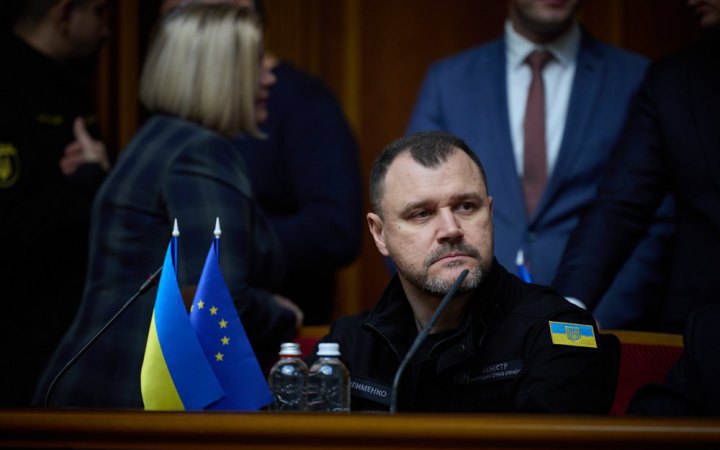
NSDC Secretary Ihor Klymenko said he does not know who exactly the members of the criminal group linked to the “KhimProm” drug syndicate were referring to when they spoke about people who could have put pressure on him while he was serving as Minister of Internal Affairs. Speaking to journalists on 6 November, he noted that NABU had confirmed it was trying to identify those individuals.
Klymenko says he does not know who is being referred to, either among his close circle or more distant contacts. He explained the mention of his surname and that of Ukraine’s Minister of Health in the suspects’ conversations as follows:
“As for the mention of the Minister of Internal Affairs and the Minister of Health, I can say it was normal for them — just ‘chatter’ between two criminals, if I may put it that way, sorry for the slang. That’s how they discussed ways to solve their problem among themselves. And we were a real problem for them.”
Klymenko said he would rather not answer the question of whether he sees elements of pressure on him and his work through the highlighting of his surname in the context of this investigation. He believes that, hypothetically, singling out a specific surname on the recordings could be a form of pressure, but he is not sure whether that is the case here.
Asked whether he was surprised to hear his surname on the audio recordings, the NSDC Secretary said he was “gobsmacked” when he heard it.
The Ministry of Internal Affairs and the Ministry of Health spent about two months preparing the resolution banning the substances whose products were sold in the U420 chain, . The document set out the substance’s chemical formula in order to ban it and, accordingly, make it possible to shut down the shops distributing it. In recordings of the suspects’ conversations published by anti-corruption bodies, they discussed attempts to bribe Klymenko so that the resolution would not include the formula covering U420 products. One of those involved suggested that, instead of trying to reach an agreement with the minister, they should reach an agreement with people who would put pressure on him.
“Look, nobody approached me at all. I didn’t have any such conversations with anyone. Putting pressure over drugs and over the Cabinet of Ministers resolution — what they meant by that, well, did they put pressure, as you can see? The resolution exists, U420 doesn’t,” he said.
Klymenko added that the police began investigating U420’s activities before the high-profile investigation by Bihus.info.
However, the searches of the chain — which ultimately, thanks to the adopted resolution, led to its closure — took place only after the journalists’ investigation.