





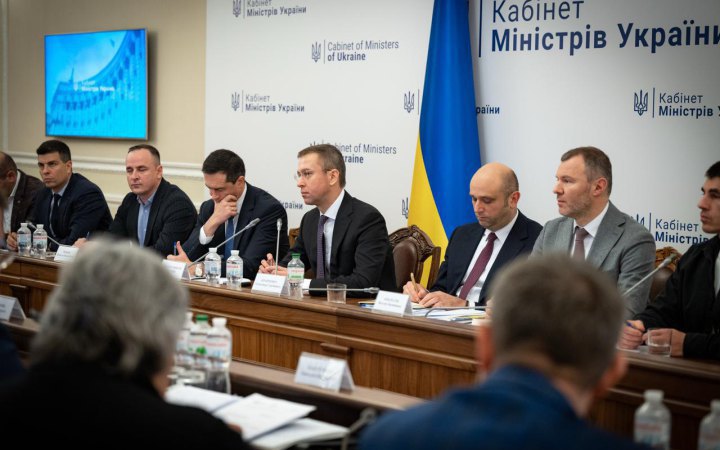
The government plans to launch a war-risk insurance fund in 2027. Its model and possible sources of funding were discussed during a meeting with representatives of the engineering, metallurgy, food, pharmaceutical and light industries, the defence industry and other large enterprises.
This was reported by Prime Minister Serhii Koretskyi.
According to him, one of the main problems for industrialists remains access to lending.
Businesses note that outside the state “5-7-9%” programme it is difficult to obtain loans. Therefore, the Prime Minister instructed the Ministry of Economy to hold a separate meeting with state-owned banks and develop solutions to launch as soon as possible a lending programme of up to UAH 1 billion with compensation of 5.5 percentage points of the interest rate.
The relevant Cabinet of Ministers resolution has already been adopted. They are also to work through the issue of currency liberalisation.
They also discussed value added tax refunds. According to Koretskyi, due to delays in international financing, the government temporarily restricted spending. After the necessary laws were adopted and part of the funds from partners was received, most payments were resumed.
In October, businesses were refunded UAH 25.9 billion in VAT, and in November a further UAH 5.6 billion. The amounts whose payments had been suspended due to a lack of funds in the Treasury account were settled in full.
Another issue was energy supply for industry. The Ministry of Energy is working to improve the mechanisms for enterprises operating amid an electricity shortage. In particular, they plan to create conditions for the stable operation of those facilities that cover their own consumption through electricity imports and their own generation.
The government also discussed export logistics. The Ministry of Infrastructure was instructed to explore the possibility of allowing private locomotives onto Ukrzaliznytsia’s tracks and simplifying cargo inspections at border crossing points.
For metallurgical enterprises, negotiations with the European Union have been stepped up on increasing quotas for Ukrainian metal products and on the CBAM carbon border adjustment mechanism.
In addition, the government plans to continue the “Made in Ukraine” policy programmes in 2027. According to Koretskyi, despite limited resources, funding for these programmes has been included in the draft state budget for next year. Localisation will continue to be one of the tools to support Ukrainian manufacturers.