





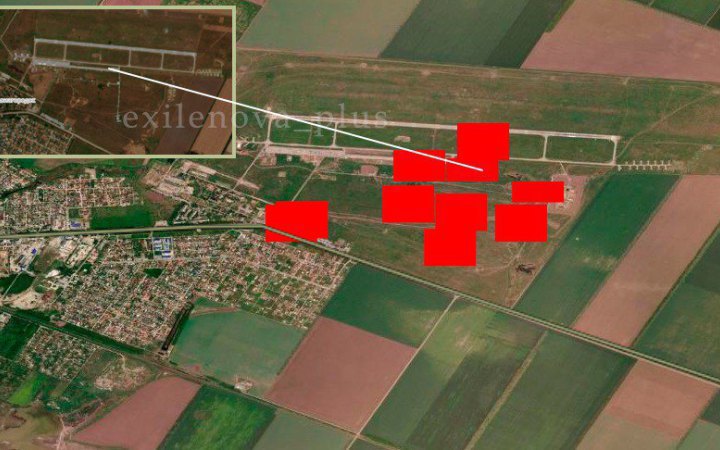
Over the next five days after the strike on Primorsko-Akhtarsk, the Russian Federation attacked with approximately 89 Shaheds per day. And there were already a steady 160-180. Of course, including decoys.
There are no hundreds of loitering munitions per day yet, and Ukrainian long-range drone strikes on launch sites affect the effectiveness and number of Shahed launches and false targets. Even if they are accumulating for several large attacks, those attacks should have already taken place.
Although, of course, it's not just long-range drones.
Eleven stations were knocked out on the branch line leading to Primorsko-Akhtarsk. Despite the fact that a Shahed weighs 240 kg and is easily transportable by truck, it is natural that they are transported from Yelabuga by rail. This is because their wings are not removable. To save resources, it is easier to transport hundreds of drones on railway platforms.
Therefore, schedule disruptions, the destruction of electrification sections, the redirection of crude oil from damaged refineries to storage and other plants also indirectly affect the number of launches.

The second factor is strikes on the production chain. The VNDIR-Progress plant in Cheboksary produces electronics, including the Kometa antenna array, while the Scientific Research Institute of Applied Chemistry in Sergiev Posad produces thermobaric warheads. It is quite clear that it is impossible to stop production even with a dozen ‘fierce’ strikes, but it is quite realistic to slow down the number of daily launches in Ukraine.
In addition, in mid-June, there was an attack on the workshops producing Shaheds in Yelabuga — perhaps this decline is also due to that. But most likely, it is a complex effect.
And, of course, the successful dip strike on the Primorsko-Akhtarsk airfield. Despite the fact that all launches are carried out by mobile units in off-road vehicles, there are buildings near the runway where pre-flight preparation, field repairs and software updates take place, and flight tasks are entered.
At least two such hangars were destroyed, and one was seriously damaged. A strike was delivered on the site where aviation ammunition is stored on the ground — either reconnaissance revealed a stockpile of warheads, or the Russians simply brought in rotten ammunition that was about to expire for some purpose. Therefore, secondary detonations damaged nearby buildings. Numerous traces of fires on the concrete — probably damaged racks of barrage ammunition.
This is already a loud wake-up call about the degradation of air defence — if it is not possible to protect the railway, at least four purification units at the oil refinery with a capacity of up to 40,000 tonnes per day have been knocked out, and an attack on one of the few airfields from which Ukraine is being bombed has been missed, then what can air defence protect at all?
Read alsoRussian Railways on fire
Putin's water disco and Medvedyev's dacha?
Once again, to understand what is happening correctly: the daily weight of long-range drone warheads on both sides is several tonnes, most likely between 3 and 4, while the Su-24's payload is 9 tonnes.
Therefore, fantasising about how we will carry out production with three tonnes per day is a strange and not entirely adequate pursuit.
Yes, loitering munitions are more accurate than cast iron, but in past wars, dozens of half-ton bombs hit targets where shrapnel destroyed equipment. Every day for years, 55 squadrons of the Red Army pounded the Axis countries with thousands of tons of cast iron.
And it was impossible to achieve blackouts or knock out fuel or bearing production. Therefore, our maximum task now is to prevent Russia from increasing the number of sorties per day and to strike at those industries that will force the Russian Federation to use up its gold and foreign exchange reserves.
Artificial transformers at traction substations, electronics workshops, military chemistry, transshipment, storage and oil refining. Our task is to push the enemy in the back and not let them push us in the back.
The strike on Primorsko-Akhtarsk is a good example of such a strategy.
Equipment for loading flight missions, ammunition, hangars for training and routine maintenance, tools, drone supplies — all of this requires money and time and is difficult to scale, and any failure in pre-flight preparation affects the daily number of Shahed flights.