







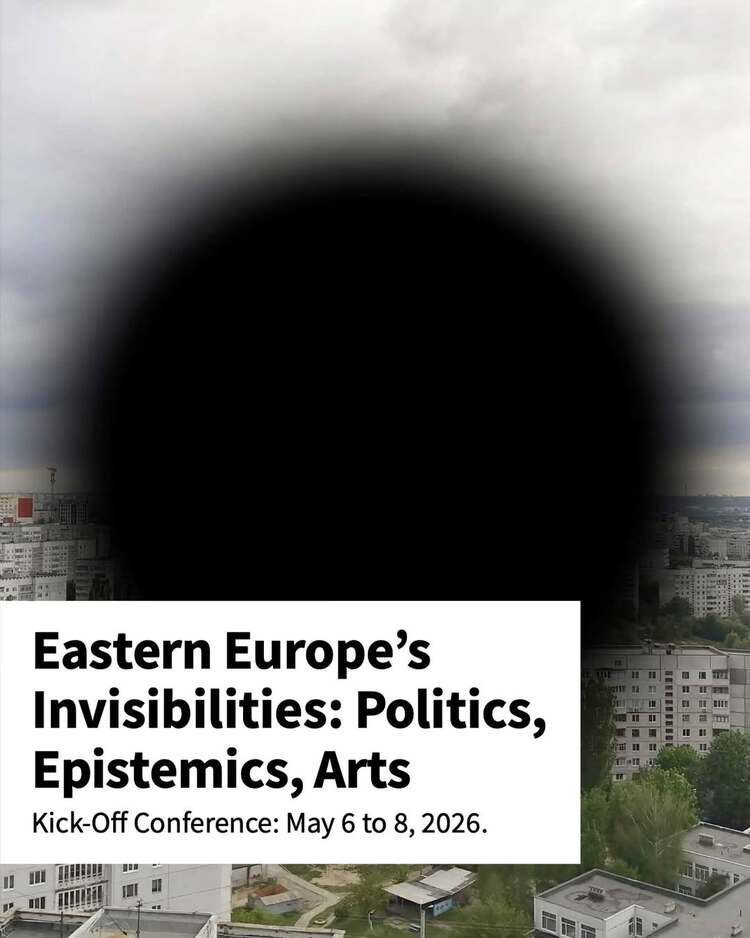
The University of Zurich will host the opening of the Institute of Slavic and East European Studies. To mark the occasion, an international conference entitled Eastern Europe’s Invisibilities: Epistemics, Politics, Arts will take place from 6 to 8 May, focusing on themes of invisibility, concealment and working ‘in the shadows’ within political, intellectual and artistic processes.
The guest of honour at the conference will be the Belarusian Nobel laureate Svetlana Alexievich. On 6 May, she will deliver the keynote address to open the event.
In parallel, the Strauhof Literary Museum in Zurich will host the opening of the exhibition Svetlana Alexievich: Chornobyl. Archive of an Invisible Catastrophe, dedicated to her book on Chornobyl. The opening is scheduled for 16 April. On 7 May, as part of the conference, there will be a public discussion featuring Svetlana Alexievich, the exhibition’s curator Filina Bickhardt, and researcher Silvia Zasse. The event will conclude on 8 May with the awarding of an honorary doctorate from the university’s Faculty of Arts to Alexievich.
The conference’s key questions centre on how invisibility is formed, experienced and overcome, and what this means for Eastern Europe and Eastern European studies. Participants will discuss how perspectives from the region help to better understand contemporary political transformations, as well as how they can contribute to the formation of a critical stance in the face of disinformation and rising authoritarianism. Particular attention will be paid to the interaction between Eastern European studies and post- and decolonial approaches, and their emancipatory potential.
According to the organisers, an important context for the discussions will be the experience of post-socialist transformations since 1989, in particular the opening of archives, including the partial declassification of secret service materials, as well as Russia’s full-scale invasion of Ukraine. It is precisely these processes that have made much of the ‘invisible’ visible in academic research.
The focus will also be on the question of what shapes the observer’s perspective, how facts are reinterpreted and perceptions transformed, and what conditions make this possible. Discussions will address who produces invisibility and how, why it is obvious to some and imperceptible to others, and what practices contribute to the ‘disappearance’ of people, phenomena or experiences from the public sphere.
A separate section will be devoted to when invisibility is a consequence of violence, and when it is a strategy of power, powerlessness or resistance. Participants will also examine the role of art and the humanities in identifying, understanding and overcoming invisibility.