






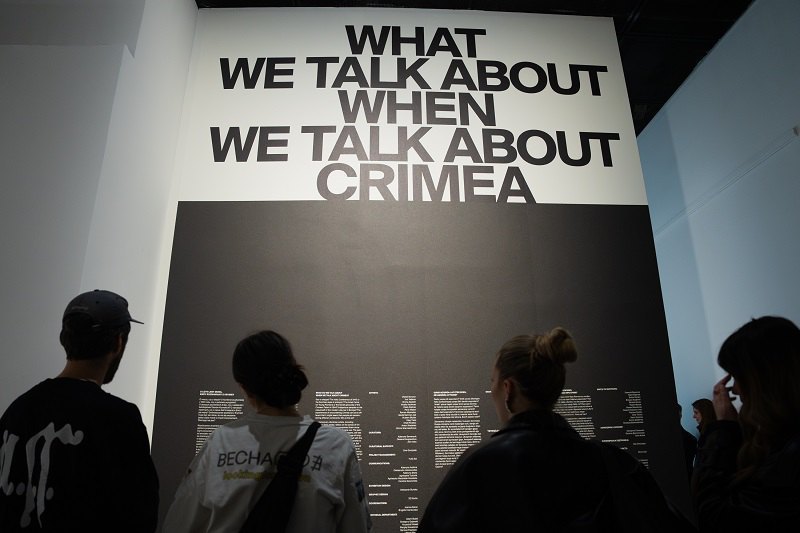
The curatorial project for an exhibition on Crimea in Poland, conceived by the Ukrainian Institute, was proposed by the Memory Platform Past / Future / Art. In their introductory remarks, the curators encourage viewers to perceive Crimea not only as the south, but also as the north. They previously explored this reimagining of familiar associations in 2024 at the First Malta Biennale, where Odesa was discussed not as the south of the former Russian Empire, but as the north of the Mediterranean. However, whilst this positioning appears entirely organic within the context of a biennial focused on Mediterranean countries, in a dialogue between Ukrainian artists and Polish audiences this shift in perspective functions more as a conceptual device, as for both countries Crimea remains geographically southern, regardless of former imperial frameworks.
The exhibition, comprising 12 works, occupies five rooms of the art centre. Approximately one third of the artworks feature video; in addition, there is a video statement by the curatorial team and a kinetic sculpture. Moving media are interwoven with static forms — including graphics, painting and photography — and this combination lends the exhibition a dynamic character.
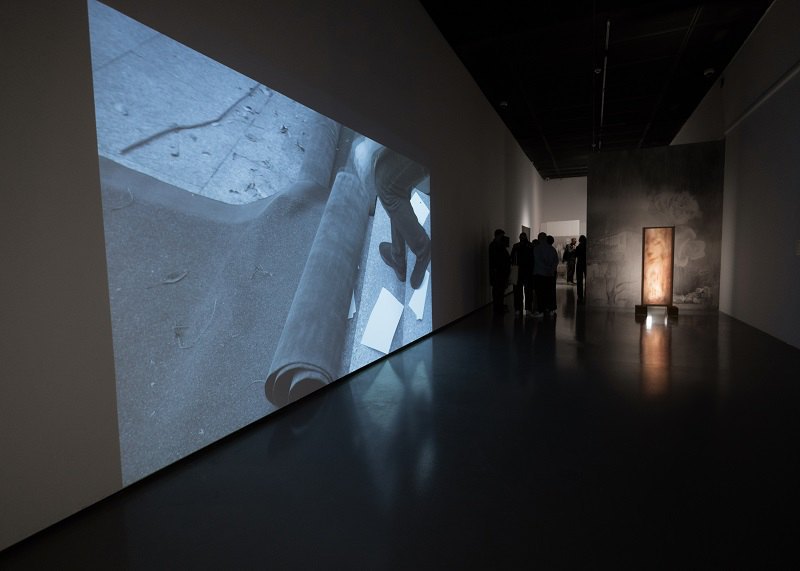
The curators have devoted a significant portion of the exhibition to the theme of the Crimean Tatars, explored by artists of Crimean Tatar descent. Inevitably, their works are imbued with motifs of a lost homeland. An entire wall of one room is occupied by video documentation of a new performance by Khalil Khalilov and Vlodko Kaufman: the artists are seen unrolling and rolling up strips of roofing felt that mimic the carpet runners on the stairs of Ujazdowski Castle. “Roofing felt is a very cold, hard, toxic material,” explains Khalilov, “yet it constantly accompanied the Crimean Tatars during deportation and provided warmth.” A tumbleweed rolls down the stairs between the strips of roofing felt, scattering twigs. The Crimean Tatars call this steppe plant biñ baş, meaning ‘a thousand heads’ — a transparent metaphor for a people torn from their roots. This work continues Khalilov and Kaufman’s series of ‘Crimean’ performances; their next is scheduled for 16 April, on the eve of the anniversary of the deportation, also at the Ujazdowski Castle Centre for Contemporary Art.
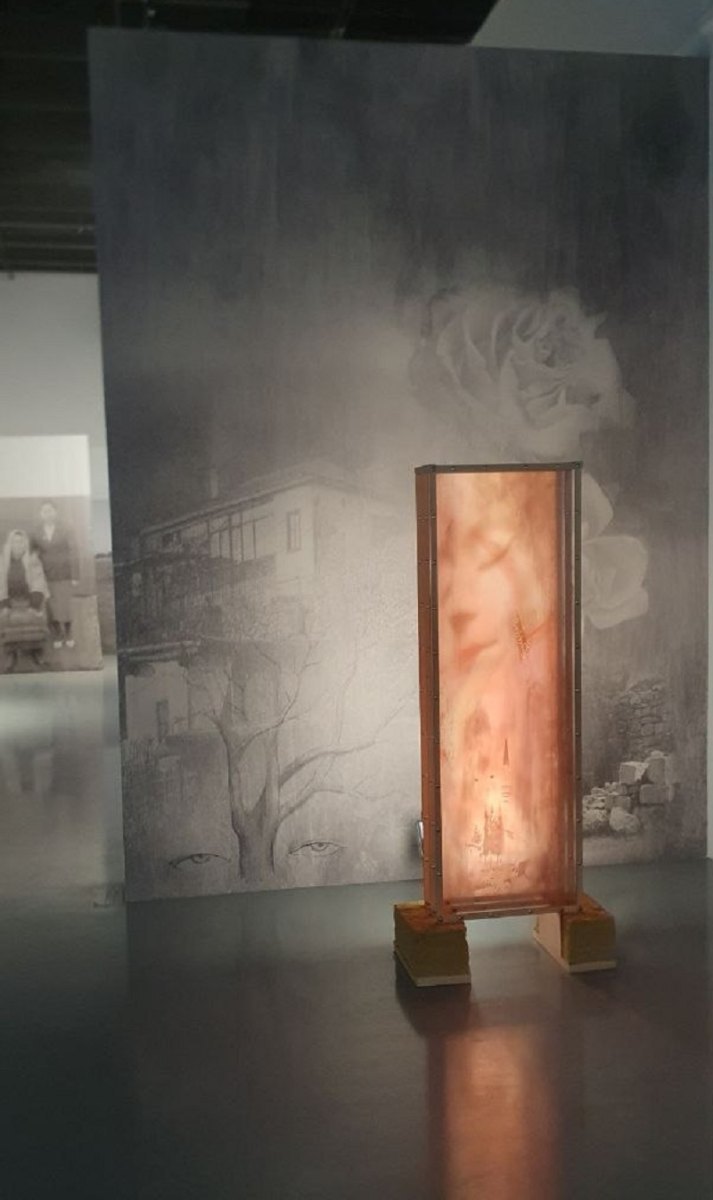
The second (and final) work created specifically for this exhibition is an installation by Sevilâ Nariman-qizi. In the Crimean Tatar language, this suffix denotes the plural. Set against a black-and-white wall drawing that imitates a photo wallpaper of ‘Crimea in bloom’, the artist has placed three transparent pink panels, each bearing faded drawings of a building, trees and faces. These images are based on the shell bricks used to construct homes by Tatars returning to Crimea in the 1990s. The work reflects on the cyclical nature of memory, with forgetting presented as its inevitable counterpart.
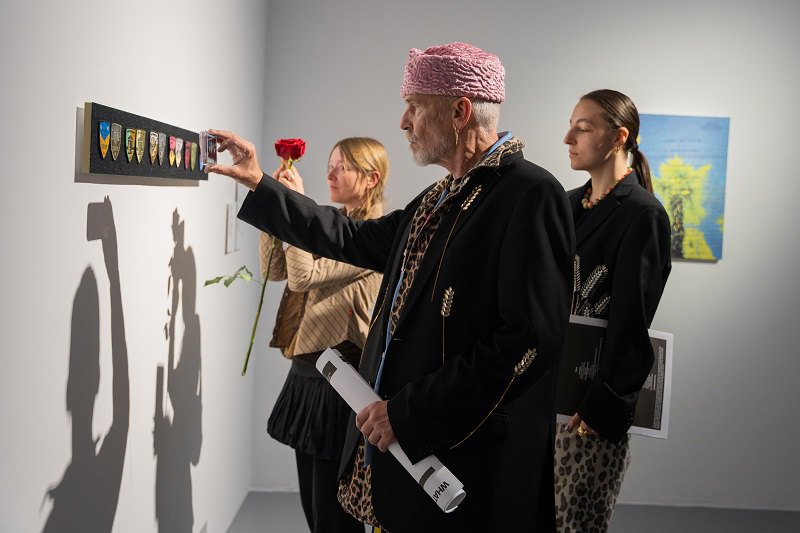
Sevilâ Nariman-qizi once studied at Rustem Skibin’s El-Cheber studio — he serves as a link connecting the generation of deported Crimean Tatar artists with those that followed. The exhibition features Skibin’s work Crimean Tatar Military Identity — a series of 12 chevronswith ornamental designs, created following consultations with specialists in the military history of the Crimean Khanate. This is not the first artistic engagement with the theme of military insignia: for instance, Yevhen Ravskyy designed symbols for the brigade in which he serves, drawing on historical heraldry. According to the curators, some members of the Ukrainian Armed Forces wear Skibin’s chevrons to emphasise their particular commitment to the liberation of Crimea from occupying forces.
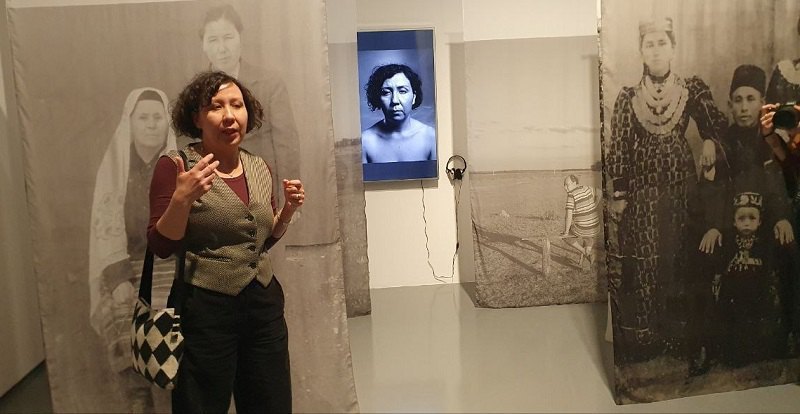
Kyiv audiences were able to see Emine Ziyatdin’s installation I Am My Father’s Daughter last autumn at the Garage 33 gallery. It comprises photographs printed on fabric, ranging from a 1914 image from the family archive to a photograph taken by the artist in 2020. Suspended between the fabrics is a screen showing the artist’s face; against a backdrop of water, she states: “I am my father’s daughter.” The absent father emerges here as a symbol of the trauma experienced both by the artist’s family and by the nation as a whole.
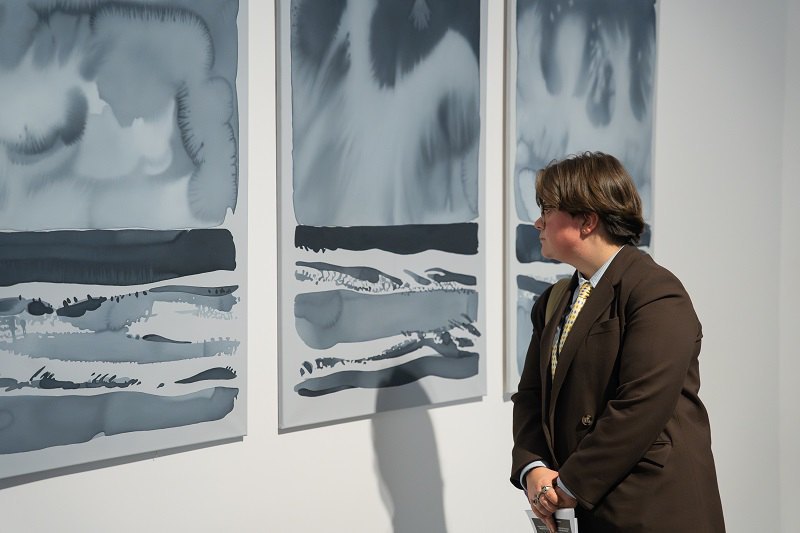
Elmira Shemsedinova’s series of paintings, Tense Horizon, consists of semi-abstract, near-monochrome seascapes executed in oil to mimic the effect of watercolour. The artist created the series in 2022–2023 as a reminiscence of the sketches she painted on the Crimean coast until 2014. Devoid of detail and colour, these works resemble faint memories of lost places.
It is noteworthy that works by artists of Crimean Tatar origin are not isolated into a separate section of the exhibition, but are interwoven with those by artists born in Crimea or closely connected to the peninsula. The curators neither exoticise the voices of Crimean Tatar artists nor position them in opposition to others; nevertheless, differences in the perception of Crimea between these groups remain discernible.
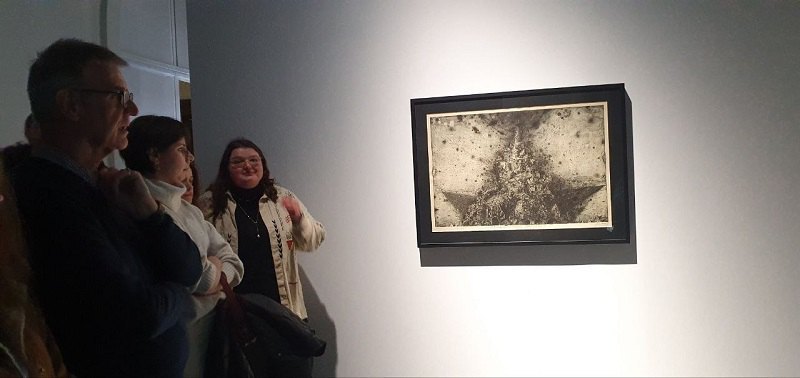
Pavel Makov’s etching Simferopol Landscape is the oldest work in the exhibition. He created it in 1988, when the USSR still existed. The exploration of the city is a central theme in Makov’s practice, most frequently focused on Kharkiv, which became the defining location of his life. However, Crimea is also closely tied to his biography: he lived in Simferopol in the 1970s (while studying at the Crimean Art College) and again in the 1980s. In this etching, the city appears in the form of Bruegel’s Tower of Babel — a symbol of cultural diversity and miscommunication — constructed from an array of small details and motifs associated with Crimea.
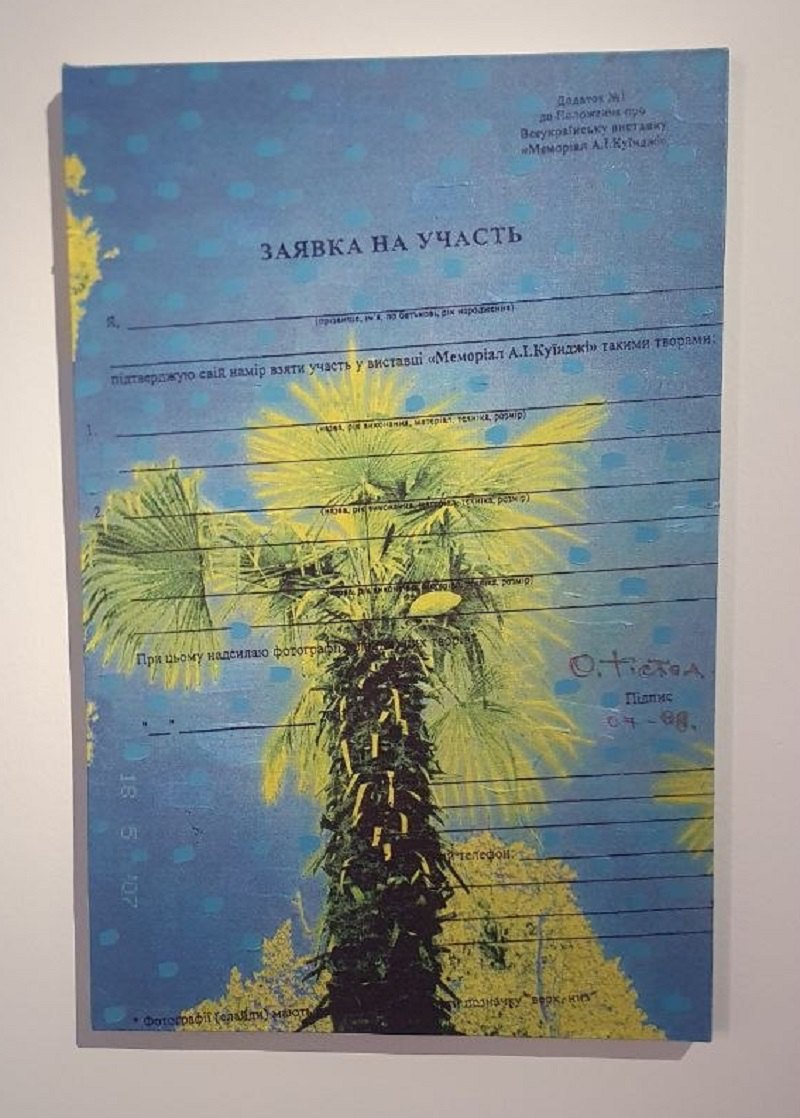
Another work by an artist who came of age during the Soviet era is Oleh Tistol’s Gurzuf.07. The stencilled image of a palm tree is one of the artist’s most recognisable ‘signatures’ (in his exploration of modern myths, he has even referred to the palm tree as Ukraine’s national tree). It also functions as a symbol of Crimea as a holiday destination: the palm tree was introduced to the peninsula only at the end of the 19th century and grows exclusively along its southern coast, where the most popular resorts are located. The exhibition features a work from the YUBK series, the canvas of which mimics an application form for the Kuindzhi Memorial festival — a landscape painting competition formerly held in Mariupol. Today, the name of Kuindzhi, who created dozens of remarkable Crimean landscapes, is associated above all with the crimes of Russian troops — including the looting of the Kuindzhi Museum and the destruction of the artist’s monument in Mariupol — and thus Tistol’s earlier work acquires an additional layer of meaning.
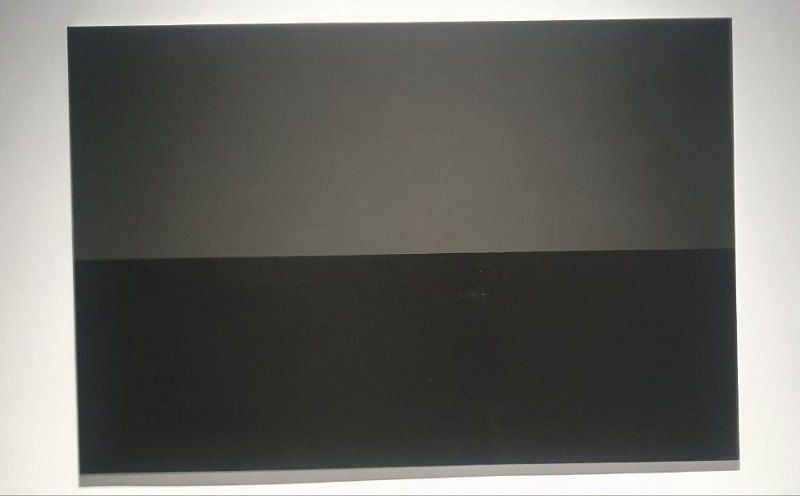
The curators also propose viewing Roman Mykhaylov’s painting Black Sea as a political statement. If interpreted figuratively, the black in this abstract canvas represents both sky and sea, while the line across the middle — a notional horizon — separates black from an even deeper black. The artist has been working on the Black Sea series since 2014; its most well-known iteration is perhaps the installation Shadows — black silhouettes of warships carved from charred wood.
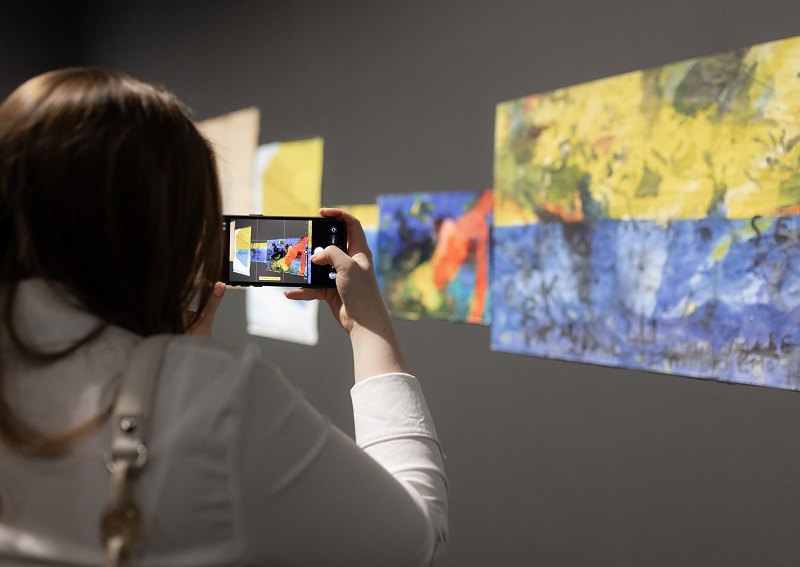
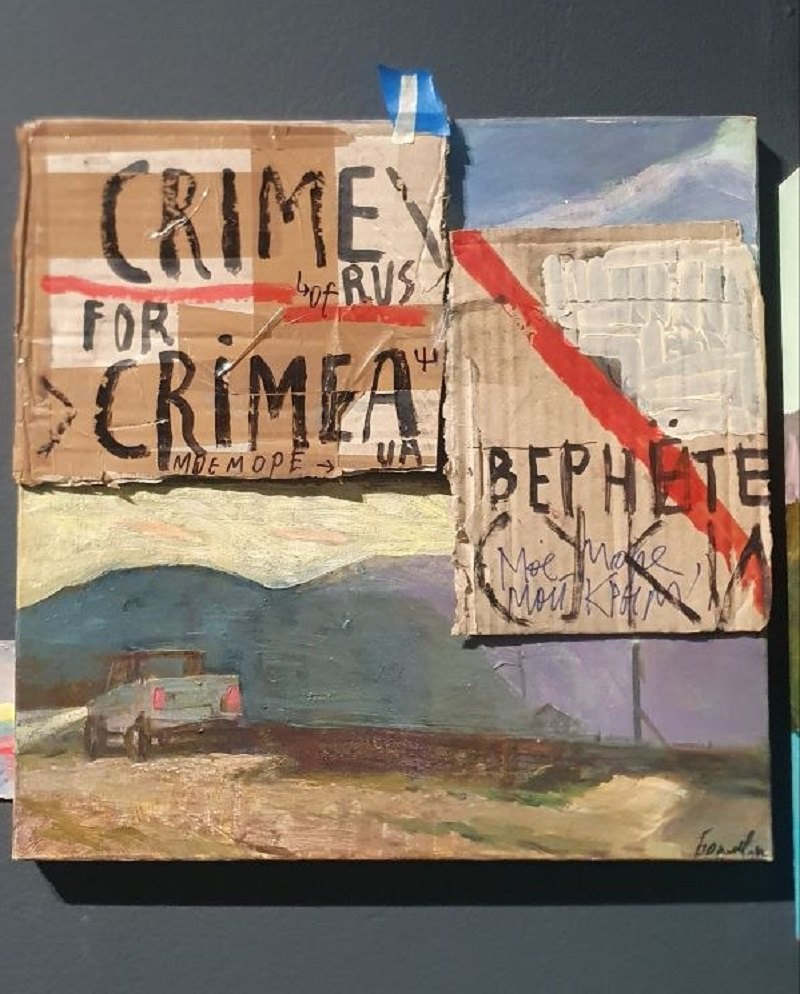
The horizon line is equally central to Oleksiy Borisov’s landscape series My Sea, which spans three walls of a single exhibition room. He has also been working on this project since 2014, when he ceased travelling to Crimea following its annexation. The works combine idyllic recollections of Crimean beaches with references to ‘little green men’ and calls for the return of Crimea. Pieces of varying scale and subject are unified by a continuous horizon line and the repeated inscriptions ‘My Sea’ and ‘My Crimea’, echoed almost as a mantra.
Opposite stands an installation by Yuriy Yefanov with the complex title I watched the sinusoidal movement of blue electronic waves until I could smell them. The artist, who was born in Crimea and now lives in Paris, includes in the work an animated sequence evoking the Artek camp in Gurzuf, where a diving competition takes place. The scene unfolds after the liberation of Crimea — Yefanov has spoken of his desire to organise such a ‘diving festival’. This is the only work in the exhibition that, albeit briefly, addresses the necessity of engaging with people living under occupation who have been exposed to Russian propaganda for more than a decade (not least through the Artek camp, which has become a platform for militarised and ideological indoctrination). The artist proposes diving as a local tradition capable of creating a space for dialogue.
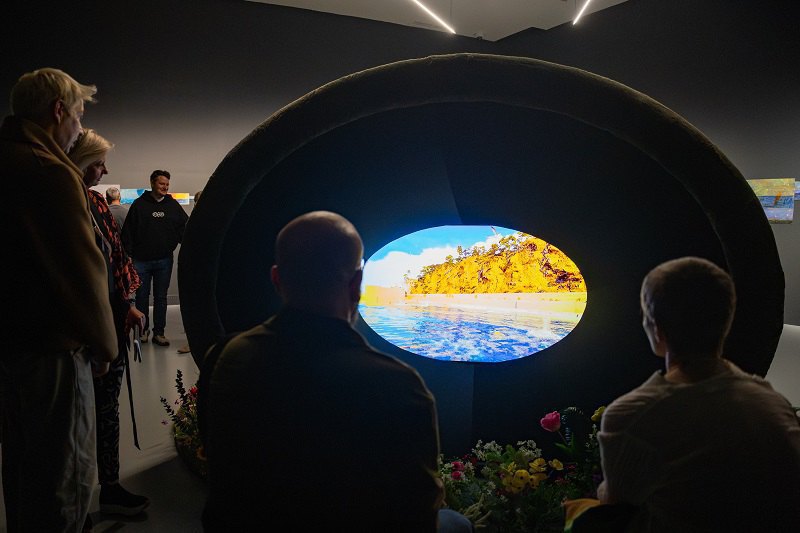
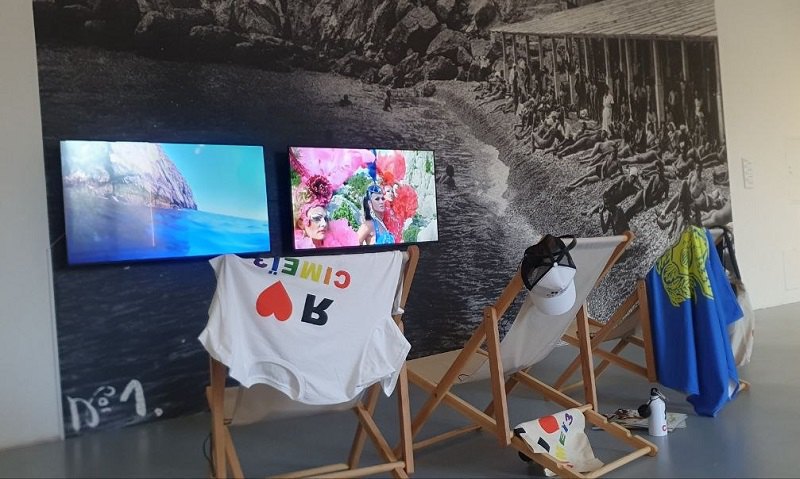
Anton Shebetko’s installation Simeiz explores the history of the queer community that once gathered around the nudist beach and the Yezhi nightclub in Simeiz. It features videos, photographs and zines that visitors can browse while seated in deckchairs, as if on the seashore. Like Yefanov, Shebetko also envisions a return to Crimea — together with the Equality March, which is currently impossible there under the homophobic legislation of the Russian Federation. In this work, Crimea emerges as a space of freedom — a lost queer paradise.
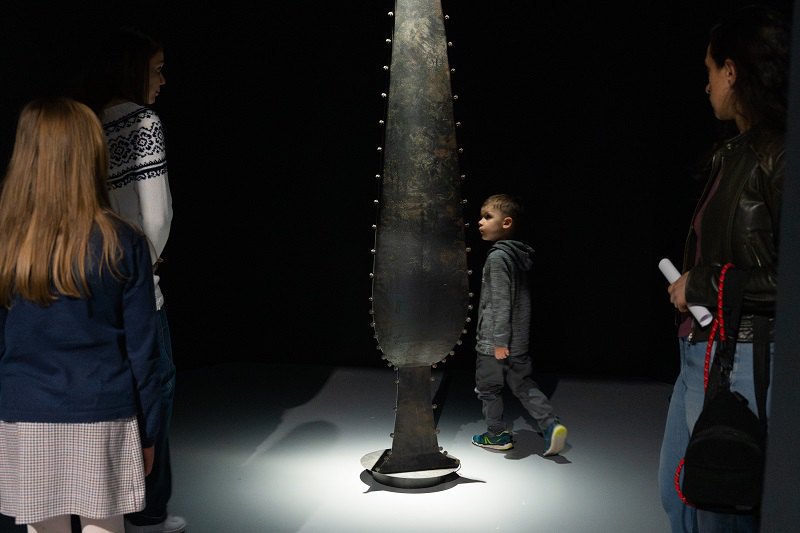
The exhibition concludes with Vitaliy Kokhan’s kinetic sculpture Cypress. A dark metal pyramid, fastened with bolts, references yet another symbol of Crimea as a tourist destination. The sculpture is placed in a separate, darkened room, where it slowly rotates on its axis. In recent years, Kokhan has been actively engaging with the theme of war memorialisation, seeking a new visual language for it. This recalls the cypress as a symbol of mourning and a familiar presence in Crimean (and other) cemeteries. Notably, it forms part of the recently erected Memorial to the Victims of the Genocide of the Crimean Tatar People in Kyiv, realised from an earlier design by architect Irfan Shemsedinov, who had originally envisioned it in Crimea. Kokhan’s cypress echoes Shemsedinov’s form. The works of Elmira Shemsedinova (Irfan’s granddaughter, who brought his designs to Kyiv) are displayed in the exhibition alongside Kokhan’s sculpture.
***
The image of Crimea constructed by the exhibition is defined by recurring motifs of the horizon, water and the sea. This collective image is one of loss. For some, it is the loss of home, family, roots and memory; for others, it is the loss of a summer destination, familiar landscapes and established modes of self-expression. It is a Crimea that appears largely depopulated and disquieting, albeit with occasional notes of nostalgia and cautious optimism.
Aimed at an international audience and commissioned by the Ukrainian Institute, the exhibition is, by design, an instrument of cultural diplomacy. In this respect, it functions effectively, conveying a set of clear narratives: the deep historical roots of Crimea that predate the claims of the Russian Federation; the repressive nature of the Russian presence, expressed through deportations, oppression and militarised indoctrination, which renders even the sea a space of danger; and the symbolic affirmation of Crimea as Ukrainian territory. However, it is difficult — and indeed debatable whether it is necessary — for a Ukrainian viewer to adopt the perspective of a Polish audience. Instead, it becomes apparent which aspects of the Crimean narrative this otherwise skilfully constructed account leaves unaddressed.
Here, Crimea is framed through its (tragic or idyllic) past and its (desired) future, but not its lived present. It appears more as a space than as a society — one that is, uncomfortably, largely Russian-speaking, and which, though not unanimously, welcomed Putin’s arrival and is unlikely to be awaiting liberation. Does the avoidance of this reality risk oversimplifying the conversation about the future, particularly the question of whether all these people are to be regarded as ‘ours’? Similarly, does the focus on Russian crimes obscure more complex aspects of the past, including Ukrainian indifference? The exhibition makes it easy to overlook, for instance, that it was Ukrainian citizens who clashed with returning Crimean Tatars over ‘self-seized’ land; that the border with Crimea remained open after 2014 and was only fully closed in 2022; and that Pride marches in Ukraine itself continue to encounter resistance.
Are all these themes necessary in an exhibition intended for a foreign audience? That remains an open question. Yet there is a sense that ‘commissioned’ exhibitions often lose a vital connection with reality. By adopting different discursive frameworks ‘for them’ and ‘for us’, they risk reinforcing the notion that ‘it is not the right time’ — and, in doing so, allow time itself to be lost. In this way, the pervasive sense of loss that defines the exhibition ultimately extends far beyond its walls.
***
Alongside the exhibition What We Talk About When We Talk About Crimea, the Ujazdowski Castle Centre for Contemporary Art has opened another exhibition, This Cat Was Drawn During the War — a group exhibition exploring visual representations of various wars, which brought together Polish and Ukrainian curators (Anna Lazar, Lada Nakonechna) and brings together Ukrainian works with pieces by artists from Germany to Mexico. At the same time, at another Warsaw museum — the Museum of Modern Art — Ukrainian art can be seen in the exhibition The Women’s Question 1550–2025. Works by Maria Bashkirtseva, Alla Horska, Tetiana Yablonska, Vlada Ralko, Kinder Album, Sana Shakhmuradova, Lesia Khomenko and other Ukrainian artists make a collective statement alongside works by Artemisia Gentileschi, Sofonisba Agnissola, Angelica Kauffman, Tamara Lempicka, Frida Kahlo, Louise Bourgeois, Tracey Emin, Agata Bogacka and many others. Clearly, Polish institutions, at least in the field of contemporary art, view Ukraine as part of a shared cultural space and include its artists in complex narratives. Perhaps we, too, can now afford to be less cautious in our shared conversations?
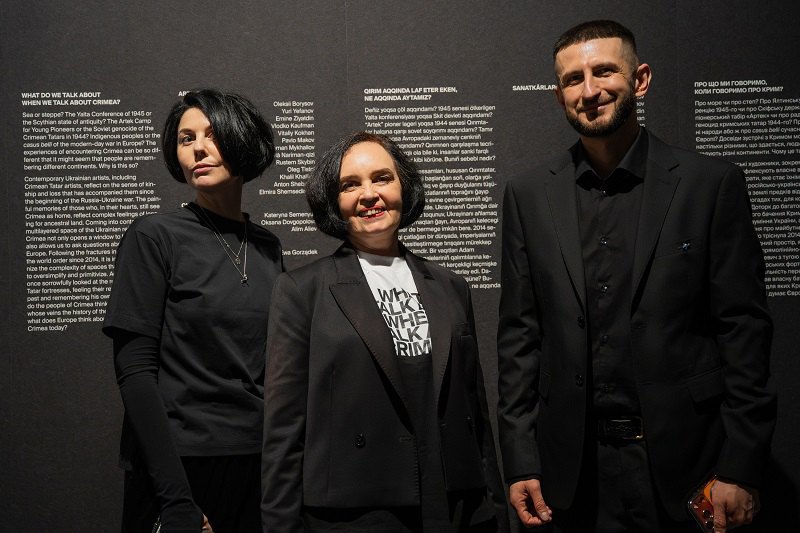
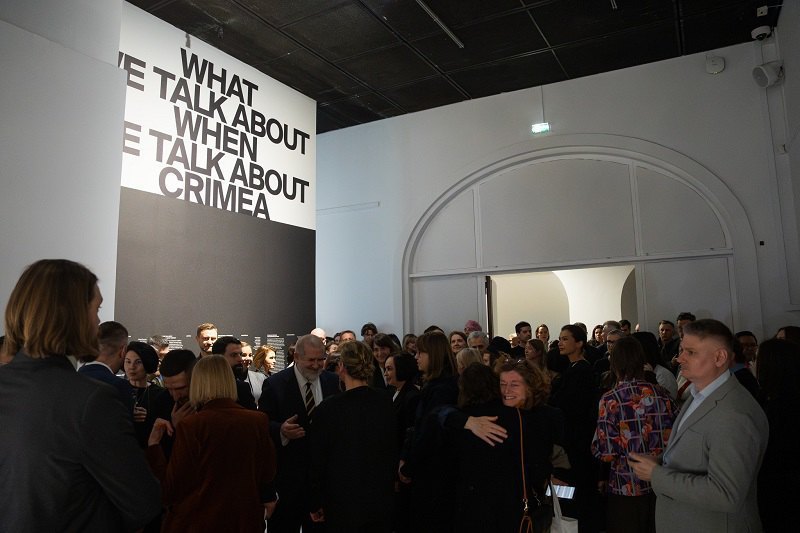
The exhibition ‘What We Talk About When We Talk About Crimea’ is organised by the memory culture platform Past / Future / Art on behalf of the Ukrainian Institute, with the support of the ‘Partnership for a Strong Ukraine’ programme. The project’s curators are Kateryna Semenyuk, Oksana Dovhopolova and Alim Aliyev. The exhibition will run until 28 June 2026.
This text was created with the support of the advertising and communications group Havas Village.