





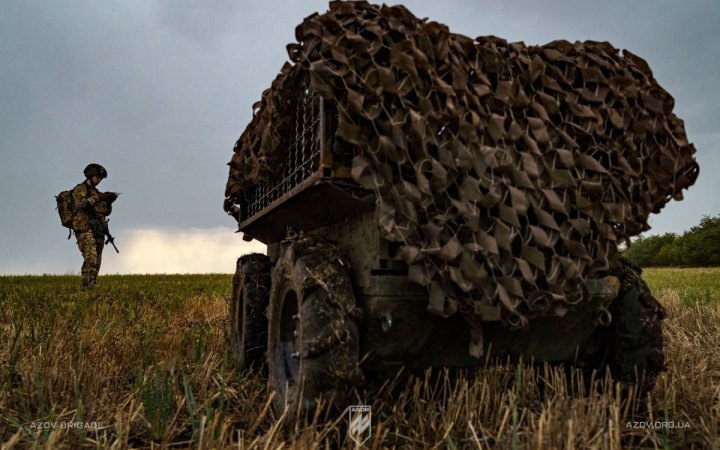
During the offensive operation ‘Vivaldi’, Ukrainian troops used ground robotic systems to deliver more than 200 strikes and carried out 94 assault and sabotage missions without putting themselves at risk. This was reported in an interview with Defender Media by Junior Lieutenant Mykola “Makar” Zinkevych, commander of the NC13 strike ground robotic systems unit.
The targets hit included shelters, fortified defensive positions, depots, command posts, Russian UAV assembly and launch points, as well as the Russia’s command personnel.
According to Zinkevych, ground robotic systems became one of the key factors behind the success of the offensive operation ‘Vivaldi’. At the initial stage, the ground drones distracted the enemy, forced it to reveal its surveillance and fire assets, and in this way drew all attention to themselves. While the Russian military was hunting the robots, assault groups entered its battle formations unimpeded, he noted.
Kamikaze ground robotic systems and drones with combat modules kept up constant fire pressure on command posts, UAV operator positions, and troop concentration areas. This disrupted Russian logistics, disorganised command and control, and undermined the enemy’s morale. Zinkevych added that captured Russians said the appearance of ground robotic systems on the battlefield forced them to abandon their positions.
As a reminder, on 15 September, Andriy Biletskyy, commander of the Third Army Corps, announced that the unit in Donetsk Region was conducting an offensive operation called ‘Vivaldi’. During the first season of the operation, the Third Army Corps eliminated enemy infiltration across an area of 75 km², liberated 10 km² of Ukrainian territory, and took Russian soldiers prisoner. During the second phase of the offensive, fighters of the Third Army Corps liberated the settlements of Shandryholove and Derylove, and also established full control over Drobyshcheve. Overall, at this stage they returned 125 km² of Ukrainian territory to Ukrainian control.
As part of the offensive operation ‘Vivaldi’, the Third Army Corps was the first among military units to use ground robotic systems for demining and to support assault actions. As the Third Corps explained, the main aim of introducing these technologies is to replace infantry with robots in the most dangerous areas, in order to preserve the lives of Ukrainian soldiers as much as possible.
In addition, during operation ‘Vivaldi’, the Third Army Corps airlifted kamikaze ground robotic systems using heavy Griffon bomber drones more than 10 kilometres deep into enemy rear areas. According to the commander of the NC13 strike ground robotic systems unit within the Third Army Corps, call sign “Makar”, this tactic has become systematic and has been used for four to five months already.
During operation ‘Vivaldi’, operators from the NC13 unit also attacked Russian positions using ground robotic systems equipped with Bulgarian disposable rocket-propelled anti-tank grenade launchers, Bullspike. After that, the robotic systems detonated directly inside the enemy’s shelters. The operators controlled the systems remotely, staying under cover dozens of kilometres from the line of contact.