





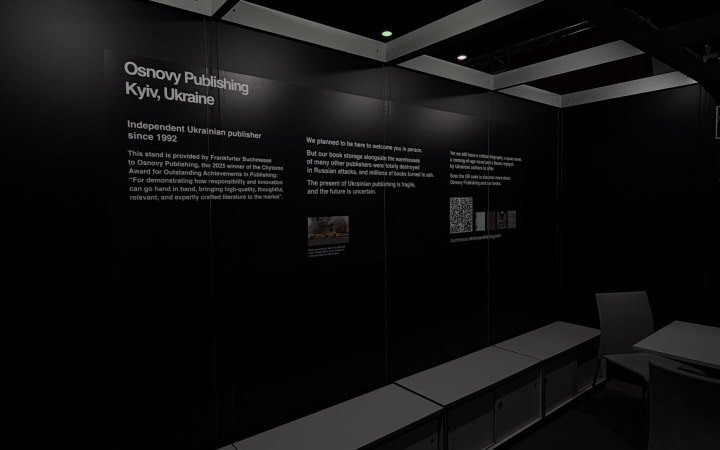
Osnovy Publishing left its stand at the Frankfurt Book Fair 2026 almost empty to draw attention to the impact of Russian attacks on Ukrainian book publishing. This was reported by Chytomo.
Initially, the team had planned to work at the fair in full, meet international partners, present books and talk about promoting Ukrainian literature and visual art abroad. However, after the Russian attack on 28 August, which destroyed a warehouse in the Kyiv region containing books by Osnovy and other Ukrainian publishers, the format of their participation had to be changed.
According to the publisher, the attack destroyed about 40% of its book stock, with estimated losses of €400,000.
“After the Russian attack on 28 August, when a warehouse with our books and the books of other Ukrainian publishers was destroyed, we are forced to adjust the format of our participation, because due to the significant financial losses and the resulting strain on the team, taking part in the fair in full is currently beyond our capacity,” the publisher said.
The publisher explained that, through the stand’s format, it wants to show an international professional audience the conditions in which Ukraine’s book industry is currently working.
“For us, this is a way to show the reality in which Ukrainian book publishing operates today: books can be written, translated, edited, designed, typeset and printed — and in a single night turn to ash. A publisher may have plans for a year ahead, and the next day will have to start all over again, having suffered losses comparable to annual revenue,” Osnovy said.
At the same time, the stand is intended not only to remind people of the losses suffered by Ukraine’s book industry, but also to present publishing rights for Ukrainian books to the international market. To sell translation rights, Osnovy is presenting several contemporary Ukrainian books at the Frankfurt Book Fair.
Among them is Kateryna Trompak’s novel “Syhin Irving”. At the centre of the story is a young American woman who, in 1938, finds herself in Carpathian Ukraine and tries to make sense of her own family history.
Foreign publishers are also being offered Volodymyr Dibrova’s trilogy “The Lives of the Famous” — a literary triptych built around the lives of landmark figures in 20th-century Ukrainian culture.
Another book is Ivan Kozlenko’s novel “Tangier”, set in Odesa in the late 1990s. It is a novel about youth, queer identity, friendship, desire and self-discovery, in which the Odesa that is contemporary for the characters echoes the city’s cultural milieu of the 1920s.
Kozlenko is also represented by the book “Anna Sten: Cinema and Life” — a biography of an actress of Ukrainian origin who worked in European and American cinema. In the 1930s, producer Samuel Goldwyn invited her to Hollywood, where he tried to make her “a second Greta Garbo”. Kozlenko explores the actress’s biography and separates documented facts from the myths created around her.
In addition to translation rights for books, Osnovy is presenting rights to the illustrations for Laozi’s “Tao Te Ching”, created by Ukrainian artist and comics author Ihor Baranko. For the publication, he produced a series of ink graphic works, rethinking the visual language of the classic Taoist text.