





Data on ten Russian institutions and 13 engineers and scientists supporting Russia’s military-industrial complex have been published on the War&Sanctions portal in the “Engineers of Aggression” section.
This was reported by Ukraine’s Defence Intelligence (HUR) of the Ministry of Defence.
The publication includes, among others, Russian higher education institutions that train personnel for Russia’s defence industry, have co-operation agreements with weapons manufacturers, train UAV operators for units of the Russian Armed Forces, conduct research and carry out development work in the field of military and dual-use technologies.
Among them are:
- Skoltech, which develops anti-icing coatings for UAVs and technologies for manufacturing turbine blades for aircraft engines;
- Moscow Institute of Physics and Technology, where computer vision systems are being developed in partnership with the High-Precision Systems holding of the Rostec state corporation;
- Chuvash State University named after I. M. Ulyanov, which trains engineering and technical personnel for VNIIR-Progress JSC, the manufacturer of the Kometa jam-resistant navigation modules for Russian missiles and UAVs, and also implements joint research and innovation projects with it.
Researchers at most of these institutions have already featured in previous publications, in particular due to their continued co-operation with the international scientific community.
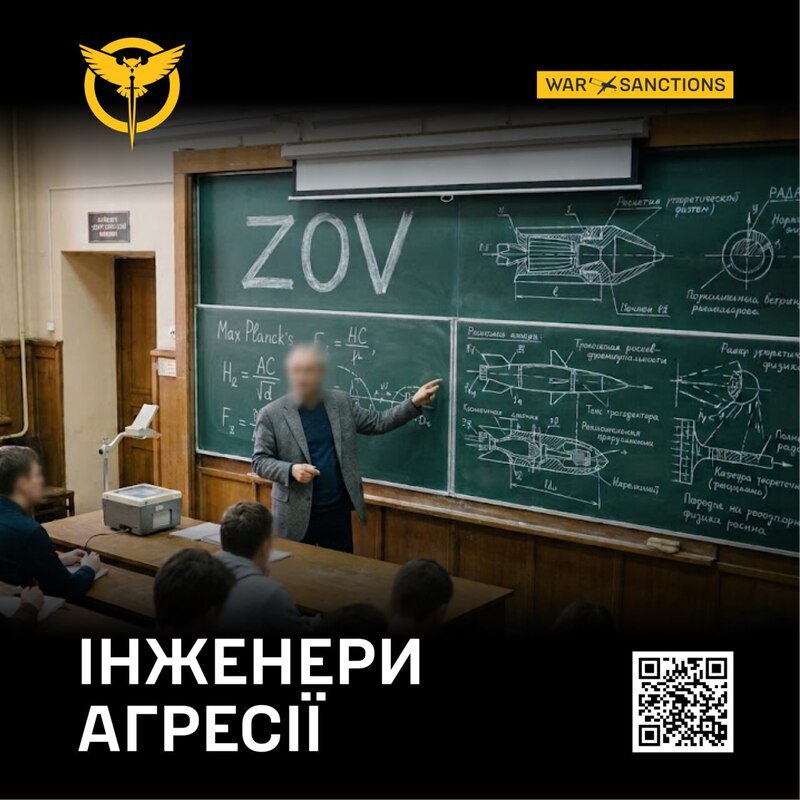
“Today we are adding another 13 Russian engineers and scientists to the list who are carrying out development work in areas such as onboard control systems for military aviation, machine vision, robotic systems, turbojet engines and so on. Some of them continue to publish in international journals together with scientists from other countries, as well as to be members of international organisations and committees,” the intelligence officers said.
The results of such co-operation are subsequently used to develop these technologies in Russia, whose main consumer during the war is Russia’s military-industrial complex — machine vision for strike UAVs, propellers for army aviation, integrated circuits for the onboard systems of cruise missiles.
HUR adds that anyone in Russia involved in developing military and dual-use technologies is a legitimate target for sanctions, and that the global scientific community should completely cease co-operation with Russian scientists and research institutions.
- In October, Ukraine’s Ministry of Education and Science, in co-operation with the Ministry of Digital Transformation, published an appeal to the international scientific community calling for an end to institutional co-operation with Russian academic and research institutions, including in the areas of joint research, scientific publications and editorial work.