





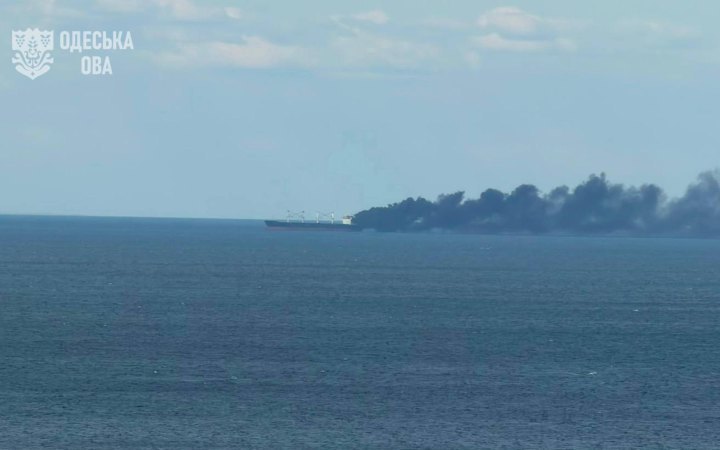
In recent weeks, Russian drones have attacked at least a dozen merchant vessels in the Black Sea. These strikes have killed more seafarers than during the war with Iran.
As CNN reports, Russia’s aim is to paralyse trade through Ukrainian ports, from which almost all of the country’s grain is exported. Some attacks took place near, or directly within, the territorial waters of two NATO states — Romania and Bulgaria.
Over the past month, the intensity of Russian attacks has increased. According to sources in the shipping industry and security services, in several cases Russia used sea and aerial drones simultaneously. It has begun using newly developed jet-powered drones, which are faster and harder to intercept, as well as drones capable of striking moving targets.
In recent weeks, Russian drones have attacked at least a dozen merchant vessels in the Black Sea, leaving at least 30 seafarers dead or missing.
The attacks are taking place not only near the Ukrainian coast, but also in the territorial waters and exclusive economic zones of Romania and Bulgaria — NATO states.
One of the most tragic attacks was the destruction of the vessel Alfa Watan in early October, when ten crew members were killed. Six days later, HS Dignity was attacked off the coast of Bulgaria, killing 11 seafarers. On 15 October, four more merchant vessels were hit, and eight people were killed. Among the vessels attacked were the chemical tankers Wine Trader and Yara J, which caught fire near the Sulina Canal; seven people died aboard the former.
Ukraine’s Foreign Minister Andrii Sybiha said that, because of Russian attacks, the Black Sea is turning into a dangerous zone for civilian shipping. The consequences are already being felt: the number of vessels calling at Ukrainian ports has fallen sharply, and insurance premiums have risen.
London’s Joint War Committee has expanded its list of high-risk zones to include almost the entire Black Sea region, excluding the territorial waters of Turkey, Romania, Bulgaria and Georgia. This poses a threat to Ukrainian agricultural exports, as around 90% of them are transported by sea. Ukraine accounts for roughly 15% of global maize exports and 10% of wheat exports, and is the world’s largest exporter of sunflower oil.
The response from European countries remains uncoordinated, although Romania and Bulgaria have begun strengthening their defences. Bulgaria has asked NATO to deploy combat aircraft and counter-drone systems, while Romania is patrolling its coastline with F-16 fighter jets and has already shot down two Russian drones over its territorial waters. Romania also plans to step up surveillance and develop capabilities to counter sea mines and drones. NATO Secretary General Mark Rutte said the Alliance is increasing its presence on the eastern flank.
At the same time, the Trump administration is placing responsibility for the attacks on ships on both sides, while experts are urging NATO to strengthen air-defence and counter-drone capabilities in the Black Sea region.
- The FT calculated that since the start of 2026, more than 570 vessels have been attacked in the Black Sea, and at least 40 seafarers have been killed. As a result, the route has become more dangerous for commercial shipping than routes in the Persian Gulf.
- Turkey threatened Russia and Ukraine with legal action in response to any further attacks on merchant vessels in the Black Sea.