





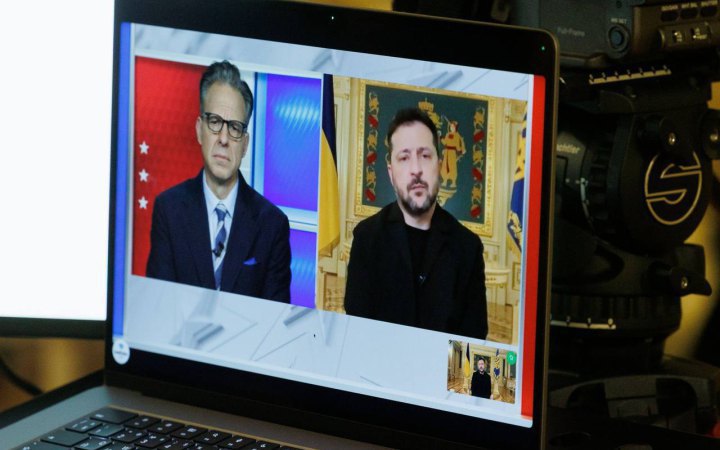
The ceasefire in Oleshky showed that establishing a truce does not necessarily require pulling back weapons or creating buffer zones. Compliance with agreements can be tracked using drones and video evidence of violations.
President of Ukraine Volodymyr Zelenskyy said this in an interview with CNN’s Jake Tapper.
According to the head of state, during trilateral and bilateral talks the parties often speak about the need for time to prepare a ceasefire, the difficulty of monitoring it, and withdrawing weapons. However, the experience in Oleshky demonstrated that such conditions are not mandatory.
Zelenskyy noted that the decision on a ceasefire in Oleshky was taken quickly, and it worked. Modern technology makes it possible to monitor the situation using drones, and to record violations on video.
The President stressed that, ultimately, everything depends on the political will of Russian leader Vladimir Putin. Zelenskyy expressed hope that with US mediation it will be possible to find a way to persuade him towards peace.
Humanitarian Mission in Oleshky: How It Happened
From 27 October, a humanitarian ceasefire regime was established in occupied Oleshky and the surrounding area. The agreement was reached with the mediation of US First Lady Melania Trump.
The ceasefire regime lasted until 22:59 on 1 November. No violations of the agreement were recorded.
On 29 October, a Ukrainian delegation travelled to Oleshky. On the morning of 30 October, it arrived with humanitarian aid. Russians and representatives of Belarus also arrived. Ukraine asked for the American side to oversee the evacuation process.
For the evacuation from Oleshky, 25 buses with 750 seats were prepared.
Ukrainians evacuated from temporarily occupied Oleshky and the surrounding community in Kherson region crossed the state border in Chernihiv region on 31 October.
During the humanitarian mission in Oleshky, 167 civilians were also evacuated on the right bank of Kherson region. Among them were 22 children and 21 people with limited mobility.