





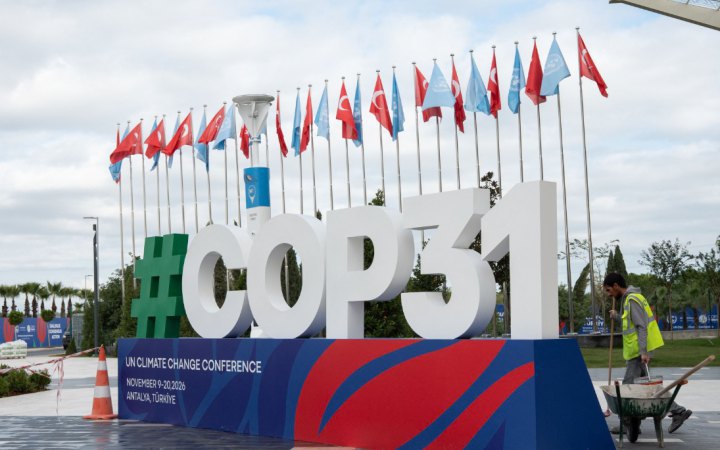
The 31st UN Climate Change Conference (COP31) will officially open in Antalya tomorrow and will run until 20 November.
As The Guardian writes, dozens of world leaders and representatives from nearly 190 countries are gathering in Turkey to take part in the climate talks.
Developing countries and civil society will seek to make climate finance and justice central themes of the negotiations at the conference.
“Disputes are expected between rich and poor countries over who should pay for the consequences of the climate crisis, as well as over the slow pace of greenhouse-gas emissions cuts,” the publication notes.
The summit will unusually have two hosts: it will take place in Antalya, Turkey, but Australia will steer the substantive part of the talks and the final resolutions. The countries reached this compromise last year after Ankara and Canberra submitted separate bids to host the event.
“We need a tangible outcome focused on practical implementation (of emissions cuts and finance) — one that people can see is really happening. We need progress; it must be a step forward compared with previous COP conferences,” said Chris Bowen, Australia’s Minister for Climate Change and Energy, who will chair the talks.
It is worth adding that the United States has already refused to send its delegation to the summit for the second year in a row. According to a White House spokesperson, President Donald Trump’s administration does not want anything to do with the “extremist climate policy” supported by other countries.
However, a group of 20 Democratic members of Congress travelled to Antalya, buoyed by their party’s success in last week’s US midterm elections. That victory allows them to block Trump’s attempts to roll back environmental regulations and end financial support for clean energy.
It should be noted that both co-host countries of this year’s COP31 remain heavily dependent on fossil fuels. Australia is one of the world’s leading exporters of coal and liquefied natural gas. The country’s centre-left Labor government has targets to reach net-zero greenhouse-gas emissions by 2050 and to generate more than 80% of electricity from solar and wind by 2030, but Canberra is falling behind on meeting them.
Turkey also wants more countries to switch to electric technologies, including electric vehicles and heat pumps, which are far more efficient than their fossil-fuel counterparts. Under consideration will be a target for electricity to account for 35% of final global energy consumption by 2035, though some participants do not support the proposal.
- COP31 is taking place as the world faces the most powerful El Niño climate phenomenon on record, intensified by the use of fossil fuels. Severe weather is expected to claim hundreds of thousands of lives and cause trillions of dollars in damage.
- This year, temperatures have broken records, and the global temperature has exceeded the pre-industrial level by 1.5°C — the threshold countries sought not to cross under the 2015 Paris climate agreement.
- This summer, more than 50,000 people in Europe died due to heatwaves. Large areas of North America were blanketed by wildfire smog. In Nepal, a glacier collapse triggered a landslide that killed more than 1,500 people.