







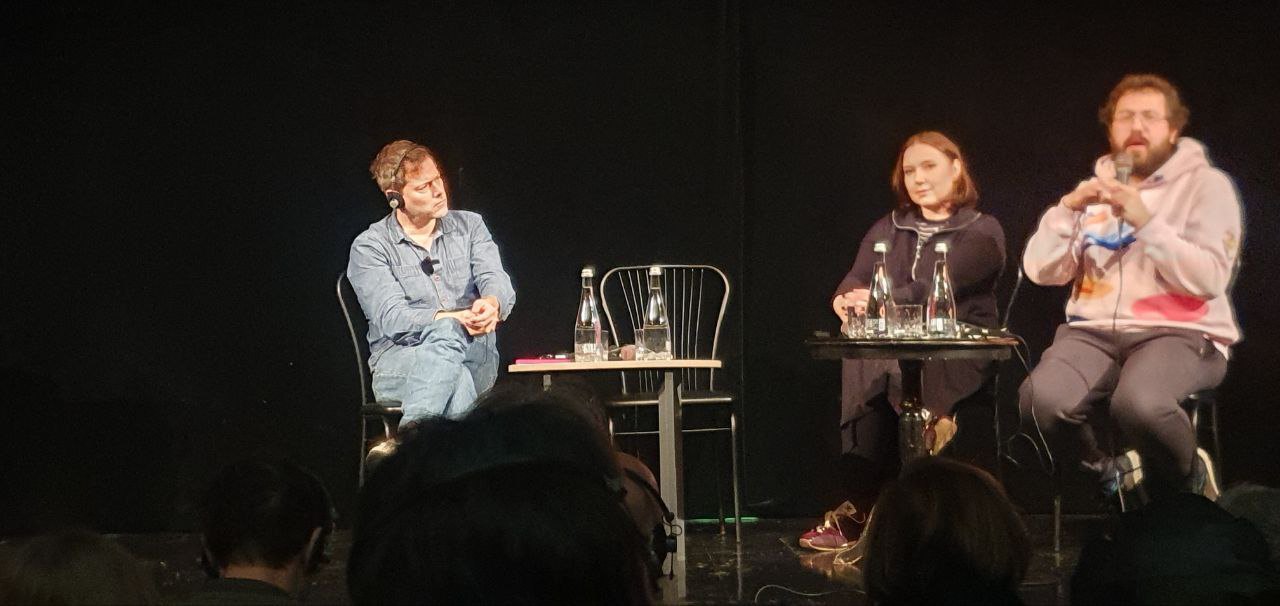
“Leaving the theatre for the front line is also a way of doing theatre”
Tamara Trunova: Milo, I want to ask you about your 2016 work Five Easy Pieces (a production based on the case of Dutroux, a serial rapist and paedophile; Milo Rau created it together with a group of children for the CAMPO arts centre in Ghent. — Ed.). I am still disturbed by what I saw. Why do you do such things? And what does being an adult in theatre mean to you?
Milo Rau: I have seen many plays with children created by adults, and they always have a palpable power structure. In my work, I wanted to show these structures. It is a story about the power that a person has on stage. You can work sadistically with the emotions of the audience — and many actors do. A child on stage can make all the adults in the hall cry in five minutes. It is empowerment, but also responsibility. This also applies to non-professionals on stage — this topic is very interesting to me.
Being an adult (in a political sense) means having a grasp of context. You will avoid some contexts and try to join others. But I would like to redirect this question to you — what does it mean to do adult political theatre here in Kyiv right now?
Illya Razumeyko: I do not know if theatre can be apolitical. If German theatre during WWII plays Strauss, it is just beautiful music, but it is also propaganda. The same applies to the National Opera, which is currently staging The Tales of Hoffmann — it is a political choice. Just as leaving the theatre to go to the front is a political choice, it is also a way of doing theatre.
Tamara Trunova: For me, it means trying to understand why cardboard boxes are being taken outside the theatre, while inside something quite the opposite is happening (this refers to the protest against Bilous’ dismissal, which took place outside the Molodyy Theatre. — Ed.). It is a sense of one’s own boundaries and an attempt to extend the area of responsibility beyond them.
Illya Razumeyko: Milo, this year you staged the play Burgtheater, based on a play by Elfriede Jelinek, which was censored because it deals with the theatre boom in Austria in 1942, the history of this theatre, and the Nazis — the grandparents of those spectators who came to see your work. It was very unpleasant for them to watch, because audiences like pleasant theatre. We hardly have any of that here — Tamara sometimes does unpleasant things, and that takes courage. And this is a question for us — can, for example, this [Molodyy] Theatre talk about what happened on this stage a year ago? (This refers to the abusive practices of the former director of the Molodyy Theatre, Bilous. — Ed.)
Milo Rau: The context of that production is the Antisemitism of Austria, which positions itself as the first victim, not an accomplice to Nazism. In particular, it deals with the change in behaviour when the Red Army approached Vienna — something that everyone finds very uncomfortable to remember.
Tamara, I want to ask you: you have staged operas in both Germany and Ukraine — what is the difference between these experiences?
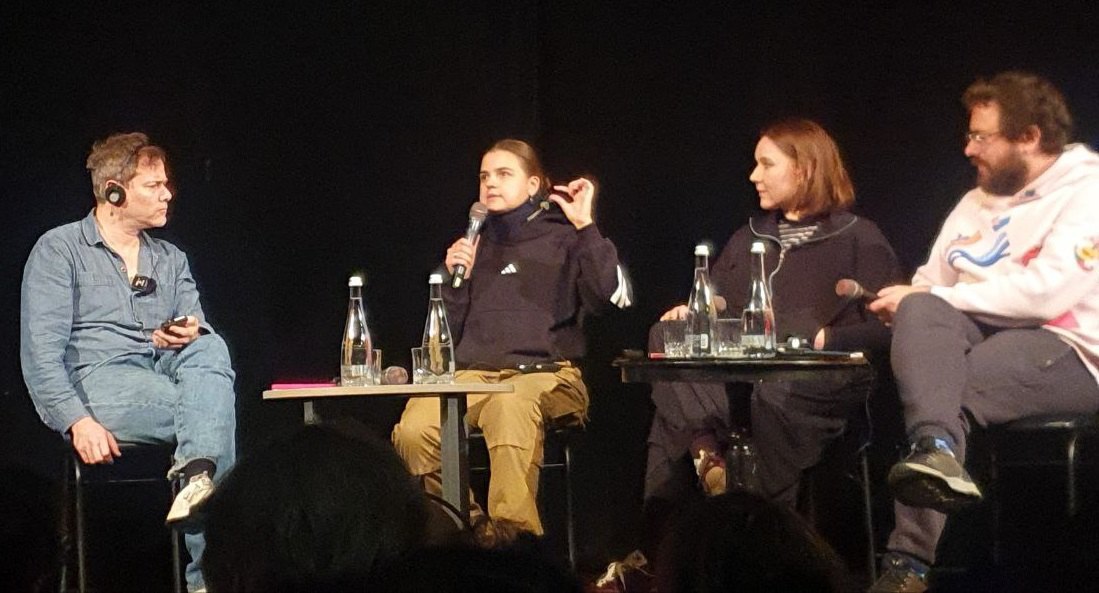
“Censorship reigns supreme on European stages: you will be asked to replace the word ‘war’ with ‘conflict’ and remove the word ‘Russia’.”
Tamara Trunova: It is much safer to stage an opera in Ukraine because you can be sure that there will be no Russians in the cast (in 2024, the management of the Bavarian Opera added Russian participants to Trunova’s production of Lucrezia / Der Mond without the director’s consent; later, the Russians themselves refused to participate when they found out that during the performance they would have to wash the Russian flag on stage. — Ed.). My German experience was very traumatic because the Bavarian Opera reeks of Russian money.
Illya Razumeyko:The war is actually very close to Germany and Austria — it is only a 20-hour train ride away. But in Vienna, it seems as if it is very far away. Censorship reigns on European stages: you are asked to replace the word “war” with “conflict” and remove the word “Russia.” Instead, there are productions about Ukrainians and Russians doing something together — and these productions have no connection to reality.
Olena Apchel (joins the conversation): I am a stage and mass entertainment director by training. I was taught to make content that is very poor in meaning and very high in quality for a lot of money. I learned well how to make “big nothing,” but I got tired of it and went down to a non-state theatre in the basement. And this is an example of a discussion that will never happen here: why were the most important performances in terms of meaning in independent Ukraine created by the non-governmental, unfunded sector, why did they not have the opportunity to go on the big stage and be perceived by the general public as something worthy of attention?
We are still burdened by the generational post-trauma of Soviet art, which was designed to distract and entertain. It stripped our culture of its complexity and left us with hopak, beautiful songs, embroidered shirts, and jokes about cooking and everyday relationships worthy of Comedy Club. Theatre in Ukraine still often uses superficial stereotypes. Theatre that emigrated to Europe has once again found itself in an environment where we are only perceived as cute and unhappy people walking around and searching for our identity.
I have seen hundreds of performances by “good Russians” in Europe — for example, Marina Davydova, who is very good at manipulating the fact that “I am not quite Russian” (the director was born in Azerbaijan — Ed.), and therefore “I have the right to be unhappy,” but at the same time “more distant”, so now I will teach you how to be unhappy and how to come to terms with it. And I have only one request for you: do not put on plays where Ukrainians and Russians (even if they are played by Poles and Greeks) sit down at the same table. We are not interested in what Russians think of us — even those who help us. Let them help. But we are not interested in talking to them on stage. They have been describing us for centuries, and now it is time to stop listening to the colonisers.
“The Western European perspective is absurd, but its absurdity can only be understood from within the war.”
Milo Rau: Yes, this “therapeutic” idea of bringing Russians and Ukrainians together is alive in Europe. This Western European perspective is absurd, but its absurdity can only be understood from within the war. I cannot understand: why do we — I mean left-wing Europeans — mainly identify ourselves with colonised Palestine, but at the same time fail to see that Ukraine is also part of a colonial conflict?
Tamara Trunova: It is your task to understand why.
Olena Apchel: All Western theory focuses on “distant” colonisation, so it is difficult for you to see our “neighbouring” one. Also, for too long we did not have witnesses who could describe our reality to you. You know about one Holodomor because one person took a few photographs (British reporter Gareth Jones — Ed.); no one described the other two, so you do not know about them.
And it is difficult for you to understand the transformation that has taken place in our country. I adored Dostoevskiy, knew Chekhov by heart, and mocked those who read Ukrainian classics. There was a time before 2014 when I worked for the Russian Ministry of Culture, directing shows with the tricolour flag. I take responsibility for that. But since 2014, I have undergone a great transformation, as have many others, and we can teach you to see your own blindness.
“Europe chooses fictional stories about Ukrainians embracing Russians”
Tamara Trunova: Milo, what is your answer? Why does Europe not need real evidence on the territory of the theatre right now? Why does it choose fictional stories about Ukrainians embracing Russians? Why are you planting such a bomb in your own future?
Milo Rau: I think there are various reasons. We do not like Putin, but we like Dostoevskiy; for us, these are two different Russias. Also, my curatorial work in Vienna confirms that the best singers are Russians, that is just a fact. Another thing: Russian culture is very close to German-speaking culture; Chekhov and Tolstoy are very integrated into it. And, again, the left wing sees itself together with Russia, that is also just a fact.
Illya Razumeyko: And then there is very effective Russian propaganda, which shows the façade of culture in Moscow and St Petersburg. However, to see the real Russia, you have to go to Chechnya — and you will not go there because there is no Tolstoy there, and the Vienna Opera is not interested in it.
Olena Apchel: I have a performative proposal. Let us imagine artists whom you respect, who work in a sharp and interesting way. Among them, it would be difficult to find a director who has not staged The Idiot or Three Sisters — this is a certain indicator of professionalism. Let us think about it: would these professionals lose anything if, in solidarity, they took a 30-year break from working with Russian classics — not throwing them away or burning them, but just taking a temporary break?
Milo Rau: I can speak for myself. I do not see any problem with not working with any classics. Why endlessly stage The Idiot? It is just boring. And again, I do not understand why we boycott Israeli culture, but this does not extend to Russia.
Olena Apchel: But this happens again and again. Even now, just like institutions in Germany, instead of talking about our directors, we spent this time on Russians — the moderator allowed us to do so, and the audience in the hall did not stop us. We have once again performatively amplified this energy.
Illya Razumeyko: I would like to note here that Milo Rau does not stage Chekhov; he possesses the tools of contemporary theatre, which do not require old texts. Therefore, this question concerns the presence or absence of this type of theatre.
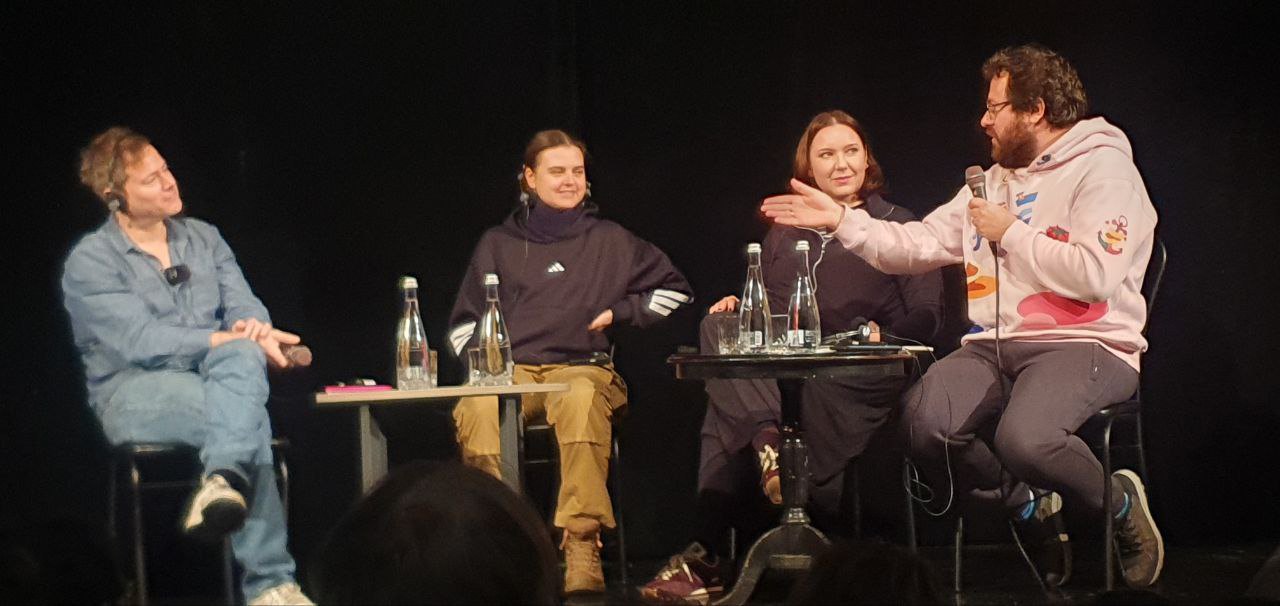
“Solidarity with Russians as subjects is very different from your solidarity with Ukrainians as objects.”
Director Larysa Venedyktova (commenting from the audience): I have an answer as to why the European left does not see Russia as an aggressor and is in solidarity with it. It is because they did not see that the Soviet Union was a pseudo-left terrorist organisation. The European left is stuck somewhere in the 1920s and cannot seem to reach the present day.
I also want to ask you a question, Milo. In 2019, your play was at the New European Theatre Festival in St Petersburg. How did that happen?
Milo Rau: I have been banned from entering Russia since 2013, so my personal participation was out of the question. As for my play, it was a way for me to show solidarity with Russian dissidents, with Marina Davydova and Kirill Serebrennikov. At the time, we did not perceive the invasion of Crimea as an invasion, we reacted too late. Although, even in 2013, it was probably too late to react.
ProducerKristina Kisielovaitė(asks from the audience): A month ago, your performance was at the Voices Berlin festival, which is organised by Marina Davydova. Why did you agree to this?
Milo Rau: I understand your question, but the answer is the same. I have known Marina since she organised the Moscow Trials show in Russia (in 2013; the performance was a reaction to the trial against Pussy Riot and took place at the Sakharov Centre in Moscow in the form of a trial against the cultural war of Putin’s political system. — Ed.). I understand that the former grey zone is no longer grey, and I would not allow my production to be staged in Russia now. But I wanted to support Marina Davydova, who was recently dismissed from her position as director of the Salzburg Festival. I supported her as a curator, not as a Russian.
Tamara Trunova: That is the point: you talk about her as a curator, not as a Russian woman. But when we are accepted into European projects, we are accepted as Ukrainians, not as directors.
Olena Apchel: Your solidarity with Russians as subjects is very different from your solidarity with Ukrainians as objects. You support Russians as people who are doing something important, but you are not interested in what Ukrainians are doing and support them out of pity. In Germany, I appealed to everyone not to support Davydova’s play, wrote pages and pages of explanations, and received no response.
Milo Rau: Then I have a question: where is the line? On which side of the line, for example, is Pussy Riot?
Olena Apchel: Until 2014, I was fascinated by Pussy Riot. But let them deal with Russia: that is where the line is. They, or Serebrennikov, or Davydova, should not be explaining to you how to treat us. They should not be allowed to describe us with your money.
Larysa Venedyktova (commenting from the audience): It seems that we are constantly complaining — but at the same time we say, “Stop pitying us.” I am confused.
Olena Apchel: Well, excuse me, but we have something to complain about. Our theatre is in the gutter, we do not make manifestos, we do not do political theatre — but we demand objectivity from them. It is not convenient, yes.
***
Milo Rau visited Kyiv at the invitation of Opera Aperta and proto produkciia. This visit is part of the RESISTANCE NOW! initiative, which originated within the Vienna Festival (Wiener Festwochen) and brings together cultural figures in response to the rise of nationalism. In 2024, 13 RESISTANCE NOW! events took place in 11 countries, from New York to Taipei.