






Key features of Ukraine’s new Equalizer guided bomb
DG Industry highlights the system’s high durability and resistance to significant overloads. This ensures reliable operation and allows pilots to maintain full freedom of manoeuvre without additional restrictions on flight control.
“From a practical point of view, this directly enhances crew safety and expands the product’s application in real combat conditions, where flexibility and rapid decision-making are critically important,” DG Industry told us.
During the development of the Equalizer, the company analysed the experience of using foreign equivalents, particularly Russian products.
“This allowed us to take into account the strengths and weaknesses of existing solutions. As a result, we created our own design, combining a number of the key advantages of similar products while adapting them to modern requirements,” the company noted.
The product’s design is versatile and can be adapted for various types of missions. These include strikes against a wide range of ground targets, such as command posts, engineering structures (including bridges), military equipment and other strategically important facilities.
The Equalizer can be used on Su-27, Su-24 and MiG-29 aircraft. The bomb has also been adapted for all types of foreign aircraft, although appropriate certification is required before it can be approved for use.
According to the developers, pilots involved in testing noted that the device is “user-friendly and imposes no additional restrictions on piloting, allowing for the execution of all necessary tactical manoeuvres, including complex evasive manoeuvres”.
As for the strike range, figures in the tens of kilometres are being cited, although more precise information is not being disclosed for reasons of security and operational expediency. “Let the Russians be the first to find this out in a practical way,” the company added.

The developers acknowledge that there is always a risk that the munition might fail to detonate or that a significant piece might remain intact, which the Russians could then use to study the technology. But even if they do obtain fragments, it will take time to analyse them and attempt to replicate them — this would take ‘years of work’, according to DG Industry.
Furthermore, they plan to refine the Equalizer and adapt it to the needs of the front line, “so any potential attempts to replicate it quickly lose their relevance”.
DG Industry does not speculate on how the Equalizer will affect the course of the war. They say their task is to supply the products, whilst it is up to the military to assess their effectiveness and impact on combat operations.
“Cost is also a key factor — it is roughly three times lower than that of a similar product, the JDAM-ER. This allows the Defence Forces to be supplied with a greater quantity of munitions and, consequently, to increase the number of successfully completed combat missions,” the manufacturer believes.
The KAB is difficult to manufacture due to several critical factors: speed, integration with the aircraft, and resistance to overloads (how well the munition withstands external loads, for example, during aircraft manoeuvres).
“This is the type of system where literally millimetres matter, and the correct choice of materials directly affects the reliability, stability and effectiveness of the product,” they noted in a comment.

What are guided bombs in general
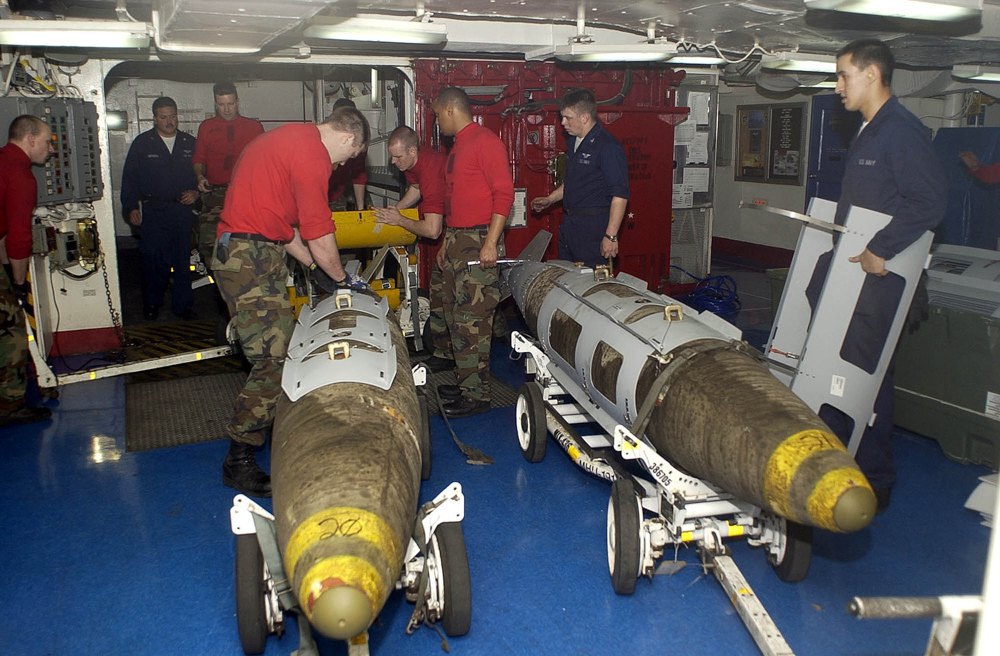
Guided bombs are munitions equipped with a guidance system that enables them to strike targets with greater precision: to within a few metres, rather than the tens or hundreds of metres of deviation typical of free-fall munitions. Guidance and aerodynamic control systems take the form of a tail rudder or folding wings that correct the trajectory after release. KABs are also known as smart bombs.
The first examples of this weapon were used in the Second World War (the German radio-controlled Fritz X bomb and the American Azon). In the Vietnam War, the US used laser-guided bombs from the Paveway series. During the Gulf War, American JDAM (Joint Direct Attack Munition) technology emerged — bombs were transformed into high-precision weapons using an inertial navigation system and GPS. The coordinates are programmed into such munitions before release, and they operate without visual contact with the target and in all weather conditions.
Satellite and inertial guidance are the most common, used in American JDAMs and Russian guided bombs with the UMPK (universal planning and correction module). This method is not suitable for engaging moving targets. The deviation from the target is 5–15 m. With laser and thermal imaging guidance, it is 1–3 m.
The range for dropping KABs ranges from 10–28 km (guided bombs without wings) to 150 km and more (glide bombs with a rocket booster).
The key point is that the aircraft drops the bomb without entering the Russian air defence zone, or leaves the area before the bomb reaches its target. In other words, the only effective way to deal with cruise missiles is to take out the aircraft over Russian territory using long-range weapons.
Instances of the munition itself being shot down are almost sensational. Defense Express reported on one such instance in February 2025 — at that time, the military near Zaporizhzhya achieved this, presumably using an old Soviet ZU-23-2. Experts suggested that this was made possible by specific tactics, as well as the modernisation of the anti-aircraft gun, plus its integration with a detection, guidance and control station.
Why Russian KABs are dangerous
In 2023–2024, Russian troops began using old Soviet free-fall bombs of the FAB series (250, 500, 1,500, 3,000 kg) in the war in Ukraine, to which they had attached a UMPC module. They were dropped using operational-tactical aviation — from Su-34 aircraft.
Russian forces began striking frontline areas in the Kharkiv, Donetsk and Zaporizhzhya Regions, as far as the bombs could reach. Over time, this range changed — either the aircraft flew closer, or the Russians used munitions that could travel further.
In the spring of 2024 in Kharkiv, for example, a situation arose where KABs began to reach the northern and eastern districts of the city, whilst the south was still outside the strike zone. Residents and visitors to the city observed this pattern first-hand and took it into account when planning their daily lives. The ‘safe’ boundary lay slightly south of the centre of Kharkiv. But it soon shifted further south, and then to the outskirts.
The Russians are also fitting rocket boosters to the standard UMPK casing; at the appropriate drop altitude, the bomb then travels almost 150 km. To counter electronic warfare, new versions of the UMPK are fitted with eight or more satellite antennas.
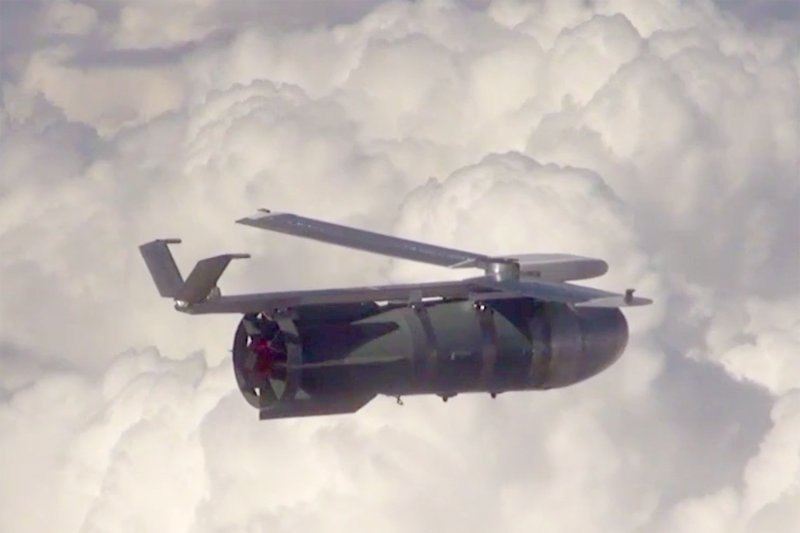
Such munitions are highly destructive but not particularly accurate weapons. For example, the FAB-1500 creates a crater up to six metres deep and 20–25 metres in diameter. People can suffer concussion even at a distance of 300–350 metres from the point of impact.
A recent example is the strike on 16 May on the village of Pidlyman near Borova in the Kharkiv Region. Two local women were killed when a KAB struck a house.
And on 5 May, 12 people were killed and 46 wounded in KAB strikes on Zaporizhzhya. Cars, a factory and a shop caught fire. Russia struck the rescue workers who had arrived to put out the fires with drones.
Foreign equivalents used in Ukraine
In May 2026, according to the Defense Express portal, the US approved the potential sale to Ukraine of over 1,500 JDAM-ER kits for aerial bombs, worth up to $373.6 million. Ukraine had previously received them as part of military aid and had already deployed them. JDAM-ERs feature GPS guidance and are adapted for Soviet-era MiG-29 and Su-27 aircraft.
Their effective range in Ukrainian conditions is reduced from around 70 km to around 40 km. This is because the Russians can launch their guided bombs from higher altitudes, whilst Ukrainian aircraft, under pressure from Russian air defences, must operate at extremely low altitudes and use a climb mode, where the aircraft raises its nose and gains altitude whilst launching the munition.
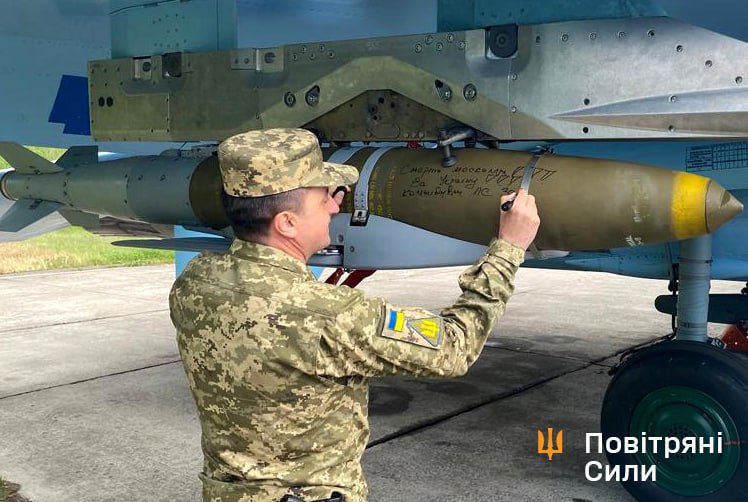
In 2024, the US procured additional sensors for the JDAM-ER, capable of targeting GPS jammers. This was due to the specific conditions on the Ukrainian front: Russian jamming significantly reduced the effectiveness of GPS-guided munitions.
There is also the French AASM Hammer — an analogue of the JDAM. This is a kit of additional equipment that converts free-fall (so-called ‘dumb’) bombs into guided ones. Thanks to its modular design, the bomb’s characteristics can be adjusted — programming the burst altitude, speed and angle of impact. In the Ukrainian Armed Forces, they have been adapted for launch from Ukrainian MiG-29 and Su-24M aircraft. The range is approximately 70 km, with an accuracy of around 10 m.
On 4 March 2024, such a bomb was dropped on a Russian facility in the temporarily occupied territories of the Kherson Region. Commander of the Ukrainian Air Force Mykola Oleshchuk posted a video of the strike and a photo of the KAB on Telegram with the caption ‘For the children of Odesa. With hatred, without respect’. Earlier, on 2 March, a Russian drone strike on Odesa destroyed the entrance to a nine-storey block of flats, killing 12 residents, including five children.
The small-sized American GBU-39 guided aerial bombs, which are also in service with the Ukrainian Air Force, weigh 110 kg. The bomb’s folding wing is located on top. When suspended, it is folded downwards; after detachment, it unfolds. The bomb can be programmed in flight to enter target coordinates and select the type of detonation — airburst or contact.
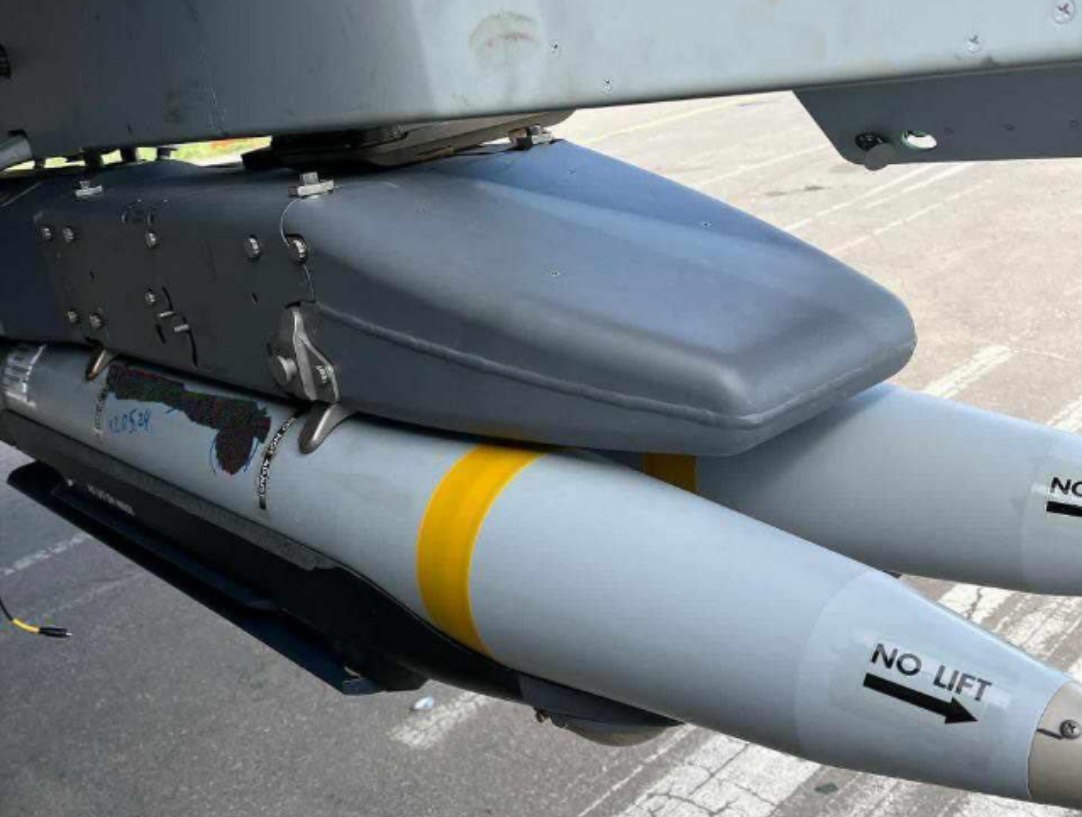
The bomb is equipped with an inertial navigation system, at least three GPS receivers, an on-board computer and an electronic countermeasures protection module. Its probable deviation from the target is just 1 metre. At sufficient altitude and speed, the GBU-39 can glide for almost 110 kilometres. The bomb’s weight allows it to be used on MiG-29 and Su-27 fighter jets.
***
As foreign supplies are insufficient, Ukrainian manufacturers are attempting to create their own equivalent. Whether it will be comparable in performance and whether sufficient quantities will be produced remains to be seen.