






Investments, risks and company valuations
Who is investing in the Ukrainian defence sector today?
Investors joining the club typically manage investment portfolios ranging from €50 million to €100–150 million.
At the same time, major investment funds are already considering projects worth up to half a billion dollars. There are currently two such interested parties. For Ukraine, these are substantial investments.
How many of the club’s investors are Ukrainian?
This is a difficult question. At present, there is only one. Dragon Capital is also considering entering the market.
Ukrainian legislation remains unfavourable to investment funds. There are numerous challenges in this sector. Intellectual property protection is weak. Investment legislation is underdeveloped. It is difficult for a Ukrainian fund to attract large amounts of capital, largely because the jurisdiction governing those funds remains Ukraine. Unfortunately, from a European perspective, Ukraine’s judicial, patent and law enforcement systems are still viewed as insufficiently robust.
Why is this a risk for investors?
Because investors assess not only the product but, above all, the team that creates the intellectual property. That is where the core value lies. It becomes a risk when significant funds have been invested but the underlying value cannot be adequately protected.
So what attracts private investors? They want to make a profit, but there is unfavourable legislation, a relatively closed Ukrainian defence market, and the war is ongoing.
Firstly, investors understand that our defence sector remains largely isolated within the country. As a result, company valuations are still relatively low. It is a high-risk, high-return opportunity, which is precisely why venture capital firms are becoming involved.
The first investments were around $50,000. Then ambitious young companies such as Buntar, Swarmer and others began to grow, and investors realised they needed to commit larger amounts. We are now seeing investments of $3.5–5 million.
At the same time, those entering the market later are finding it increasingly difficult to identify attractive opportunities. Company valuations have risen, and businesses have become aware of growing investor interest. There is also the question of how companies value themselves. In some cases, valuations are highly speculative, based on comparisons with other firms without understanding their financial structures, sales volumes or production capacities. That is not a sustainable approach. Companies need to understand how to value themselves properly and be able to demonstrate why they are worth a particular amount.
So what returns are investors expecting?
Take D3 Venture Capital, a venture fund focused on defence technology, as an example. It was an early investor in Swarmer, a Ukrainian developer of autonomous UAV solutions. Just imagine the returns generated once the company went public on the Nasdaq exchange in the United States in March 2026.
Did they realise this would happen?
It’s down to the professionalism of the people working at the fund and their ability to assess the situation. And believe me, Swarmer was guided through the process for a long time. They were shown how to make themselves understood by investors. Every investor has an interest in promoting a company from their portfolio.
Could other companies follow this path in the near future?
Yes. Many are interested; that’s true.
What does this offer the companies themselves?
The more they open up, the more people invest in the company, the faster it grows. When a company receives its first investment, it’s already a green light for other investors to get on board.
Currently, even a large Ukrainian defence company is valued significantly lower than American start-ups in the US. A real product, a real company, a team, feedback, and battle-tested technologies are all being overshadowed by start-ups.
So, as long as Ukrainian companies remain isolated within the domestic market, they will never grow and become the equivalent of Rheinmetall, Saab and so on.
But in companies that are open to the international market, investors are willing to take much greater risks.
How can companies use the funds invested in them?
It depends on what they raised the investment for. But let’s be honest, it’s a crutch to keep the company afloat, even if it is actually operating. Some have raised funds for R&D, working capital, components, development, and testing.
There are no strict limits. Although sometimes investors say: ‘For everything except working capital.’
Ukrainian and global trends
Have you noticed an increase in interest from private investors following announcements about the opening of arms exports?
Yes. Following President Volodymyr Zelenskyy’s statement in October 2025 at the Third International Defence Industry Forum that it was time to launch exports, there was a massive surge over the next three months.
Many investors came to Ukraine. From Brazil, Colombia. Everyone realised that the market was developing.
Even at the forum itself, the president met with investors and answered their questions. And there were a great many questions. Because for any investor, it is important that the company they have invested in can sell not only in Ukraine but also worldwide. And this will breathe new life into the market. Both for investment and for cooperation.
But now I’m more often receiving enquiries due to the problems that are arising. When the war in Iran broke out and the whole world heard about Ukrainian interceptors, we were inundated with enquiries: who can I talk to, who should I invest in, I only need interceptors.
And we are now changing investors’ perceptions. It came as a revelation to them that the interceptor drone is the final stage, and that before that there is a huge amount of work to be done with other systems. And that a single system does not work on its own; a complex is needed.
That’s how the Drone Deal concept came about. Because you need training, radars, special acoustic sensors, and an overarching system to integrate it all into. You need the right people who know how to adapt and implement this system.
But everyone wants a magic wand.
Were these investors already experienced in the defence sector?
They were very different. It didn’t matter whether it was a company that had only just become interested in defence or one that already had experience — they were all focused on a single ‘super-drone’.
A standard European investment fund is used to companies such as, for example, Anduril (an American defence company. — Ed.). The ‘Tesla’ of the defence sector. High-quality, effective solutions. But the price is sky-high.
And when they enter our market, there’s a disconnect. Now they’re also seeing the Taliban taking out Israeli Merkavas in droves, bombing their depots and vehicle parks. A single FPV — a tank, if I’m not mistaken — costs 3.5 million.
At the moment, investors are mainly interested in drones. Are there any other hot items, for example, I’ve heard that AI systems are also in high demand?
In terms of equipment, it’s just drones. They’re not interested in any conventional equipment, neither artillery nor any new mortars. They don’t invest in conventional defence. It’s only if you want to set up a workshop for refurbishing military equipment. But that’s more of an investment in infrastructure than in the company itself.
But if you’re a venture capital fund and want to invest in the future, it’s only drones.
The latest figure for private investment in Ukrainian defence tech stands at $105 million. What does this tell us? Is it already having a significant impact?
We can talk about the trend. In 2022, someone is investing $500,000 in the Ukrainian defence sector. I have the utmost respect for these people, but I find it hard to imagine how they made that decision in 2022. It was such a risk.
But year on year, we are growing rapidly. Our forecast for this year is around $200 million. With the opening up of exports, we plan to reach around half a billion.
In global terms, that’s nothing. The UK alone invests around three billion pounds in its defence sector. And that’s just government programmes. I can only imagine what the private investment is like.
So the current figure is very small. If we reach two to three billion a year, we’ll be able to talk about a phenomenon.
But the average investment amount has already grown significantly. There are now companies that aren’t interested in an investor willing to put in two to three million. The minimum is now 10 million. And that’s already Series A in investment terms. This gives me confidence that we will genuinely accelerate these figures.
But what is 10 million euros in the global defence system? Imagine that amount at Rheinmetall. It’s nothing.
That’s why I want us to celebrate not a billion, but at least around three to five billion. I want to nurture such companies. For us, as a country, it is important that we play a role [in the global defence system].
And do you think this is only possible through collaboration with foreign companies?
To be honest, I don’t really believe that a company operating solely within Ukraine could grow to the level of the Czechoslovak Group, for example.
Without international exchange, contracts and a presence abroad, it’s impossible.
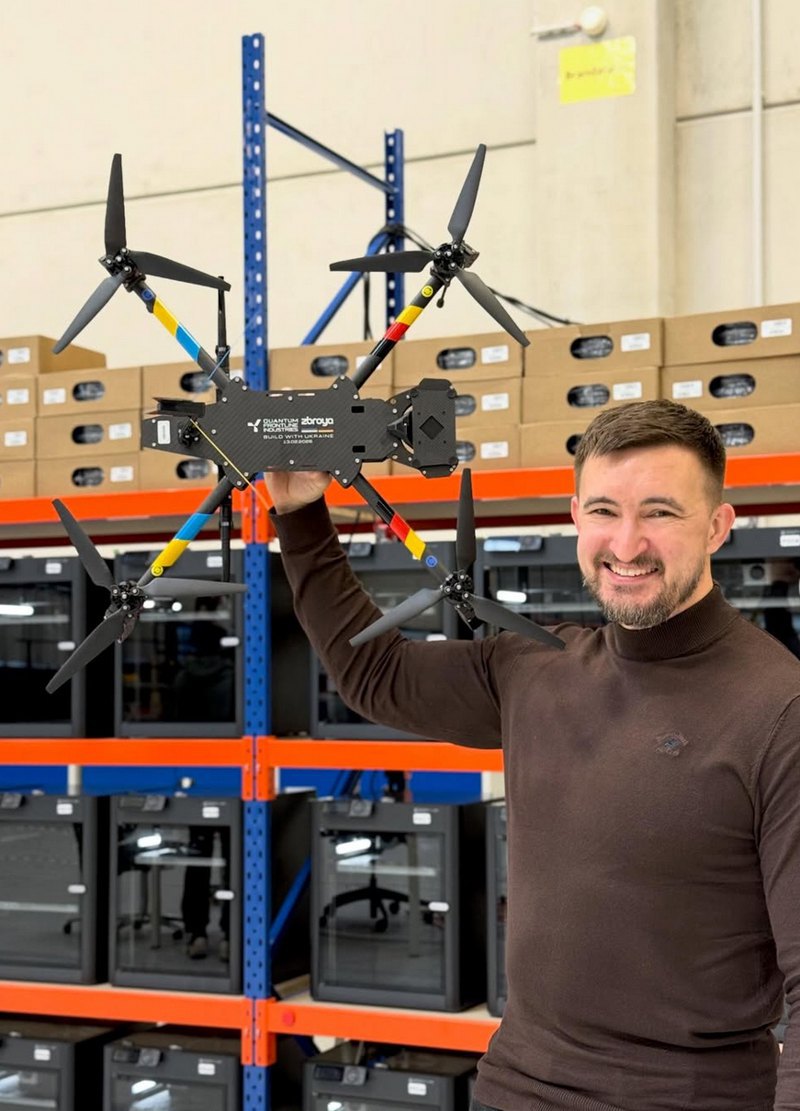
It can only be done through partners. That’s why we launched Build with Ukraine.
Is it actually possible to track trends in private investment on the global market, in European countries? Are they also more interested in drones there?
There’s a real drone craze at the moment.
There are also nuances with international funds; they are mostly ‘herbivorous’, so to speak. They need the product to have dual-use capabilities. They don’t see the market as purely military. This is the right approach for risk diversification.
But in our situation, it’s difficult to think about any kind of dual-use. However, companies that want to survive after the war must already be incorporating this idea into their products — what we will do with them in civilian life.
Joint ventures, intellectual property and compliance with standards
Is the Build with Ukraine programme also considered an investment in the Ukrainian defence sector?
It is not an investment. It is more of a political matter: ‘If you want to build our technologies with us in your own country, then we ask you to help with this additional support.’ For example, to cover the annual production budget and supply the product to the Ukrainian army. This is how a foreign company becomes involved with our technologies.
How many Ukrainian companies have already set up joint ventures with foreign firms?
Under the Build with Ukraine programme, we currently have 19 agreements, two of which are already operational. These are two Ukrainian companies with joint production facilities and a full suite of solutions, licences, permits and so on.
This is the first step, because companies need to understand how they work together, whether everything is okay, and whether they’ll fall apart within a year. There’s the first contract, the product’s been created, everything went great — now let’s think about the second one. For example, localising a certain percentage of component manufacturing. These are steps towards the future.
What does this mean for Ukrainian companies?
In terms of investment alone, a company’s value increases exponentially. You’re already in Europe, building partnerships and operating within the EU. This literally opens up access to global finance. And that means limitless opportunities. Not to mention the number of business support programmes and available grants.
And our task as a market is to work as hard as possible to have ten real joint ventures by the end of the year. This is a qualitatively different level for a company. And, by the way, we still need to be ready for this, both as a team and as a company as a whole. And this needs to be taught.
How have these two companies, which have joint ventures, managed to reconcile the weak protection of intellectual property in Ukraine with the legislation of the partner country?
Both companies are working with German partners. The German partners currently treat us with understanding, recognising that we have different legislation in some areas. It is true that they operate under European legislation, whilst we operate under domestic legislation.
There are many issues regarding protection, but the partners are willing to cooperate. They are sponsoring these projects, which, incidentally, is also important.
In general, Germany is currently setting an example for all European companies and countries that such cooperation is indeed possible. We are currently seeing the greatest interest coming from the German side. Everything has fallen into place there: they have the financial capacity, the political will, and the interest of their companies.
Am I right in thinking that the issue of intellectual property now rests with German companies?
I think this is also a benefit for them. Because they realise that, with access to Ukrainian technologies and battle-tested solutions, it will be much easier for them to sell jointly developed products on international markets. For them, this means profit and growth.
Can we say that this experience of cooperation could form the basis for further developments to protect intellectual property within Ukraine?
100%. But we could have an incredibly fantastic law, yet without a robust judicial branch, it can be interpreted any which way. From region to region, from interest to interest. And any legal defence for you, as a company, in the courts would take decades.
Today, IP in Ukraine is all about speed. How quickly you can adapt changes to a product. Why is it so hard for European countries and manufacturers to accept this right now? Because over there, if you develop a shell, it will remain a shell for 100 years; it was sold and will continue to be sold. The same goes for an aeroplane. A drone is like milk: three months — and goodbye.
And they aren’t ready for that. Hence the comments about there being a lot of manual labour, and them calling us garages or households.
That is precisely why the big giants are very reluctant to enter this market. They are not ready for this. Neither their mindset, nor their military doctrine, nor their production capacity — nothing in Europe is ready for such a change. But the Russians are ready.
When it comes to integrating the Ukrainian defence industry into the global market, the issue often raised is that Ukrainian companies do not meet NATO standards or certification requirements. In your view, how many Ukrainian companies are already capable of initiating this process?
Well, in terms of being fully ready, there are about 30 companies on the market. At most. Out of over a thousand.
And what’s holding the others back?
Firstly, the quality of management. It’s clear when production is based on a genuine understanding of how business is actually run, and processes are structured accordingly. Even if a company focused exclusively on the product for the first two years, at some point it realised it needed to move beyond this ‘emergency market’ into something stable, to get on track.
Here, when it comes to ISO certification, some companies think, ‘Goodness, 10 grand — and in two months it’ll all be sorted.’ I explain to them that it’s not just so you can put the certificates on a shelf. It’s so the company can speak to partners on the same level of technical and business language.
That’s why NATO partners tend to view us more as family businesses. Because very often, for example, there’s the owner, the chief accountant, the chief engineer — all of these roles are filled by a single person or people with the same surname. There are no signs that the company is moving towards becoming a corporate entity rather than a family business. And that’s important. But here we have a huge gap, both mentally and structurally.
And on the subject of intellectual property — in the event of a rights infringement by, say, an American company, our legal system…
Good luck.