





How does the marketplace work, and have there been any disqualifications yet?
How would you assess the performance of DOT-Chain Defence? What are the key performance indicators?
We focus on the system’s competitiveness, not merely on supply volumes. Our goal for this year is for more than 80% of the unmanned systems market to be involved in DOT-Chain in one way or another. We want to ensure that the key manufacturers of products listed on DOT-Chain are represented within the system.
For the end user, this means having a choice. For the market, it means operating in an environment where companies must compete with one another, whether on price, product quality, service excellence, or all of these factors combined.
Overall, we assess the system based on feedback from our key clients in this context — the military. They rate it positively, which is why we continue to develop and expand the system.
Recently, Drone Line joined the platform; previously, it had been purchasing equipment directly from manufacturers. I therefore believe that the system has proven to be faster, more efficient and easier to use than a decentralised model, in which brigades would have to organise procurement independently. Such an approach is also challenging for the market, as it involves hundreds of different contracts, procedures and regulatory requirements.
Are these only private manufacturers?
No, state-owned manufacturers can also participate; the system allows for this. We do not discriminate on the basis of ownership.
The main distinction is that state-owned enterprises often have a certain degree of historical continuity in production — they tend to continue manufacturing what they have produced for decades. However, this does not apply to all of them. Some are genuinely seeking to restructure and diversify. Companies that traditionally specialised exclusively in artillery and mortar ammunition, for example, are now attempting to enter categories related to unmanned systems. This may include the production of UAV-mounted payloads or strike modules.
Read also“We have to invest our own funds.” What issues with state drones are soldiers mentioning? And what about the manufacturers?
Have there been cases where a company was not admitted to DOT-Chain Defence, and if so, why?
If there have been such cases, they have been isolated. They involved entities subject to sanctions, legal entities undergoing bankruptcy proceedings, or non-domestic manufacturers offering imported products. In other words, these were companies that failed to meet the basic eligibility requirements applicable to all contractors.

Has anyone been disqualified for a breach?
Not yet.
How often do you have to fine manufacturers on the marketplace?
Quite often. We handle a huge volume of deliveries (the Minister of Defence recently announced that the platform features around 800 items from 200 manufacturers. — Ed.). This applies to both the marketplace side and the user side. We have several hundred customers. So multiply one figure by the other. And there can be several orders a month. We keep track of all of this.
The delays we’re talking about aren’t critical. In other words, these aren’t widespread negative occurrences. There are isolated cases, but they are common to various manufacturers and different categories when they are late with deliveries. Of course, appropriate penalties and fines are imposed for this.
Do they pay these fines on time?
Generally speaking, yes. Some try to go to court when they disagree with the claims process, though this is rare. In principle, they pay.
I recall that back in the DOT days, there was talk of protracted legal battles with some suppliers who did not want to pay fines. Why are there fewer such cases here?
It’s more likely that this is a new system. Even when we’re talking about fines, they generally don’t pose a threat to these companies’ financial stability. That is, these are individual deliveries that they fail to fulfil on time. A penalty is charged for these individual deliveries. But it’s reasonable.
With central contracts, the manufacturer usually has something to fight for. Because if they have missed a deadline, we are talking about a batch for the entire contract; these are large quantities, and therefore a significant liability.
With DOT-Chain, the quantities are small — the liability is small — so it may be easier for them not to spend resources on litigation, but simply to pay the fine.

And if they fail to pay, do they face being banned from the platform?
Not necessarily. They face legal action, which will result in a court ruling. This court ruling will be enforced either voluntarily or through the enforcement services. The only thing we are seeing is not a systemic disruption to supplies that actually jeopardises the provision of supplies to the troops. If we were to see that this is a systemic issue, we would assess it appropriately. As things stand, this is not the case.
Regarding service. How important is the quality of after-sales service in the collaboration between the marketplace and the manufacturer? Is this a criterion?
Service is assessed first and foremost by the customer. From what I can see: if a manufacturer has a well-developed service not only in terms of the technical aspect—where, if a product needs reconfiguring, they will reconfigure it—but also in terms of the customer experience, naturally, the units choose precisely such manufacturers.
But we also frequently receive requests from military units asking us directly to add a particular manufacturer to the marketplace. In that case, we prioritise them.
So, a manufacturer can get onto the platform not only by applying themselves, but also through a recommendation?
There are two rules, and they are very simple. The first is that whoever applies first is placed in the queue in that order. And prioritisation within the queue depends on whether there is a request from military units.
What happens after the military lodges a complaint about a manufacturer’s service, and how is it resolved?
If the question is whether we penalise such manufacturers or suspend orders, the answer is definitely no. We have a department that handles such complaints on a horizontal basis. That is, when a complaint is received, they contact the manufacturer directly and point out: ‘Look, your managers on the ground are doing something wrong.’
There is no more systematic punishment at present. Perhaps, at some stage, we will reach a point where we include direct service requirements in contracts, with a specific level of accountability—for example, that a complaint must be resolved no later than 24 hours after it is received. But for this, we need more feedback from both the military and the market on how to regulate this.
We are in no hurry to regulate these relationships through contracts, because any regulation is, in a sense, a restriction. We are very cautious about this. But if a systematic demand emerges and we see that it is objective, we may move in that direction.
One of the criticisms levelled at the marketplace is that it gives an advantage to manufacturers who are already large. I know that you launched the Cupidrone the project on 14 February. Have there been any instances since then where a match was made, where a division was working with one manufacturer but was offered another, and everything worked out?
We don’t offer anything to anyone. That’s important. In other words, we don’t advocate for any single manufacturer. We don’t want a situation where people later say: ‘Defence Procurement Agency said we should buy from this particular one.’ Definitely not.
Is there currently a free flow of military equipment from one manufacturer to another? We would like this flow to happen more easily. Because at the moment it isn’t happening on a scale that would send a good, clear signal to the market that they are actually competing a bit more closely with one another.
There are large manufacturers who work with specific teams. These teams turn to them time and again and aren’t inclined to reconsider their choice. We see this behaviour.
Are we, in this context, creating any preferences for the military or for manufacturers to highlight them more actively on the marketplace? Not at the moment. Any preference must be very well justified. If we create it in a way that raises questions, people will then see some ulterior motive in it. We don’t want that.
Drones in tenders and why 70% of UAVs via DOT-Chain are not currently in the plans
There was recently news that they want to switch drone procurement to tender procedures. Is that the 30% that will be supplied centrally?
Yes, that is the percentage planned for supply and already being supplied centrally. It is actually more than 30%. 70% was the plan of the previous minister, announced at the end of last year. The Ministry stated at the time that, specifically for FPV, they planned to allocate 70% to DOT-Chain by 2026.
The current ministry team has reviewed this decision. Essentially, we are continuing to fund supplies for teams via DOT-Chain at a level corresponding to the volume at the start of this year, but no more than that. In other words, centrally ordered supplies still predominate at present.

Will more than 50% still be centralised?
It still follows orders from the General Staff, but there is now a significant difference: these orders are only fulfilled for those items that have made it into the rankings. In March, the regulations on demand planning were amended. If you’re ordered on DOT-Chain, on Brave Market, and if you have good Mission Control metrics, then the product now enters the ranking. This ranking is administered by the Ministry of Defence. And the General Staff can only select certain products from those manufacturers included in the rankings. But this is still a centralised approach.
So, what follows this centralised logic will now partly be included in tenders. This will not affect what goes to DOT-Chain Defence monthly for each brigade. There is a fixed amount for tenders, which will be allocated monthly.
Tenders will be announced for most UAV categories, but not all.
Is the aim of these tenders simply to save money?
Firstly, to save money, and secondly, in some categories, to give access to government contracts to smaller manufacturers or those who previously did not feature in the General Staff’s orders.
But aren’t they in that ranking?
No, they aren’t. The tender system will not be based on the ranking system; it will run in parallel.
Because the ranking system also strengthens the position of those who have been in the market for a long time. For the most part, over all this time, it has been the large producers who have received orders on marketplaces, whilst smaller ones have had fewer orders. Fewer of them are classified as successful in Delta. Therefore, the tender system will both save money and provide an entry ticket to those producers who currently either have no state orders at the central level, or who have significantly fewer than they could have.
Will this initially be a small percentage of centralised procurement?
That is not yet known. We are still discussing this with the ministry; our recommendation is to launch this as a pilot scheme with a small volume.
Tenders present a certain challenge in terms of calculating everything correctly. The tender categories must be formulated in such a way that every manufacturer understands exactly who they are competing against. If they are too broad, incompatible goods will end up in the same tender; if they are too narrow, there will be no competition, and everyone will accuse the process of being tailored to a specific manufacturer. That is why the Defence Procurement Agency plans to approach this as a pilot scheme.

But will price still be one of the main criteria? I’m wondering whether we’ll end up in a situation like the one with the hot water bottles this year.
Price will certainly be the main criterion. But we now have a mechanism in place to prevent a situation where all orders are placed with a single manufacturer who offered the lowest price but then failed to deliver.
I am referring to the diversification of contracts, which we introduced with the Ministry of Defence in March this year. It has proven to be effective enough to prevent us from ending up in such situations.
For reference: this is the mechanism announced in March for the procurement of UAVs, small arms and ammunition, under which, instead of a single supplier with the lowest price, the Defence Procurement Agency distributes orders among several participants according to a special formula, provided there are two or more acceptable bids. Bids that are 30% or more expensive than the lowest are not considered, and the volume allocated to each participant depends on their actual capacity to fulfil the contract.
Let me clarify further regarding this 70/30%. So, is the target of 70% of drone procurement via DOT-Chain no longer in place?
The Ministry of Defence’s current vision is different. It is not about 70% versus 30%. It’s about ensuring certain volumes are procured via DOT-Chain. Financial resources are allocated for this on a consistent, monthly basis. The remainder should be based either on existing ratings, which are already in use, or on the results of tenders to be launched this summer.
And what percentage ratio are we talking about?
It’s hard to say.
Perhaps this is a naive question, but why not, for example, transfer all FPVs to the DOT-Chain?
We should only talk about everything going onto the DOT-Chain once we see the shift between manufacturers that we mentioned earlier, when this truly becomes a widespread phenomenon on the marketplace. That is, when manufacturers actually start competing with each other, including on price. Because right now they compete on brand, not on price. People have already got used to certain manufacturers based on various criteria.
Today the market is almost perfect: there are many manufacturers, many users, free choice, and they interact with each other. But it is precisely in pricing that there are still flaws, due to the lack of fluidity. And when we see this, then we can talk about everything moving onto the DOT-Chain.
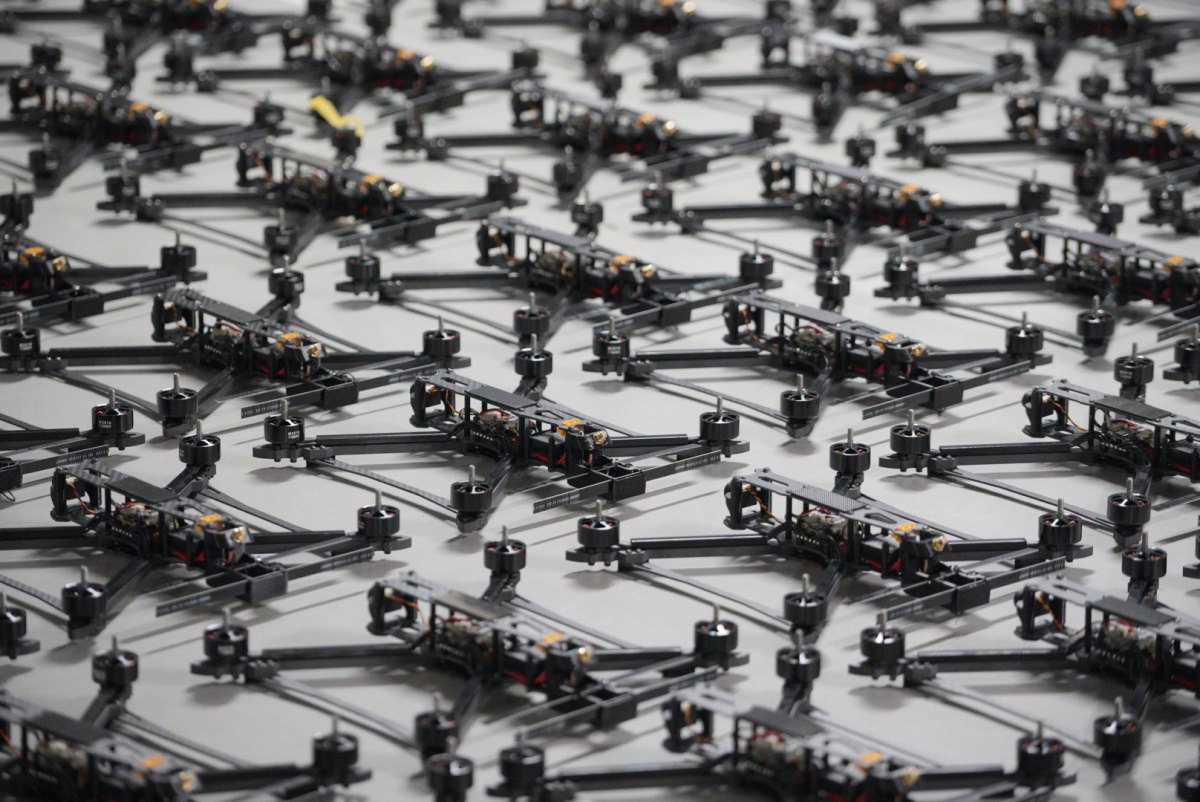
Why is this fluidity not yet there? Perhaps because smaller manufacturers have not yet gained the capacity to put pressure on the larger ones and attract orders to themselves. But solutions are being introduced to unify the user experience, just as the EU once forced Apple to switch to Type-C to remove barriers to switching from one manufacturer to another. There is a trend towards reducing these barriers to switching from one manufacturer to another.
A trend towards interchangeability?
Exactly. When this interchangeability takes hold, when smaller manufacturers start to engage more actively with teams and compete with larger ones, and this is reflected in the price, then we will say that the market has truly reached the stage of development where it can be fully relied upon. Apart from a certain reserve that must be held by the chief of staff and the minister.
The CORPUS coalition and the line between centralised and decentralised procurement
In April, the Defence Procurement Agency signed a memorandum with defence procurement agencies from five partner countries to establish the CORPUS coalition. How did this idea come about? And which of the partners did the agency approach first?
Last year, we saw that our partners no longer doubted our professionalism, and they began to take an interest in the specifics: how to proceed when it is necessary to urgently procure goods that were previously not available on the market at all.
Their request to work with us wasn’t about the ‘big brother’ assessing the ‘little brother’ to see if they belonged in the circle of civilised nations. They didn’t want a transactional exchange, but rather a shared understanding of the challenges, each drawing on their own experience. That’s why we decided to formalise this collaboration into a structured framework.
Meaningful communication was established immediately with agencies from several countries: the British, Norwegians, Swedes and Italians, followed by the Finns, with a few more joining now. When there were many such bilateral dialogues happening simultaneously, we initiated a joint platform to save time and make the exchange more valuable for all participants.
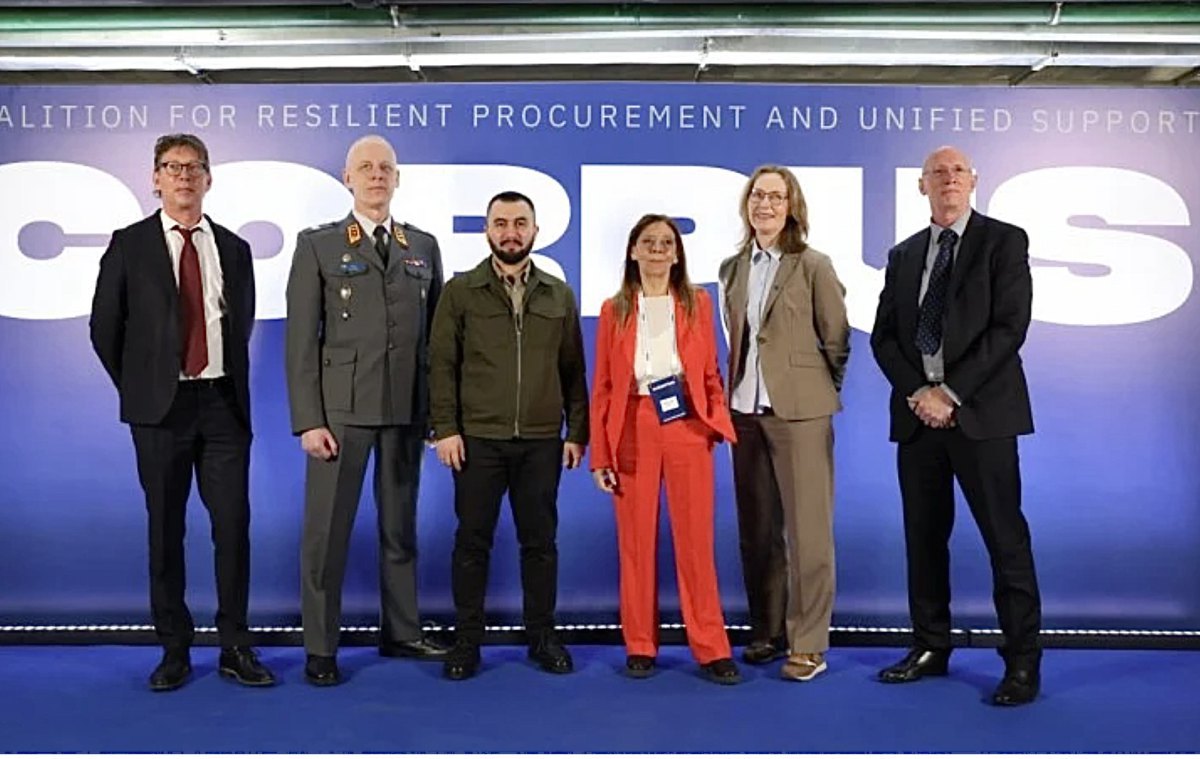
At the CORPUS presentation, representatives from these countries stated quite clearly that they were specifically interested in the software and in how Ukraine manages these rapid procurements. What exactly is Ukraine interested in regarding these countries’ procurement systems?
Firstly, how they prepare their defence ecosystem in peacetime. The logic of ‘weapons stockpiles = readiness for war’ is no longer sufficient; a dynamic environment is needed that develops even without an active phase of war. Our partners are tackling this in different ways, and we plan to adopt some of their solutions.
Because we are currently in a situation where everything is on fire, both literally and figuratively. But sooner or later we will enter a phase where we must prepare for war, but not wage it actively.
Secondly — how they track supply chains. At the moment, we’re sourcing whatever works from all over the world, but sooner or later we’ll have to comprehensively monitor who is importing what and from where, for the sake of both European integration and national security. The Europeans are developing digital tools for this, but exactly which ones is classified information.
Thirdly, three out of five CORPUS partners combine procurement for their own armed forces with export contracts. Whether the DPA will take on such a role has not yet been decided, but if it does, it will be interesting to see from their experience how these two functions do not conflict with one another.
Also, apart from the fact that we are in the heat of war, there is likely a difference in market culture. Ours, for example, is often described in the industry as toxic, and there are also quite a few schemes.
Do you understand how this works in partner agencies? For example, regarding debts owed by manufacturers. Do they have this problem too?
Debts, everyone has them. The question is whether these debts are risky. In other words, is the counterparty deliberately going bankrupt to avoid fulfilling their obligations, or is it an acceptable debt where you understand that there were certain circumstances, and they will now finish manufacturing the goods, deliver them, or return the money. This second scenario definitely applies to our partners. As for the first one, they probably have less of it than we do. But it’s not that common with us either.
We do have outstanding debts. In my view, they aren’t that significant. We began publishing the figures following a decision by our supervisory board, which agreed on this with the Public Anti-Corruption Council under the Ministry of Defence. (According to the latest report on the DPA website, the amount of debt in the first quarter of 2026 stands at 27 billion hryvnyas — Ed.)

Of this amount, no more than 10% is debt that I consider risky. In other words, these were counterparties. This also includes contracts signed by our team. I’m not saying these were bad decisions; it’s simply a fact. The rest of the debt consists of accounts receivable, where sooner or later either the goods will be delivered or the money will be repaid.
In this sense, perhaps we do indeed have something to learn from the Europeans in terms of compliance, but our situation isn’t actually that dire.
And on the subject of decentralisation — NATO representatives emphasise that their system is more decentralised than centralised, and that we need to move in that direction. In terms of the culture in the countries with which Ukraine cooperates, what is their balance — what should be fully decentralised, and what should the state manage centrally? And would this balance suit us?
In this balance, they are currently keeping a closer eye on us. And it is precisely our decisions on the decentralisation of procurement that they like. As things stand, they fulfil their defence force procurement orders in a more centralised manner than we do, thanks to our purely decentralised, purely centralised and combined models.
And what about the product range that, in your view, cannot be decentralised?
Where it doesn’t matter who the manufacturer is, where there is no specific user experience, where I simply prefer one thing over another. For example, 155 mm rounds of a certain range, with specific characteristics, and so on. In principle, if it is of good quality, it doesn’t matter whether it is produced, for example, at a particular factory in Ukraine, or at another factory in Ukraine, or whether it is imported at all. Because it is a 155 mm round that simply fulfils its tasks.
And in contrast, there are products with high added value, where user experience comes into play — in other words, everything that can, in one way or another, be decentralised. Whether that’s pure decentralisation or a hybrid model.