





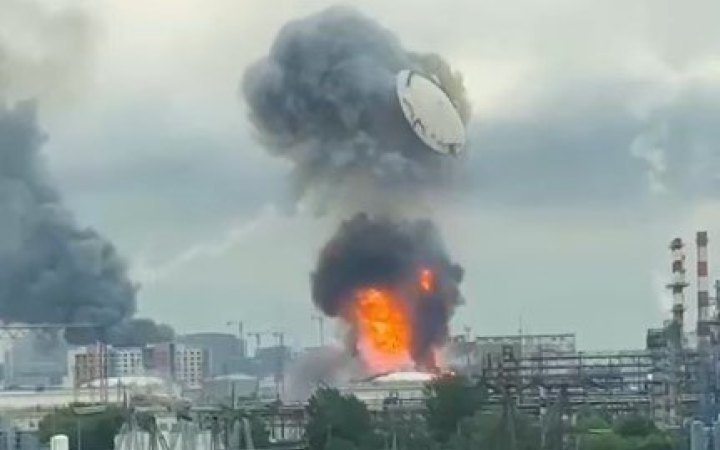
In June, the Defense Forces carried out long-range strikes (deepstrike) against Russia’s military-economic infrastructure—from temporarily occupied Crimea and Krasnodar Krai to Western Siberia.
This was reported by the Ministry of Defense.
The maximum distance for the successful use of strike assets exceeded 2,000 kilometers from Ukraine’s state border.
The strikes were aimed at depriving the enemy of resources to wage war: fuel; communications equipment; and the production of weapons and their components.
In particular, in June the Defense Forces carried out long-range strikes on 11 Russian oil refineries:
Tyumen Refinery (“Antipinsky”), Tyumen Region (more than 2,000 km). It is one of the largest oil-refining enterprises in Western Siberia. The plant’s capacity is 7.5–9 million tons of oil per year. The facility produces petroleum products for the needs of the Russian army.
Moscow Refinery (500 km). As a result of the strike, the AVT-6 primary oil processing unit and a combined unit were damaged, and storage tanks were destroyed. The plant halted oil processing for an indefinite period. The enterprise supplies up to 40% of Moscow’s gasoline needs and about 50% of its diesel fuel, and also provides jet fuel to the capital’s airports.
Ufa refineries “Bashneft-Ufaneftekhim” and “Bashneft-Novoil” (1,500 km). The Ufa refinery complex is one of the largest oil-refining hubs in Russia. They supply fuel not only to a significant part of the Volga Region, but also ship to other regions of Russia, including deliveries of fuels and lubricants for the needs of military groupings operating in Ukraine.
Orenburg Gas Processing Plant (1,200 km). Damage to four gas processing units has been confirmed, and the production process has been suspended. The complex produces gas and sulfur, which is used to manufacture explosives.
The Orenburg Helium Plant takes gas to extract helium and ethane, which are critical for missile technologies and aviation.
Refineries “TANECO” and “TAIF-NK”, Nizhnekamsk, Tatarstan (1,200 km). The region’s largest oil-refining complexes were hit, with a design capacity of more than 16 million tons of oil per year. The enterprises produce a wide range of fuels and lubricants, including for military needs.
Kuibyshev Refinery, Samara (900 km). A strike hit the enterprise, which has an annual processing volume of about 3.7 million tons of oil. The plant stopped operating after hits on the AVT-4 and AVT-5 primary processing units, as well as the tank farm.
Yaroslavl Refinery (“Slavneft-YANOS”) (800 km). A hit accompanied by smoke was recorded on the plant’s territory; its design capacity is 15 million tons of oil per year. The enterprise produces fuel that is important for Russia’s military logistics.
Refineries “Ilsky,” “Afipsky,” and “Slavyansky”, (Krasnodar Krai) (300–400 km). These enterprises supply diesel fuel and gasoline for the military logistics of the aggressor state. Their combined processing capacity exceeds 12 million tons per year.
Other facilities that provide fuel storage and transshipment were also hit.
Read alsoTitan-Barikady, oil refinery, space communications center: Defence Forces conduct large-scale combined operation
The long-range strike strategy also envisaged a comprehensive impact not only on the energy sector, but also on the enemy’s technological and command capabilities. In total, more than eight strategic facilities were hit, including enterprises producing artillery systems and navigation electronics for missile weapons, as well as key satellite and military communications centers.
“The degradation of Russia’s oil-refining industry and military-industrial complex directly reduces the aggressor’s military-economic potential. The systematic destruction of Russia’s strategic facilities is an effective tool of pressure on its war machine. The Defense Forces continue to compel Russia to end the war,” the Ministry of Defense emphasized.