






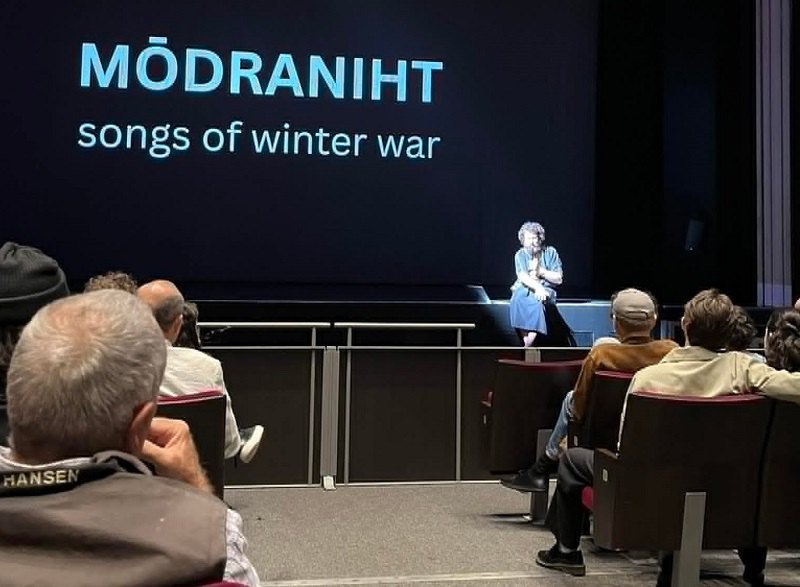
Opening Remarks Before the Premiere of MODRANIHT at Rotterdam Opera Festival
Hello, friends! The opera will begin in ten minutes, but before that I need to share a few thoughts with you. I am sitting here on the edge of the orchestra pit. It is an interesting position, ideologically speaking. A good place to talk about the difference between Opera and Music Theatre — Oper and Musiktheater. I have a few Ukrainian theories about this German term, Musiktheater. Usually, people from German-speaking countries enjoy developing theories about other nations, but today I will try to do the opposite: a Ukrainian theory about a German phenomenon.
In my view, the term Musiktheater was invented by German-speaking musicologists in the 1970s as a way of keeping young people and contemporary artists away from opera houses. After all, if you create opera, you need an opera house — a large building with an orchestra pit and substantial resources. But if you create Musiktheater, you can do it in a garage or a small black-box venue. The people who run powerful organisations such as Opera Europa like to call this the ECOSYSTEM of contemporary performing arts. They have their opera houses; we have our small independent garages and underground black boxes; and everyone is supposedly happy together within this ecosystem.
If we look a little wider and a little deeper into the idea of separating opera from music theatre, we quickly find ourselves inside other political ideas. In particular, the idea of dividing people into Übermenschen and Untermenschen — superhumans and subhumans. This idea also has a cultural dimension, stretching from Wagner and Nietzsche to Stockhausen and beyond. One well-known chapter of European history tells us that people who had Wagner were, for a time, able to kill those who did not. The reality of my country today is that people who have Tchaikovsky, Shostakovich and the Bolshoi Theatre can kill their neighbours, do so with confidence, and take pride in it. If you think I am exaggerating, let me remind you that in 2025 the Bolshoi Theatre closed its season with a major propaganda production of Prokofiev's War and Peace, glorifying Russia's invasion.
My name is Illya, and together with my colleague Roman Hryhoriv, I have been working in contemporary opera in Ukraine for the past twelve years. Four of our operas have been presented on this wonderful stage. And, of course, this is not simply a stage but a community of people who create Europe's most important music theatre festival, Operadagen / O. Festival. Guy Coolen, the artistic director, and Lique van Gerven, the technical director, are among those people. Over the years, I have probably exchanged some 300 emails with them. I think that is the point at which a professional partnership begins to resemble family ties. Speaking of theatre, some of the props we ordered for previous productions once belonged to Lique's apartment in Rotterdam. Today they form part of the interior of our studio in Kyiv. These invisible journeys of objects are what contemporary theatre is really about.
We presented our previous operas here in 2022 and 2024 — years already marked by the full-scale war. The Third World War, taking place on the territory of Ukraine. A great deal has happened between those productions. Sadly, much of it has been tragic. We lose people close to us. Every month we attend the funerals of artist friends killed by Russians, either on the battlefield or in their homes.
Today is Tuesday. On Sunday evening, while our group was travelling by train to Poland, Kyiv came under the most devastating aerial attack since the Second World War. Russian forces deliberately targeted numerous cultural sites. The entire district where we rehearsed this opera just two weeks ago has been destroyed. Three weeks ago, a newly restored Chornobyl Museum opened in central Kyiv. The exhibition included costumes, stage designs, theatrical models and other artefacts from our opera Chornobyldorf. During the attack, the museum was heavily damaged and the exhibition, together with many unique artefacts, was completely destroyed by fire. Yet after losing so many remarkable people, after seeing Russians erase entire towns and villages, the loss of objects no longer feels extraordinary. It is simply another day in Kyiv, where Russians try to kill you and destroy everything you have. On our way here, we joked that the Russians were deliberately trying to destroy our opera. Fortunately for us, this is difficult, since we rarely perform in Ukraine and spend much of our time travelling internationally. Of course, it is only a joke. The Russians are not trying to destroy only our opera. They are trying to destroy Ukraine and Ukrainians altogether — as a physical, political and social reality.
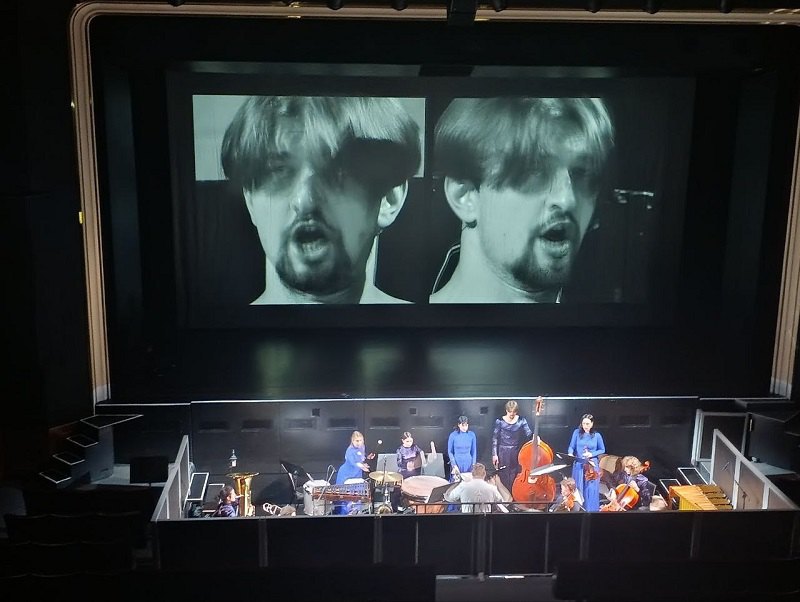
Last summer, together with our performers, we began working with the Veterans Theatre — people who lost arms, legs, eyes or parts of their faces on the front line. In tonight's opera, you will see a short fragment created together with our performer and veteran, Andrii Onopriienko. He now works in theatre, performs in major productions and plays leading roles. This evening, he is appearing with his company at the National Theatre in Kyiv, while in our opera he appears in a brief video essay.
How do you speak about war on stage? Literally, I think it is impossible. War and theatre are, in some sense, opposite things. Tomorrow we travel to Vienna for Wiener Festwochen, and I still have an unanswered email from Vienna's Municipal Department 36. The question is: exactly how much war, and how intensely, is war depicted in your work? Will it be too much for a Viennese audience? I do not yet have an answer. But I will try to prepare one for our performance in Vienna and present it publicly.
The opera you will see tonight is the result of 24 months of work. In a way, it has been an existential process. We often say that this is "an opera written by life itself." During its creation, the work changed its title perhaps five times. One of those titles was Winterreise (Winter Journey), connected to the story of the Aral Sea. That sea is disappearing in Central Asia as a result of Soviet Russian communist policies. At one stage, the genre of the work was described as opera pratica, or "how to make opera during wartime" — essentially a manual, a genre variation on Roland Barthes' essay Musica Practica.
The opera you are about to see lasts 109 minutes. Its title is MODRANIHT. Songs of Winter War.