







The (DIS)SENSE pavilion has opened in Venice, aiming to express opposition to the Russian state’s participation in the Venice Biennale of Contemporary Art and to give a voice to countries, peoples and individuals who have suffered oppression and aggression at Russia’s hands.
The project was initiated by artist Katya Margolis, who, following the start of Russia’s full-scale invasion of Ukraine, has openly criticised Russia’s actions and called for support for the Ukrainian Armed Forces. Memorial Italia and Arts Against Aggression have also joined the organisation of the pavilion.
The pavilion is housed in the former Church of San Leonardo and brings together artists, curators, activists and cultural figures whose work addresses political imprisonment, colonialism, war, forced displacement, identity and human rights, according to the organisers.
Through exhibitions, installations, archival materials, performances and public meetings, the church is intended to become a space where multiple voices can coexist — voices that cannot be reduced to a single narrative, the organisers said in a press release.
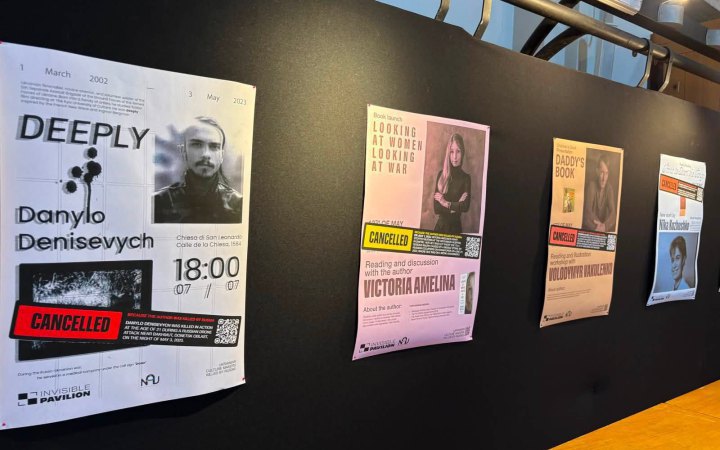
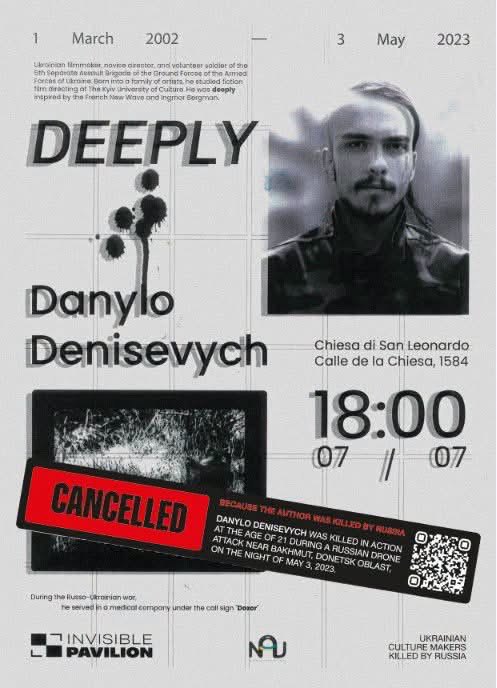
During the opening, a film by the young Ukrainian director Danylo Denisevych, who was killed on the front line near Bakhmut in May 2023 at the age of 21, was screened. Before the screening, his elder brother Ivan, currently a student at the University of Padua, addressed the audience.
The pavilion’s exhibition includes the following projects:
- Resistance Imprisoned, curated by Nadya Tolokonnikova (founder of Pussy Riot), dedicated to the works of political prisoners from various countries and artists who remain imprisoned in Russia;
- Ingrian Pavilion — an art intervention by Pavel Rotts, first presented during the opening days of the 61st Venice Biennale. The project continues the DecolonizArt initiative, dedicated to artists from peoples colonised within the Russian Federation, and explores themes of memory, forced resettlement and cultural identity;
- A Little Untitled Queer Art Project, curated by Nicola Bertoglio, dedicated to LGBTQ+ artists and political dissidents in exile;
- Death in Venice — a project by Krish Salmanis, curated by Solvita Krese, reflecting on artistic protest and forms of resistance to imperial cultural policy;
- Invisible Pavilion — a memorial installation in Venice’s urban space dedicated to Ukrainian artists who lost their lives as a result of Russia’s war against Ukraine. Concept by Katya Margolis; curated by Network Associazioni per Ucraina (NAU).
In addition, the pavilion features solo projects by Danylo Tkachenko, Nadiya Skidan, Iryna Revina Hofmann, Filip Pishchyk (Bluemoloko) and Katya Margolis.