






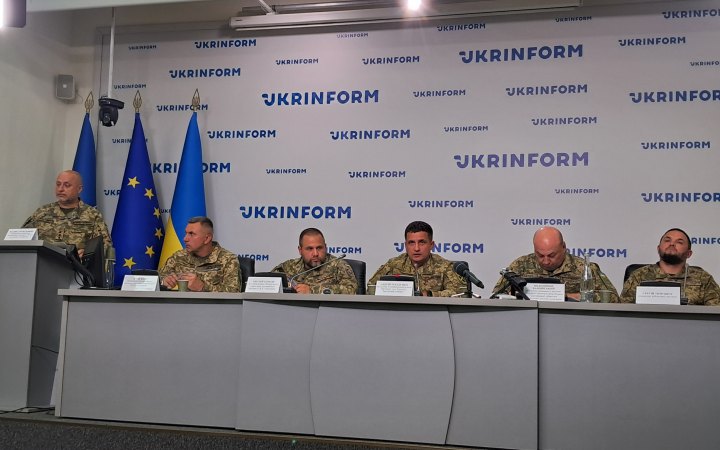
In less than a year, the unified radar field project was implemented.
All radar stations were integrated into a single system, eliminating the duplication of targets and situations in which several interceptors were directed at the same target. In some areas, primary radar data is already being processed by artificial intelligence algorithms, significantly improving efficiency compared with manual signal processing.
“We took all the radar stations we have and managed to integrate them into a single system to get a unified picture. Today, when a single target appears, we all see it in the same way; there is no duplication or triplication of the target, and no multiple interceptors are directed at a single target,” Lebedenko explained.
Projects involving next-generation weapons.
Laser weapons, developed by both teams within the Armed Forces of Ukraine and private companies, are already capable of shooting down FPV drones and are being adapted to counter Shahed drones. According to Lebedenko, within two to three months, systems more effective than machine guns against aerial attack vehicles will become available. At the same time, pulsed weapons are being developed to counter drone swarms.
Private air defence systems to protect critical and civilian infrastructure.
Within six months, 63 companies submitted applications. Five are already carrying out operational tasks, with 272 recorded deployments and 38 targets shot down. Military personnel who are no longer fit for active service for health reasons are being recruited as interceptor operators. The project began at Ukrzaliznytsya facilities and is now being extended to energy companies, including through their own investment.
“We are deploying our military personnel who are no longer fit for active service as interceptor operators. They now have a place to work. We can set up these units with specialists who are knowledgeable about air defence but are no longer part of the Armed Forces,” Lebedenko noted.
A centralised remote control system for interceptor drones to defend cities and critical infrastructure.
According to the brigadier general, the system reduces the need for highly qualified pilots and makes their work safer.
Seven manufacturers are currently developing guided aerial bombs (KABs).
Some models are already equipped with turbojet engines, extending their range to 100–200 km.
“This involves restoring older systems and developing effective capabilities for our air force to support our ground forces,” Lebedenko said.
The Marichka intelligent information system.
This artificial intelligence-based system is designed to accelerate decision-making at the platoon–battalion–group level. At present, commanders and their staffs require six to 12 hours and around 20 documents to analyse the operational situation. The system automates calculations of the balance of forces and resources, although the final decision remains with human commanders.
Serhiy Tymoshchuk from the Joint Centre for the Scaling of Technological Solutions and Experimental Combat Research presented the following developments:
— the Impulse system, which streamlines administrative processes in military units, enabling information to be obtained within minutes rather than several days;
— the Mayno system, which will integrate around two dozen existing logistics systems. Initially, it will cover two areas — communications and quartermaster support;
— Army+,developed by the centre in cooperation with specific units of the Ministry of Defence; the project is currently 70 per cent complete, with further development planned;
— the Prizma system for assessing the psychological state of personnel, aimed in particular at helping prevent mental health problems;
— the Armed Forces of Ukraine’s Sfera data centre, designed to improve coordination between different units;
— the Ornament system for the secure transmission of both classified and public information.
How the Central Research Institute of the Armed Forces of Ukraine operates.
According to Lebedenko, expert working groups collect up-to-date information on the course of the war, identifying operational challenges and proposed solutions while taking into account the capabilities of research and development centres. These findings are then translated into detailed technical specifications for manufacturers, software developers and industry through cooperation with the Brave1 cluster and manufacturers’ associations.
Selected proposals undergo professional assessment against technical requirements before prototypes are sent for testing under the Iron Range project run by the State Research Institute for Testing and Certification of Weapons and Military Equipment. Manufacturers are provided with access to small arms, ammunition, specialised testing terrain, as well as radar and electronic warfare environments — conditions that many companies cannot replicate independently. Applications for testing can be submitted through the project’s website, after which products are scheduled according to their category.
In 2025, 2,500 samples of weapons and military equipment were tested at the range. In 2026, the figure stood at 1,800.
For the field of unmanned ground vehicles (UGVs), a dedicated development concept was formulated, together with unit staffing structures, military occupational specialities and the first training school for personnel. The initiative was subsequently adopted by the commanders of the Air Assault Forces, the Territorial Defence Forces and the Unmanned Systems Forces.