





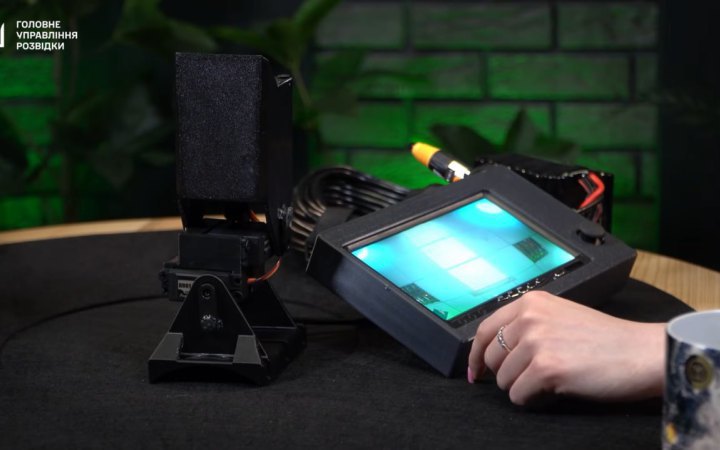
Engineers from the Active Operations Department of Ukraine's Defence Intelligence (DIU) have developed Perimeter, a sector surveillance system designed to continuously monitor Ukrainian military positions without requiring troops to remain physically on watch, the DIU said.
The system was developed in close cooperation with special operations personnel, who identified reducing risks to service members during surveillance as the key requirement.
According to DIU, troops previously had to remain at observation posts, exposing them to additional danger, particularly near the state border where the threat of enemy sabotage and reconnaissance groups remains high.
Perimeter allows a surveillance camera to be placed at a forward position while operators remain inside a bunker. The video feed is transmitted to monitors, enabling troops to monitor an area around the clock without exposing themselves or leaving cover.
"It has both a daytime camera and a low-light camera. Even in the absence of light, it sees very well and shows outlines, including after sunset. It does not perform as well as night-vision devices, but it works on a similar principle. It also has an infrared camera," said "Osaka", an engineer with the Wings unmanned systems unit of DIU's Active Operations Department.
The camera has a field of view of up to 180 degrees and is operated with a single joystick. According to the developers, the design was intentionally kept as simple as possible.
"But also inexpensive and built with interchangeable components. Not in the style of Rheinmetall, but from parts available at the nearest radio market," DIU said.
Particular attention was paid to camouflage. The compact housing has a rough surface designed for applying camouflage materials, and in wooded areas the camera is reportedly almost invisible even to thermal imagers. The system is also waterproof and designed to operate in rain and harsh field conditions.
The complex runs on separate batteries and does not use the military's standard power resources. Two batteries provide around 24 hours of continuous operation. The system does not record video, a decision that reduced costs and eliminated the need for additional electronics that troops said were unnecessary.
The production cost of one system is about UAH 60,000. Nearly half of that amount is accounted for by the thermal imaging camera, while batteries, the display and the protected outdoor cable make up a significant share of the remaining cost.