






Air-defence engagement statistics for September record 20 missile strikes (down 64% compared with August). Air-defence forces shot down 4,967 UAVs (66% of those that attacked, down 15%). The drop in the interception rate is explained by the growing share of the enemy’s jet-powered UAVs in each strike.
On 1 October at around 11:30, two Russian drones hit the area of the supporting section of the Pivdennyi Bridge. At the moment of impact, a Green Line metro train was crossing the bridge. The blast wave kicked up dust, which entered the carriages through the ventilation system. Passengers and the driver were not injured, and the train’s structure remained intact.
On 1 October at around 21:50, a third hit occurred, this time directly on the road surface.
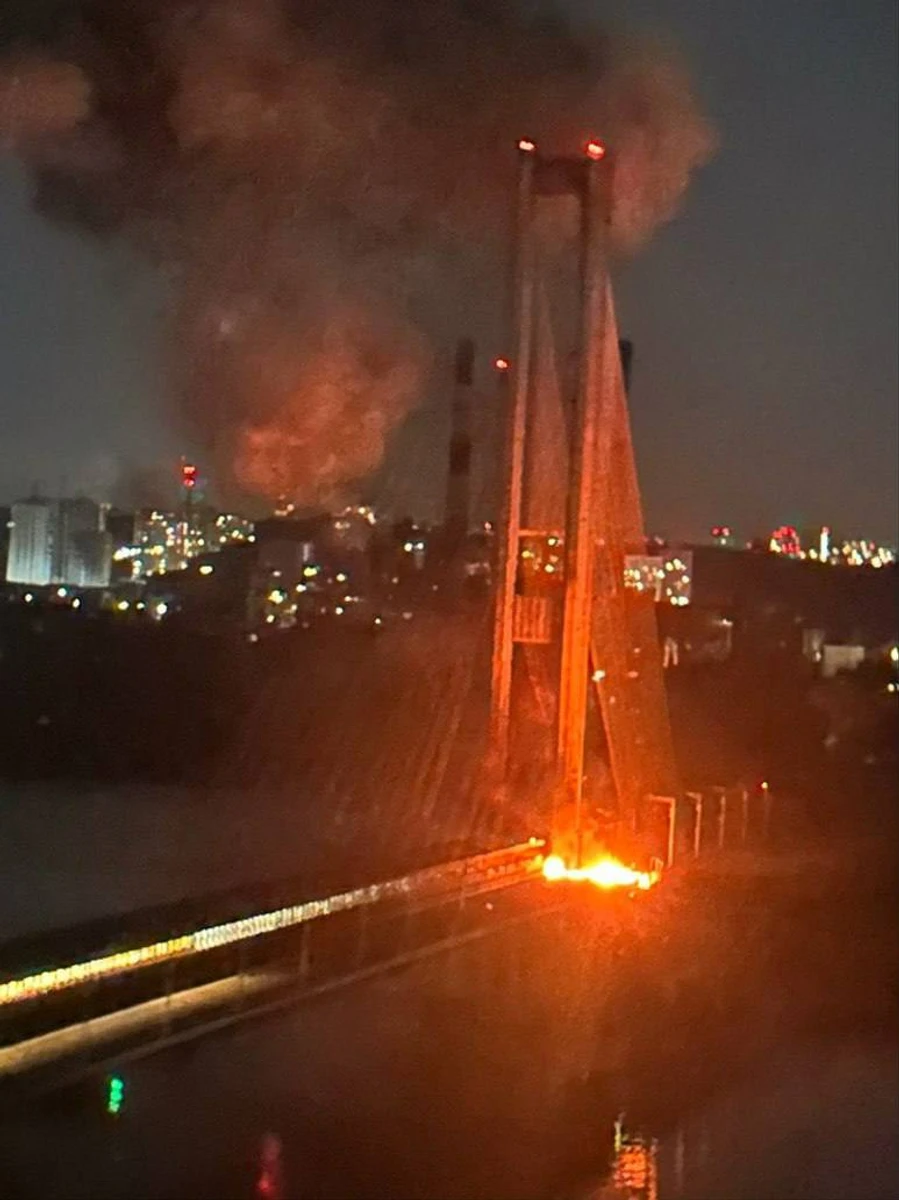
On 2 October at around five in the morning, the enemy hit the bridge for the fourth time. Later that day at 17:50, Kyiv Mayor Vitali Klitschko reported another strike. By then, the bridge had already been closed to road traffic and the metro. A bridge support, a crash barrier, the road surface and the metro’s protective concrete barrier were damaged. Preliminary inspections by specialists from Kyivavtoshliakhmist found no critical structural damage that would threaten collapse.
The Pivdennyi Bridge was fully closed in both directions; traffic was restricted on Paton Bridge (from the right bank to the left) and on the Metro Bridge (partially—one lane from the left bank to the right).
It turned out there is no point in trying to destroy the supports—something that is, in any case, an extremely difficult task. You can act entirely asymmetrically, and the aggressor is demonstrating that to us very clearly.
How did this happen?
Analysis of the strikes shows that the drones hit a fairly complex target: a vertically positioned bridge pylon with relatively small geometric dimensions—specifically the one that bears an enormous load by holding the cables. The conclusion is that the drone was guided at the moment of impact by an operator, meaning it had a high-quality, stable communications link through which the operator received video.
And how is that possible?
The enemy has managed to create a very short decision-making chain for striking targets in Kyiv.
A satellite passes over Kyiv, takes a photo, transmits it to a command post near Moscow; analysts decode it there and pass it on to the command post where the decision is made. This model takes four to six hours, and sometimes more.
But here we are dealing with a completely different chain: an enemy UAV streams video online via a relay (?), because from Kyiv to relays in Belarus is some 200–300 kilometres—too far for onboard radio equipment that uses neither Starlink nor “Rassvet” nor anything similar. Most likely, somewhere between Kyiv and a relay outside Ukraine, a relay drone is loitering during the strike; or, as one respected veteran suggested, the relay is actually in Kyiv itself (which would raise a host of questions for the State Service of Special Communications and Information Protection and the Security Service of Ukraine). Specialists believe the enemy used commercial 4G/LTE modems, leveraging local mobile networks. In other words, the chain is “drone – relay – command post – decision-making – online guidance to target”.
It is clear that distance from the border with an inadequate neighbour is no longer a protective factor. Given that the enemy’s strike groups have long used MESH technology (very broadly speaking, a decentralised radio network made up of several identical nodes), we can say we have not yet seen anything like all the problems awaiting Ukraine over the next two to three months. We will not even get into how the enemy uses one UAV to livestream another’s attack—everyone has seen it.
The enemy has acquired the ability to conduct battle damage assessment in real time—that is, to evaluate the results of strikes. This allows the next wave to hit targets that have not been damaged enough.
So: 22–23 September—a major night-time drone attack; during the day on 23 September—jet drones struck Kyiv in the morning, afternoon and evening. On 23 September—an almost all-day drone attack; the night of 24 September—a missile strike in several waves of ballistic missiles. 29–30 September—the start of a major combined attack at 18:00; the night of 30 September—a massive strike; during the day on 30 September—drone attacks.
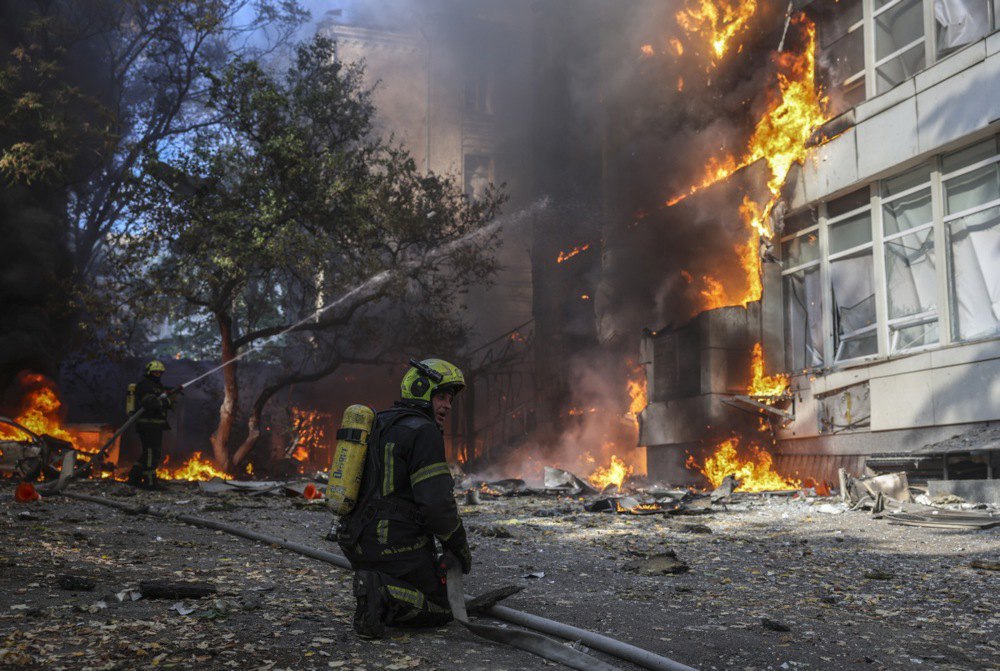
A trend is emerging of the enemy shifting to almost daily attacks, often stretching from the evening of one day through the entire night and continuing into the next day. Kyiv has been under particularly intense pressure. This has been made possible by the presence in the airspace over the capital, or nearby, of both reconnaissance UAVs and strike drones loitering while awaiting commands, as well as relays whose location is still not entirely clear. Add to this the ability to strike emergency rescue teams and medics, track their routes, and destroy structures to create rubble that blocks movement—and we can feel for ourselves what a Transparent Battlefield (“transparent battlespace”) is.
But let us return to the drones that not only hit bridge supports but also cause them tangible damage. Serhii “Flash” Beskrestnov has informed the public about the enemy’s new specialised warheads, KRSN (a shaped-charge cutting special payload).
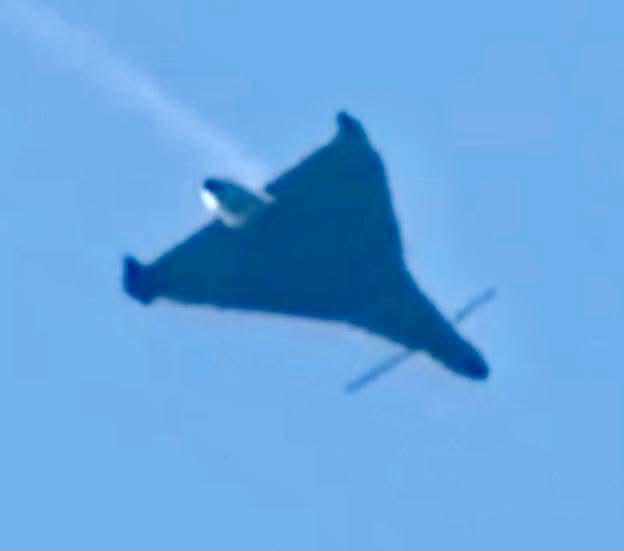
What is it? KRSN was developed specifically to destroy high-voltage power-line pylons and iron (metal) bridge structures. The device has a main charge weighing about 40 kg plus four additional damage modules. A strike by four jet-powered “Geran” drones can destroy a bridge support over an area of up to 4 m². That is roughly what happened on the Pivdennyi Bridge, where UAVs attacked the thinnest part of the pylon (around 3 m²). Ukraine’s military intelligence had been tracking the development and preparation of such warheads since mid-August—about 1.5 months before their first use.
Anyone following the topic has already seen photos of the enemy UAV with either “horns” or “moustaches”. That is the Russian office of simple solutions: they fashioned a mechanical fuze out of a water pipe. Inside the tube is a rod; the fuze triggers on contact with metal, because it will almost certainly get tangled in a power-line pylon or in a bridge’s cables.
Close co-operation between the enemy’s defence industry and military (sadly, we have to acknowledge this) has made it possible to bypass all sanctions at once, avoid the need to produce thousands of ballistic missiles, yet solve the same task—bringing down Ukraine’s strategic logistics. And for noticeably less money.
Overall, the idea behind the new warhead can be found in military textbooks from the 1960s and 1970s, which ought to be in the library of the Kamianets-Podilskyi sappers’ alma mater. And interestingly, Ukrainian engineers who care have made the same kind of warhead. Ours. Perhaps even better than the enemy’s. They made the casing at their factory from sheet steel for a four-figure sum in hryvnias, stuffed it with explosives (which they obtained), and the result was encouraging: in tests, the charge punched through a sandwich of two airfield slabs with a metre of earth between them (enemy drone-port shelters are built on this model). The top slab was cut in half and thrown about 10 metres in opposite directions. That slab weighs 3,200 kg, by the way.
And what then? Nothing. We have run out of money for veterans’ sport, and there was never any money for advanced drone warheads in the first place.
The forecast is this: the enemy has brought an experimental batch of KRSN to the DAP—either 50 units or 200; it is not known for sure. In the Kursk area and near Navlia in Bryansk Region, from 20 September reconnaissance has observed work to prepare “Geran-4” UAVs with KRSN at launch sites. The enemy has a window of roughly two months until we find countermeasures and produce jet interceptors in meaningful quantities. Over those two months, the enemy will try to damage most bridges, including those across the Dnipro, through which Western aid and other resources needed by the Defence Forces reach the East. Movement towards the western border will also be restricted, if not stopped altogether. All cable-stayed bridges are a potential target—because they are easy. The chimneys of thermal power plants that are still standing are also a target. Overpasses and railway bridges are next in line.
Winter will be even harder than expected.