






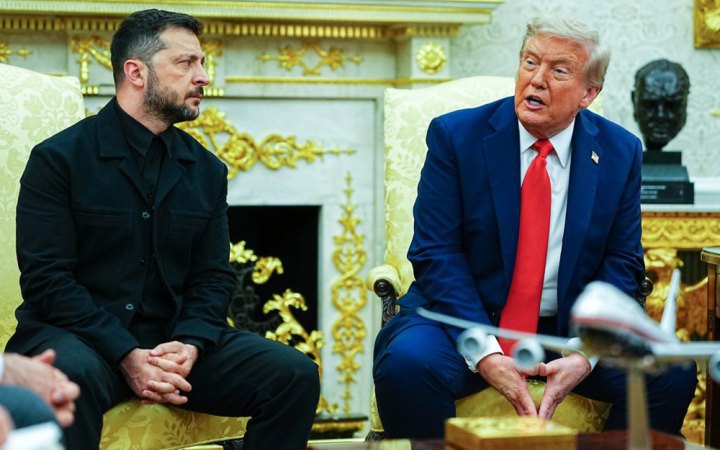
On security guarantees for Ukraine
Trump: The US will help Ukraine with security. This is a necessary factor for ending the war.
Zelenskyy reported that the US had sent Ukraine a draft document on security guarantees — an additional document to the framework agreement that defines the principles for ending the war. Ukraine makes its own amendments to all agreements and then sends them to its partners for review.
According to Volodymyr Zelenskyy, in the agreement, the United States proposes to guarantee Ukraine's security based on NATO's Article 5 model, which provides for collective defence.
The President of Ukraine also reported on a video conference with a group of colleagues from the United States regarding security guarantees.
"Security guarantees must be truly effective and work to prevent a third Russian invasion. Therefore, we are paying maximum attention to this," Zelenskyy emphasised.
On the elections in Ukraine
Trump urged Volodymyr Zelenskyy to "be realistic" and stressed the need for self-determination, repeating the thesis about the alleged lack of democracy in our country and "huge corruption."
The US president also cited unknown statistics, according to which 82% of the Ukrainian population allegedly demand the signing of a peace agreement.
Zelenskyy said that he does not want the absence of elections to be used as an argument against Ukraine. Therefore, he responds to what his partners say.
At a meeting with journalists on 11 December, Zelenskyy explained that he supports holding elections because his American counterpart Donald Trump said that everyone wants to end the war and that it cannot be that Ukrainians are dragging this out because they want to hold on to one position or another.
"The most important thing is for the elections to be legitimate. If our partners can help us organise the election process safely and within a reasonable time frame, I will support it. And so that this is not just a media signal from me, I have asked the MPs to prepare legislative changes regarding the possibility of holding elections during martial law. Today, it is important to end the war, and it is important to end it in a strong position for Ukraine. There was a signal from the United States regarding the elections — I responded, and I am ready for this. There are two important things that need to be worked out: security and legislation. Therefore, my request to Ukraine's key partners and to the Ukrainian parliament is to show how both of these things can be worked out," he said.
About the ‘free economic zone’
The United States is proposing that Ukraine create a ‘free economic zone’ in the Donetsk Region on territory that the Russians were unable to capture. This means that Ukrainian troops will have to be withdrawn from there, President Volodymyr Zelenskyy said at a meeting with journalists on 11 December.
"They don't know who will control this territory, which they already call a 'free economic zone' or 'demilitarised zone' (as the Russians call it, ed.). This is roughly what the compromise vision of the United States of America looks like right now. When we talk about a 'free economic zone' and that there can be no troops there because they are at a certain distance from each other, then it is probably fair to ask: if someone moves away from one side, as they want Ukrainians to do, why doesn't the other side of the war move the same distance in the other direction? And there are questions about management in these territories, on both sides of the contact line, if someone moves away somewhere. This still leaves a lot of questions. Therefore, the conversation on this continues," the president explained.
He said that he had heard all the proposals from the American side and, in fact, through them, from the Russians regarding the territory of Donetsk Region, and said that this was definitely not in Ukraine's interests, but that it was necessary to continue the conversation and try to find answers to all the questions so that everything would be more adequate.
"For example, these ones have moved back 5 km, those ones have also moved back 5 km. If some have moved back 10 km, then the others should also move back 10 km. Also, as is done in all wars, there must be some kind of monitoring. If so, how does a ‘free economic zone’ differ from this principle? It is a parity principle. If you believe that a ‘free economic zone’ or a so-called ‘demilitarised zone’ should exist, live and develop, and if only civilians, police, etc. should be present there, then the question arises: if some troops have to leave and other troops remain where they are, what exactly will stop these other troops, i.e. Russian troops, from going further? Or from infiltrating the ‘free economic zone’ under the guise of ‘civilians’ and taking it under their control? This is all very serious. It is not a fact that we, as Ukraine, will accept this, but when you talk to us about compromise, you have to offer a fair compromise," the president stressed.
When asked if he would accept such a proposal, Zelenskyy said that Ukrainian citizens should answer that question.
"Whether in the form of elections or a referendum, the Ukrainian people must have a say. We will see how this all plays out. Right now, I believe that a lot depends on our military. What the Ukrainian military can hold back, how they can stand their ground, where they can destroy the occupiers," he added.
On concluding a peace agreement
Trump: It's close.
"Ending the war in Ukraine is a thousand times more difficult than closing a real estate deal."
Zelenskyy: Ukraine has shared with the US its vision for a peace plan, which it developed jointly with the Europeans.
This is a response to the plan that the US edited and discussed in Russia. It is not final.
"The first plan has already been edited — from 28 points, the plan has been reduced to 20 points. That is, this plan is constantly being worked on and edited. And this is an ongoing process that continues today," said the President of Ukraine.
"It contains several things, such as: post-war economy and recovery, security guarantees and other things that are set out in the basic document, and then, based on one or another point that needs to be detailed, there will be a separate document. In other words, the 20 points are the foundation, the conditional framework, on the basis of which there will be a corresponding number of documents," Zelenskyy noted.
"We are grateful that America is working with us and trying to be in the middle. We are in constant contact with them. But today it is still difficult to say what the documents will look like in the end," Volodymyr Zelenskyy noted.
"The Russians want the whole of Donbas, but we, of course, do not accept this. And the Americans are looking for some kind of format. They discussed the issue of a ‘free economic zone’. The Americans call it that, and the Russians call it a ‘demilitarised zone’. Our position is fair: we stand where we stand, that is, on the contact line. Therefore, there is a discussion between these different positions, and it has not yet been decided."
On limiting the size of the army
Ukraine has agreed to limit the size of its army to 800,000 people. This has been agreed with the military, President Volodymyr Zelenskyy said at a meeting with journalists on 11 December.
The idea is to enshrine this number in the peace agreement. Zelenskyy recalled that earlier, in the first year of full-scale war, Russia demanded a reduction to 40-50,000.
Before the full-scale war, Ukraine's army numbered about 250,000 people. After the attack, Russia began to demand a reduction in the size of Ukraine's army. According to media reports, the first version of the agreement that the US presented to Ukraine mentioned 600,000.
Trump on Zelenskyy
The only person who does not like his proposed peace plan to resolve the war in Ukraine is Volodymyr Zelenskyy, the White House host said, adding that the Ukrainian president's entourage, on the contrary, likes the draft agreement.
Trump also noted that the plan currently consists of ‘four or five points’. The negotiation process, he said, is difficult because it "involves the division of territories”.
However, White House spokeswoman Caroline Levitt said that Trump is "extremely disappointed with both sides of this war”.
"He is tired of meetings for the sake of meetings. He no longer wants talks, he wants action," the White House spokeswoman said.