







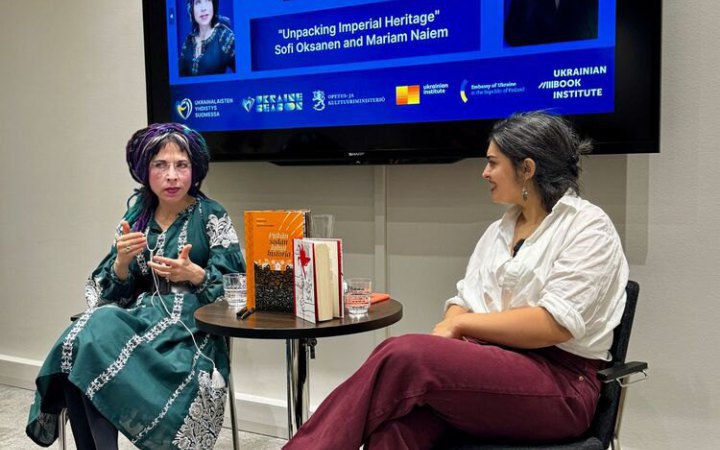
“Those little Eastern Europeans being very emotional”
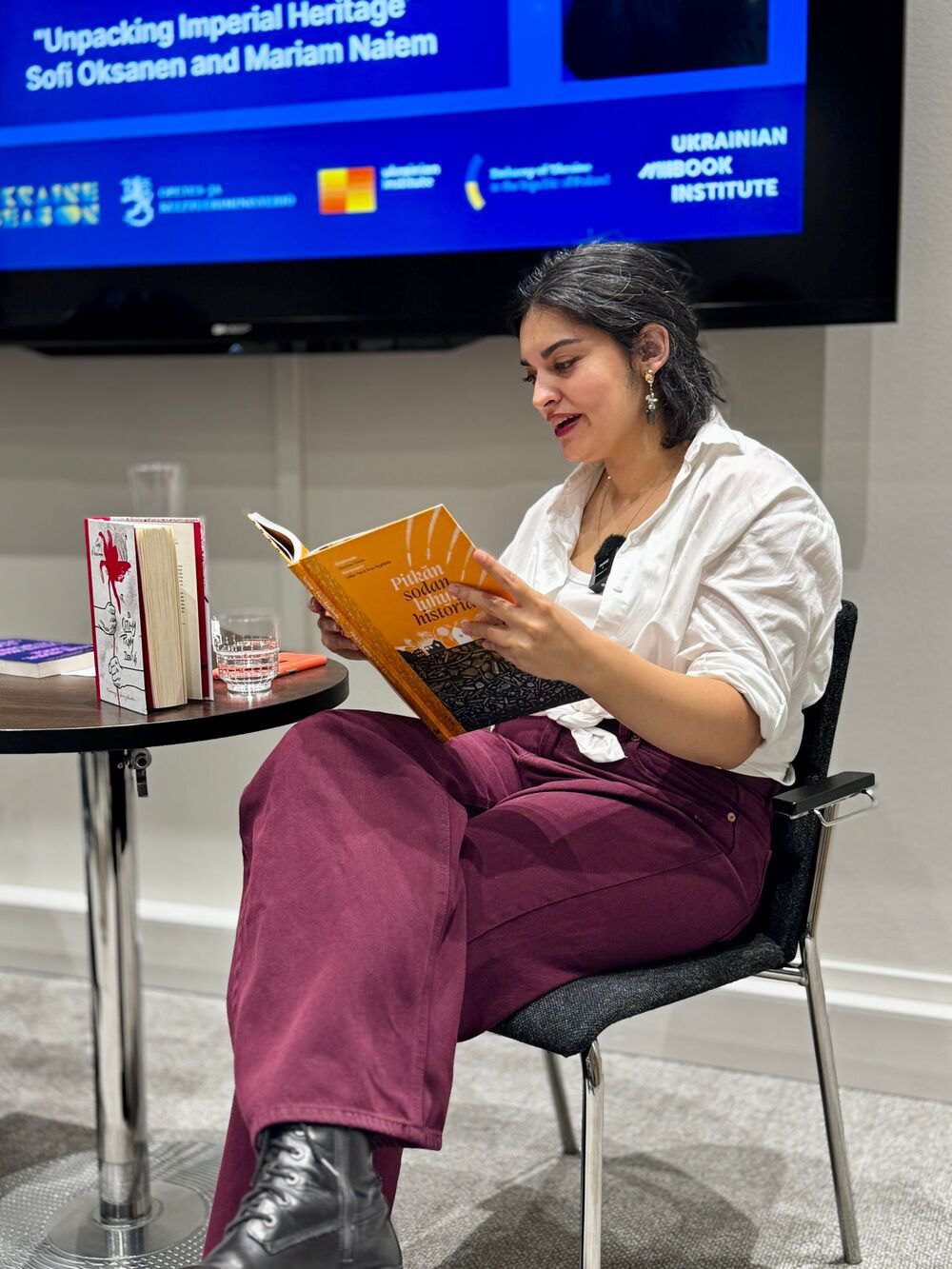
Sofi Oksanen: How should we define Russian colonialism and why is it so difficult to understand even though it’s so simple?
Mariam: The problem with Russian colonialism is it’s secular colonialism. It's a way to expand the idea of Russian identity. Instead of saying you will never be part of our culture and you will just serve our government, they try to say that you're Russian, you need to erase your identity and replace it with that of a colonial subject of Russia. If many countries in Europe are using neocolonial practices, Russia uses old school 19th century colonial practices.
Sofi: In Finland, we don't even have a proper word for different colonialisms. That tells something about our history with colonialism and I also “thank” our legacy of Finlandization for this issue. Finns are not used to using colonial words in relation to Russia. Finnish is a wonderful language, we have so many words for ice. But this is where we lack words, and that's why we need to talk about it to make terms understandable, approachable, and accessible. Finlandization is connected to colonialism, but we don't talk about it in that context.
Mariam: What is the biggest impact of Russian colonialism on Finnish culture?
Sofi: Finlandization. That we are not used to speaking out about Russia or the Soviet Union. Quite often people are surprised when I say that Finlandization was nailed down with agreements of friendship and mutual cooperation. And over the years it also became a form of self-censorship. For example, around 10 years ago (2015. – Editor) when Crimea was already occupied, what was the theme country at this book fair? Yes, the Russian Federation. I had a new book coming out and a full schedule at the fair. I said that I can't come because when a theme country is involved, that means that the state is sponsoring the fair. Then the director of this very fair (Stig-Björn Nyberg was a program director in 2015. – Editor) gave a statement to the press that “she is seeing a boogeyman under the bed”. In this phrase you can actually hear the colonial impact. This statement was diminishing my position and making me sound like a child, like “those little Eastern Europeans being very emotional and childlike”.
Mariam: Like you are irrational. Russian ethnographers, when they tried to describe Ukrainians, were always using words “they like nature”, “they're irrational”, “they cannot make their own government”. Also, when the Russian aristocracy was trying to describe how important it was to understand the value of Russian culture, you were claimed to be crazy if you didn't understand it. It’s so hard for the Russian imperial mentality to imagine that you don’t want to be part of their culture. If Ukrainians don't want to know Russian or speak Russian and read Russian, it means that they need to be civilized because, again, the Russian language is a symbol of civilization. If they don't want to know Russian, then we need to civilize them or kill them.
Sofi: That is something that we definitely can hear in Russian narrations online. If you are talking about Russian human rights crimes, then you are considered Russophobic, a bit crazy, mental, and again emotional. There is definitely also a gender aspect in this, because if you happen to be a female, then you are even more crazy. That is definitely something that we can also see in Finland long before the Crimean Peninsula was invaded and before the Revolution of Dignity. All the Baltic states were test falls for Russian disinformation operations. If you talked about Estonian history, that meant you were a bit loony. That is something that Finns prefer to not actually think about because it's a bit embarrassing, especially now when they can see the result of Russian colonial behaviour on the news every day. Even our former president commented that Estonians are suffering from post traumatic stress disorder. One of my favorites was when the previous president was commenting on Estonia's choice to join NATO. The explanation was that they are so small, they cannot defend themselves and they are used to collective security because they were part of the Soviet Union. Seeing occupation as collective security is another sign of adjusting to Russia’s imperial narration.
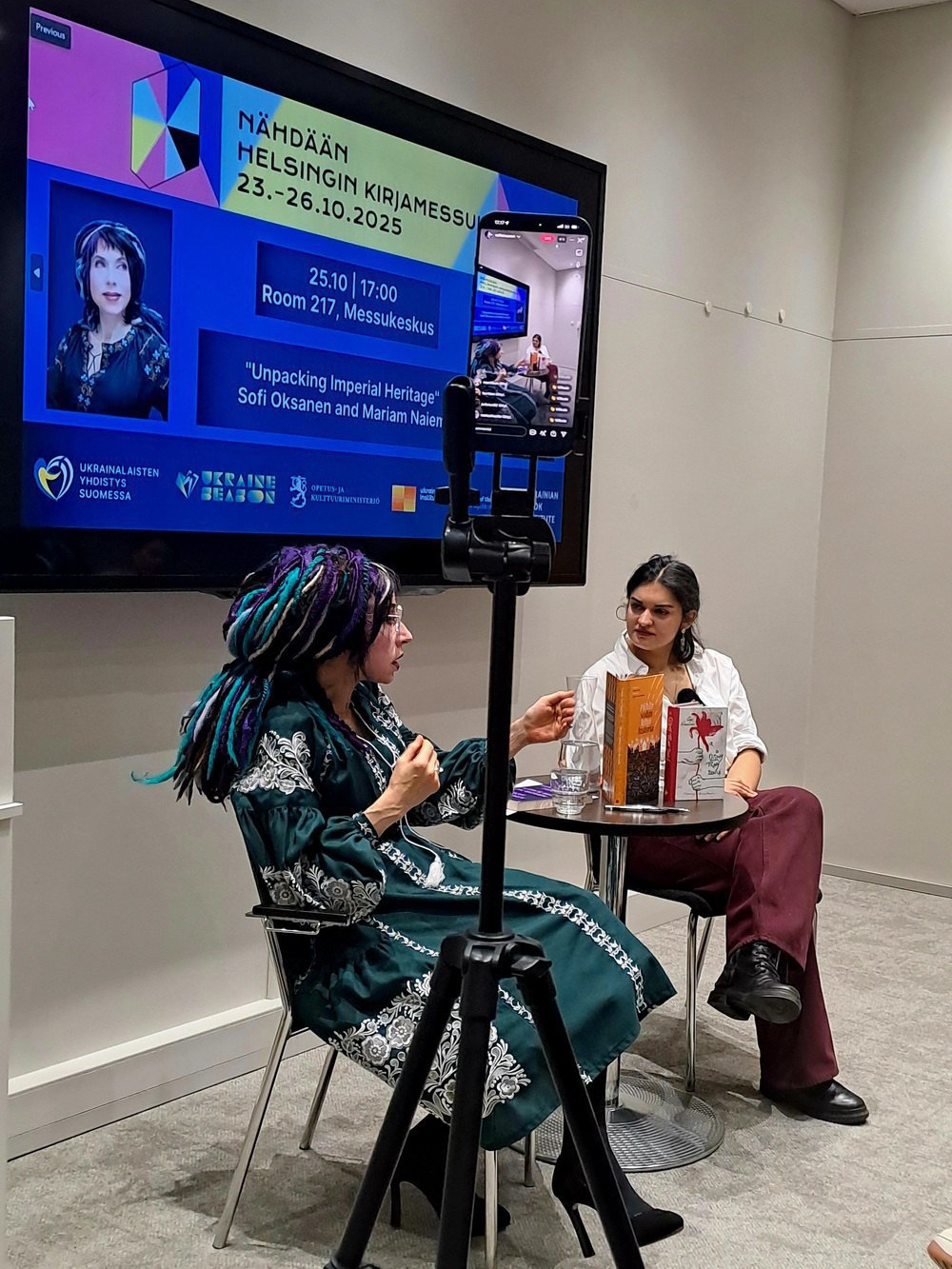
“You can be a victim of propaganda when you think you are safe”
Mariam: This part of Europe is kind of trapped between two different styles of empire. There is still a lot of imperialism in the European consciousness and you can see this in the top down view of Ukrainians. To be very honest, a lot of people from post-Soviet countries are perceived as less well off. But from the other side, there is Russia. For a long time Slavic studies were Russian studies. Decolonization is not only a task for Ukrainians. People sometimes think that propaganda can impact you only if you live in Russia and know the Russian language. But you can be a victim of propaganda when you think that you are safe.
I made an experiment before the full scale invasion. A lot of people in Ukraine, including the occupied territories, were swallowing Russian news. I was among those who were judging these people. I decided to put myself in their shoes and started watching Russian First Channel news. When you are watching propaganda for the first five minutes, you are aware of what you're watching. After four days of immersion, my brain started to think that that dude (Putin. – Editor) actually has a reason.
Sometimes people think that propaganda is a very obvious lie, but we need to understand that there are levels of it. There is a typical lie of saying that Earth is flat, but there's also something more subtle. In very subtle propaganda, they're turning some truth into pretty manipulative narratives. For example, the basic idea that Russia invaded Ukraine in 2022 because NATO was expanding. The fact is that NATO was expanding, but there are so many contexts behind it.
Sofi: The majority of people are not aware of old narrations that the propaganda is building on. So if you don't know the previous narrations then you cannot actually pinpoint where certain features of new narrations are coming from. If you don't know the history of Soviet narrations, you might not even see the danger.
One of the words that is definitely coming from the east, a very common word, is Russophobia. Why, if we are criticizing Finland, are people not considered Finnophobic? This is the expression that you get only when you talk about problems Russia has or Russian colonial behavior or human rights crimes or something less nice.
Mariam: The whole idea of victimhood is also embedded in Russian culture. When you look at the image of the Russian intelligentsia, it's basically people who can see how the world is unjust, but they cannot do anything about this and they're just sad. The whole point of being a victim gives you an excuse to be a murderer as well. Before WWII there were defensive wars and the governments were saying – we are waging defensive war and trying to kill people. But after WWII it was much harder to say it out loud. For example, when there were any kind of colonial protests against some action within the British empire, these actions were called ‘operations’ rather than wars. It is part of the Russian narrative to claim that everyone is jealous of something and here you can put some blanket statement.
A lot of people can speculate that not all Russians or Russian culture is part of Russian aggression. This is a pretty good field for discussion. Let’s put it this way, if people don't want to cancel Russian culture, the baseline should be to be aware, to be critical and reflexive. We need to focus on what part of Russian culture is actually connected to murder and massacre. I was talking to one guy after a lecture and he was saying that coming from an imperialist culture (he was from France), he doesn't understand his values and his personality without violence. It's an interesting problem for people from imperialistic backgrounds because you don't know what your culture is without killing others. Since Russian propaganda uses Russian culture, Russian art, we need to be critical and understand why it's happening.
Blaming someone and trying to see yourself as a victim is a very nice self-defense mechanism to avoid being accused of what you're doing.
“Imperialistic identity could not be erased with the fall of an emperor”
Sofi: Very well put. Quite often people are using the words imperialism and colonialism as synonyms, but there's a difference.
Mariam: Yeah, in liberal arts there are so many descriptions. In my book I'm using descriptions from Edward Said and Robert Young. In very easy words, you have your apartment and you're working, you have your stuff. And I'm coming with some guys with knives and pistols and telling you to give me everything. Your apartment is my apartment now. You still continue to work but a little bit more than before, you don't have any weekends. Your salary is my salary and also your stuff is my stuff and all your family will work for me. This is colonialism.
Imperialism is a mindset. The idea that I dare, I deserve to have it because I'm so great and civilized. The word civilized is a bit complicated for me because of what we call civilization. What civilization is for one culture is a massacre and killing for another.
Imperialism exists without colonialism. Some countries in Europe have an imperialistic mindset without having physical colonies. There are also forms of neo-colonialism. And in that case, you still have your apartment, but your rent is higher. You're paying more money. It's happening not because I'm taking money specifically from you, but because I'm working with the landlord and bribing him, and we work together against you. This is how Russia was acting with most of the post-Soviet countries. We can see how the most corrupt parties connected to Russia always have the same vibe. Imperialism is a myth that needed to be constructed. Somebody put a lot of effort into creating the whole idea of greatness. For Russia, greatness is actually the size of the country, so this empire needs to swallow more and more.
Sofi: Yes, Russian identity is an imperial identity. The problem is that many wishful thinkers believethat everything will be fine if Putin dies, but it won't. If the country continues to support the imperial identity, then absolutely nothing changes.
Mariam: I agree with you. A lot of Ukrainians are saying it's not Putin's Russia, it's Russia's Putin. So basically Russian history created Putin and it's just a question of time until we have another one. I don't think that imperialistic identity could be erased with the fall of an emperor. It's spread throughout every aspect of life in history, in education, in economy.
“Clicks and comments matter”
Sofi: I get a lot of questions “what can I do except donate and support Ukraine?”. I always say that at least you can click on good news because clicks count. Even if you don't have time to read all the news, click and comment because that actually matters. There are a lot of Russians commenting and you should be aware of the language you use. When you hear the word "russophobia", say "Hey, be aware of the words because language creates reality which becomes deeds”.
All the Baltic states were test walls for exactly the same things and same narrations. We heard the same phrases that Russia is now using about Ukraine but people were not actually responsive. If you don't say stop, then it will continue. Language and narratives create reality.
Mariam: Thinking is making. So, the language that you use, the words that you are taking from the internet and putting in your head, they also change your mindset.
Also try to be curious and try to learn more about the subject you are interested in. For example, if you like literature, for every Russian author you know, try to find one author from an ex-colony of Russia. If you like romanticism, read romanticism from Belarus or Kazakhstan. Try to expand, not to delete or cancel Russian culture in your head because it could be difficult. Try to watch other movies or listen to other music.
Sofi: Definitely, and that is why books matter so much. Thanks to the Soviet legacy, there are not that many books translated from Ukrainian. Just imagine that the first book about Holodomor in Finnish was published in 2017. Quite often publishers might say, "Oh, we don't have enough translators." Another reason for the slowness is that people don't know where to start.
Estonia is a country that knows very much about surviving. We really value our culture and even though it's a small language, we try to expand people's knowledge. The size of the country doesn't matter, you can be a superpower. For example, look at Iceland. Everyone who knows something about Iceland knows that it's a nation, it's an identity and nobody thinks that it belongs to somebody else. And that is why it is important to be aware of culture, because if a country has a culture, then you are on the map. If you are not on the map, then it is very easy to invade and colonize you. It is very easy to say that you don't exist.
Mariam: Society might have this idea that there are (big) cultures and (small) cultures. But when you study actual culture, you start to understand that there is no such a thing as an important culture, big culture or small culture. Everything is important, everything is interconnected and studying each aspect or artifact could have a huge impact on overall society or all of humanity.
It's an imperialistic and maybe chauvinistic way of thinking that we're so nice by supporting these small languages. It’s about the expanding of curiosity – to understand that you're doing that not to be nice to someone else, but for yourself because that can emphasize something about you.
Sofi: In Finland people know something very Ukrainian, but they just thought that it was Russian. Ilja Repin is actually much-loved in Finland. I remember myself as a teenager travelling across the country to see Illja Repin’s exhibition in Kuopio and it was extremely popular. Then we also had a huge exhibition in Ateneum, a state museum. Unfortunately, Repin’s Ukrainianess was erased and when Ukrainians tried to comment on it publicly, that didn't get very strong feedback. It's also a bit disturbing for people to think that there is an artist I love and then suddenly somebody tells me that I had been loving that artist through a colonial lens. I just met a Spanish person who said that I understand everything about what you say about colonialism and Russia, but it is very disturbing for us because we don't like Putin and we don't like the idea that we have been watching the world through Putin's eyes.
Mariam: Nostalgia plays a big role. I was spending time with my mom who was watching Soviet movies and I can quote most of them. That's part of my history, my identity, my jokes. I cannot erase that and I don't think I want to, but I can acknowledge where that could lead.
In eighth grade we were studying “The hero of our time” by Lermontov, that was a great example of how imperialism works and how it is so settled. He is in the Russian military, part of aristocratic society and once he is not far away from Ukrainian territory – that part of the book is called “Taman”. He tries to hire a boat and wants to pay the boatsman who is described as stupid. Instead of the “g” sound he is saying “h”. Every Ukrainian knows that “h” in Russian language means that you are of Ukrainian origin. Without writing that the guy was Ukrainian you can understand that the person is Ukrainian and described as stupid You are 13 years old and you understand that this is the representation of your culture.
Sofi: In the Soviet movies Estonians, Lithuanians and Latvians always had a role to play as Nazis.
So in that way if you think about how to change the colonial narratives, we can do it on the outside. But for Russia to change it requires that they are aware of all these things.
Mariam: It shouldn’t be just us at this table if Russian culture wants to change. To be able to change you also have to be willing to listen instead of just talk. From the Russian opposition right now you can hear a lot of talking but you don't see they are willing to listen. During these three and a half years there is no Russian who ever asked me anything because you cannot be aware of what your culture has done to others since you were raised there.