






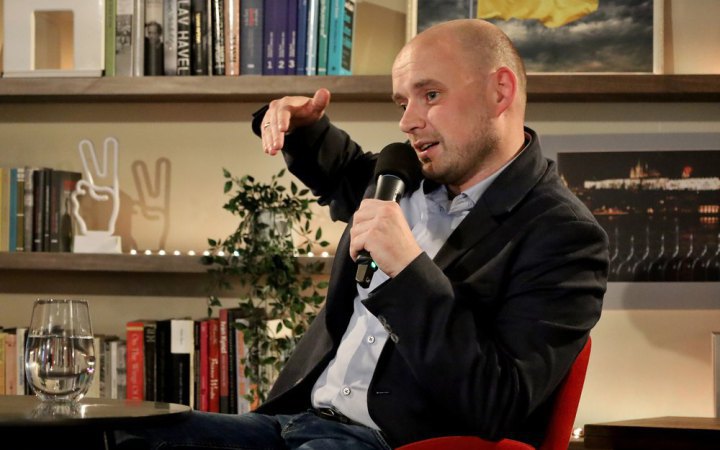
‘This topic grows more relevant by the day, and I keep adding more and more arguments,’ wrote Radomyr Mokryk on his Facebook page the day before.
So, opening his lecture, he began with the latest events that life itself supplies — namely the recent statement by US Vice President JD Vance suggesting that Ukrainians and Russians should ‘trade with each other, travel between the two countries, and engage in cultural exchange.’
So is JD Vance’s dream even realistic, and why does Russian culture have such a strong cult status in the West? How has it, for centuries, shaped the image of Ukrainians from a position of superiority and built its grand ‘Russian world’ myth? These were the questions Radomyr Mokryk explored in his lecture, analysing the period from the Pereiaslav agreements of 1654 to the present day.
‘One people’
According to him, for centuries Russian culture has functioned as a shield for militarisation, because an empire needs not only to dominate but to know how to present its domination. The historian argues that the document signed in the 17th century was understood differently by Ukrainians and Russians, yet it resulted in Ukraine being absorbed — the sovereignty of the Hetmanate was destroyed and turned into the Malorossiya Governorate.
In the 18th–19th centuries, Russian culture began forming the key stereotypes about Ukrainians as ‘lazy khokhols,’ equated with an inferior race. Even Mykola Hohol contributed to creating a romanticised image of a land of witches and mysticism — which Russians saw as something naive, lesser, awkward.
‘One historian in the 19th century wrote that Ukrainians are ours, but they are not us. They belong to us, but they are not the same as we are. Russia is, essentially, an eternal claim.’
In the 18th–19th centuries, he says, the notion of a so-called ‘single people’ and ‘shared history’ began to take shape, reinforced by bans on the use of the Ukrainian language.
‘For the Russian authorities in the 19th century, the Ukrainian project was extremely important. It meant marginalising the culture and creating stereotypes,’ he stressed.
Ukraine as a fiction
The colonial project of the Soviet era, paradoxically, was presented as an anti-colonial one — as if the era of empires had ended. Yet all the stereotypes formed in the previous century continued to be applied. The historian illustrated this with a 1954 Soviet poster for the 300th anniversary of the so-called reunification of Ukraine and Russia, showing the ‘elder brother’ resting his hand patronisingly on the shoulder of the ‘younger’ in an embroidered shirt.
Colonial perceptions deepened in the 1960s: ‘This is a mix of stereotypes. Just like today, they appealed to Kyivan Rus, claiming there was one people back then. The same thing was happening as in 1954. I found an issue of Pravda — it’s identical. They speak of the Ukrainian language as a “dialect.” A third of the article insists Ukraine is a tool of geopolitical warfare against Russia.’
This, he says, was — and remains — the central intention: to strip Ukraine of subjectivity by insisting it is merely a tool in Western hands. This perception existed in the 19th century too: that Ukraine belonged to the sphere of influence designed to harm Russia. The same worldview, according to Mokryk, is demonstrated by Putin:
‘Putin’s understanding of history is, for him, a legitimate justification for a war that carries signs of genocide. It’s crucial to understand that such an interpretation of history can play such a role. Ukraine, for them, is fiction — a provocation of the West.’
Mokryk continues: ‘I found a KGB document on manifestations of nationalism in Ukraine — mid-1960s. It equates expressions of identity with nationalism. And the KGB always tries to find traces of the West.’
‘These ideas are deeply embedded in Russian history or, rather, in Russia’s historical perception of Ukraine. That Ukrainian identity was invented by Count Potocki (with no clarification which one), or that it was crafted in the Austrian General Staff — the same nonsense Putin repeats today.’
Today’s ‘brainwashing’
The historian shared his experience of speaking with children who were fortunate enough to be returned from Russian captivity: ‘I was curious to learn what they were taught in those camps. One 16-year-old girl said they were constantly pressured with claims that Ukraine is not a nation, and they are not a people — they’re “khokhols.” The desire to diminish runs at the core of it — even today, especially towards those children who were abducted. These are words straight from the source.’
He showed photos from occupied Ukrainian cities, including the Mariupol theatre where many people were killed, now covered by the occupiers with portraits of Russian cultural figures. Meanwhile, in the West, Mokryk argues, Russian culture has been romanticised for the past century — starting with the White émigrés, who shaped the image of Russians abroad.
‘Russian literature became a symbol of something deeper — if you read it, you supposedly wish to understand something more profound,’ he said.
This romanticisation of Russian culture is still actively used, despite the impossibility of equal coexistence of different peoples within that empire, Mokryk concluded in his lecture on the key stages of Russia’s cultural colonisation.”